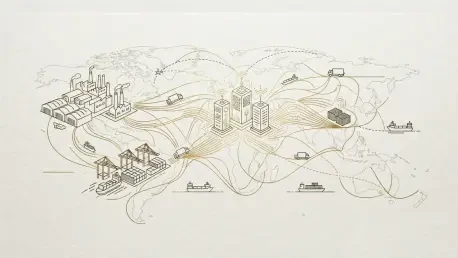

Not long ago, a business leader could reasonably leave geopolitics to governments, foreign ministries, and the very top tier of multinational executive leadership. Strategy focused on markets, margins, and competitive positioning, while political risk was addressed in annual reports and occasional high-level meetings.Today, that boundary no longer exists. Geopolitical pressure now travels through supply chains, payment systems, cloud infrastructure, and capital flows so regularly that it can no longer be treated as an external shock. At least not without incurring substantial costs. This article examines how geopolitics has moved from the margins to the middle of business leadership, where exposure actually lives inside an organization, and what embedding geopolitical awareness into strategy requires in practice.
The Management Framework Has Not Kept Pace
Modern business management requires greater geopolitical literacy.For decades, global business ran on a coherent set of assumptions that reflected a real period of relative stability, but as MIT Sloan’s Peter Hirst notes, that environment has changed materially.Leaders now face a world shaped by superpower competition, regional fragmentation, industrial policy, national security regulations, and strategic rivalry around critical technologies. These forces show up across industries, not only in defense or energy, but in product decisions, talent strategy, capital allocation, and long-range planning.Many executives are closely tracking these developments, but staying in the loop and closing operational gaps are two different things. In many organizations, decisions are still made through a cost-and-efficiency lens, even though the environment now runs on different logic and demands new resilience infrastructure and supply chain alternatives. However, geopolitics generates both headwinds and tailwinds, so treating it only as a source of disruption means missing the strategic openings it creates along the way.The first step toward capturing either is knowing where your organization is actually exposed.
Mapping Exposure Across Supply Chains, Finance, and Digital Infrastructure
Before an organization can embed geopolitical awareness into its strategy, managers need to know precisely where pressure is most likely to build up. In practice, organizations often map key dependencies with less rigor than they apply to financial performance or regulatory compliance.For starters, think of supply inputs, financial networks, and digital infrastructure. Each layer carries a different type of exposure:
A supplier concentrated in one jurisdiction
A payment processor operating under foreign regulatory authority
A cloud platform subject to another government’s data laws, creating informational risk
These connective tissues tend to stay invisible until an important transfer stalls or a specific data law triggers compliance penalties.Mapping geopolitical pressure points will produce a longer risk register, but it helps you understand how pressure can enter the organization and where it can be absorbed before it reaches operations. Even in sectors where substitutes are more readily available, the window to act narrows as dependencies deepen. Identifying that window is the first step in treating geopolitics as a strategic variable rather than an external condition.
When Everyday Infrastructure Becomes a Lever for Coercion
Geopolitical shifts touch different facets of the enterprise, and everyday infrastructure is just as susceptible to exposure as the strategic assets organizations typically think to protect. The payment systems case can illustrate that cause and effect well. In normal conditions, payment processing is treated as utility infrastructure, since the core expectation is that transactions clear. But the sector is highly concentrated, with a small number of networks dominating processing volume in most markets. If an organization routes its operations through one or two vendors, and regulators require those vendors to cut access, the business can be excluded from its own markets without warning. Not because of its own conduct, but because pressure was applied elsewhere in the system.Olivier Chatain, Professor of Strategy and Business Policy at HEC Paris, describes this as the “broken mirror” moment: the end of the assumption that infrastructure built under one set of political conditions will remain neutral as those conditions shift. The same logic applies to cloud platforms, data exchanges, and logistics networks. For leaders embedding geopolitical thinking into strategy, this reframes a fundamental question. It is not whether your infrastructure is reliable under normal conditions. It is who else controls access to it, and under what circumstances that access could be revoked.
Sourcing Decisions Are Strategic Decisions
Recognizing that infrastructure can be weaponized changes how sourcing decisions should be made. For procurement officers, this means the function shifts from searching for the optimal cost-and-reliability combination to exercising a more geopolitics-informed risk management.Geographic concentration in supplier networks is one of the most common and least visible sources of this risk. In case of a crisis event, what happens when an organization’s primary suppliers are located in the same region and subject to the same political jurisdiction?With over 70% of global textile and apparel exports originating in Asia, the apparel industry offers an illustrative example. This means a single port closure or regional disruption can immediately affect global inventory and revenue across the sector. The most direct response available to procurement officers and supply chain leads is regional diversification. The Institute of Supply Management confirms that a second source in a different location directly reduces exposure to region-specific risks.Meanwhile, a survey by the Chartered Institute of Procurement and Supply found that around 69% of businesses are actively diversifying their supplier base for this reason. Procurement officers and supply chain leads who treat regional diversification as a cost rather than a capability will consistently find themselves without options when they need them most.
The Capability Most Organizations Are Missing
Standard risk processes and KPI dashboards are built to surface the risks organizations already know to look for. Geopolitical exposure rarely announces itself that way. It tends to arrive embedded in decisions that look routine: a supplier contract, a platform migration, a financing arrangement. By the time it appears on a risk register, the exposure is often already locked in.Chatain argues that organizations caught between competing state interests often become “roadkill,” not primarily because they lack information, but because they cannot judge whose information to trust. Geopolitical risk spans law, political economy, technology policy, and supply chain operations simultaneously. Few organizations have that range of expertise in-house, and fewer still have processes that allow risk officers or strategy teams to escalate a concern that does not yet show up in standard metrics. As a result, commercially attractive decisions move forward without anyone with the standing to ask whether the jurisdictional or political context changes their logic.This is where the structural responses discussed earlier run into their limit. These practices can help identify exposure in systems and contracts. They do not, on their own, create the organizational reflex to pause when something looks routine but carries geopolitical weight. That reflex requires people with cross-functional judgment: enough familiarity with legal, political, and operational dimensions to recognize when a decision sits at their intersection, and enough organizational authority to slow it down when it does.Building that capability is partly a hiring and training question, but more fundamentally it is a governance question. Strategy executives and risk officers need explicit remits that include geopolitical dimensions, not as an add-on to their existing function, but as a named part of their decision criteria.
Geopolitical Literacy Belongs Inside the Strategy Function
Geopolitics is not a communications skill or a government affairs function that operates at the edges of the business. It is an operational capability that belongs inside procurement, strategy, finance, and product decisions. Mapping geopolitical headwinds and tailwinds by business function means answering the following questions:
Where are assumptions about market access, technology availability, or capital flow resting on conditions that may not hold?
Where is disruption creating demand that your organization is positioned to meet?
A thorough assessment, conducted by function rather than in the abstract, converts geopolitics from a boardroom concern into an operational input.Ultimately, organizations whose business leaders approach geopolitical exposure strategically are better equipped to face volatility, turn risk into opportunity, and emerge stronger than ever.