
Marco Gaietti is a titan in the world of management consulting, having steered major corporations through decades of shifting market cycles and complex strategic overhauls. With an extensive background in business management and customer relations, Gaietti has a unique vantage point on how macroeconomic policy trickles down to affect corporate balance sheets. Today, we sit down with him to unpack the seismic shift occurring at the intersection of artificial intelligence and central bank policy. As tech giants move from a period of unbridled growth into a phase of heavy debt-funded infrastructure, Gaietti provides a sobering look at how the Federal Reserve’s latest signals are reshaping the risks for the world’s most powerful companies.
The following discussion explores the increasing vulnerability of Big Tech to interest rate fluctuations as they double down on AI data centers, the market’s reaction to Kevin Warsh’s debut as Fed chair, and the emerging “higher-for-longer” consensus reflected in decentralized prediction markets. We delve into why the massive $750 billion capital expenditure projected for this year is turning tech stocks into a proxy for the bond market and how investors are navigating a landscape where rate cuts appear increasingly unlikely.
With major tech firms projected to spend $750 billion on AI infrastructure this year, how is this massive financial commitment fundamentally altering the relationship between Big Tech and the Federal Reserve?
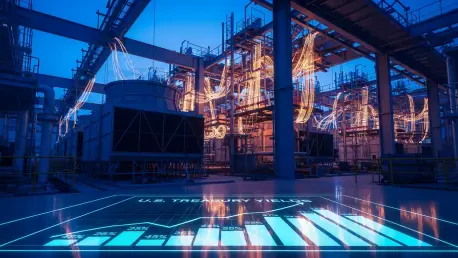
This staggering $750 billion figure represents an increase of more than 80% compared to 2025, a jump that fundamentally shifts the DNA of these organizations from being cash-rich havens to debt-reliant infrastructure giants. In the past, companies like Alphabet, Microsoft, and Meta could largely ignore the Fed’s posturing because they were sitting on mountains of cash, but the frenetic pace of AI data center buildouts has forced them to lean heavily on debt financing. This creates a visceral sensitivity to the 10-year U.S. yield, which we recently saw trading near 4.45%, effectively making these tech behemoths more vulnerable to borrowing costs than we have seen in decades. When the Fed signals even a hint of a rate hike, as we saw following Kevin Warsh’s recent press conference, the market feels an immediate chill because the interest on those massive loans starts to eat into the perceived profitability of the AI revolution. Investors are no longer just looking at user growth or software margins; they are obsessively tracking inflation data and Treasury yields because the capital intensity of AI has tied the tech sector’s hands to the central bank’s steering wheel.
How did the market’s perception of future interest rates shift following Kevin Warsh’s first press conference as Fed chair, and what do the Polymarket odds tell us about the current sentiment?
The atmosphere shifted almost instantly, with the market pricing in a much more cautious, perhaps even hawkish, tone from the new Fed chair. On Polymarket, we saw the implied odds for the “No change” outcome in the July 2026 decision jump by 7.0 percentage points, landing at a dominant 78.5%. This move reflects a collective realization among traders that the era of easy money is not returning anytime soon, especially as the central bank signaled the possibility of a rate hike later in 2026. While a small 20.55% of the market is still bracing for a 25-basis-point increase, the overwhelming consensus is that the Fed will hold steady to combat persistent inflationary pressures. The fact that $14.48 million has already been traded on this single July resolution suggests that this isn’t just speculative noise; it is a deep-seated conviction that the Fed is prepared to keep the screws tightened.
Why are we seeing such a strong conviction in the “higher-for-longer” narrative, specifically with over 80% of traders betting on zero rate cuts for 2026?
The conviction stems from the sheer volume of capital being deployed and the underlying inflationary pressure that such spending creates in the broader economy. When you see $37,178,309 flowing into a prediction contract where 81.55% of the volume expects zero rate cuts, you are looking at a market that has abandoned the hope of a “pivot” and is instead bracing for impact. This “0 bps” outlook is a direct response to the massive drawdown of cash reserves by firms like Amazon and Meta, who are effectively front-running a technological arms race that requires endless liquidity. If the Fed were to cut rates now, they would risk overheating a sector that is already spending at a record-breaking pace, so the market is acknowledging that the central bank’s hands are tied. It is a high-stakes game where the cost of capital must remain high enough to prevent a total inflationary blowout, even if it means tech investors have to endure more sell-offs and volatility.
Beyond interest rates, how do speculative high-volume events like the SpaceX IPO prediction provide a window into investor appetite during these uncertain macro conditions?
Even in a high-rate environment where the 10-year yield hovers near 4.45%, there is still a palpable hunger for “generational” equity events that can transcend traditional market risks. The SpaceX IPO contract on Polymarket is a perfect example, with the company leading at 86.5% odds and over $2.7 million traded, showing that investors are still willing to place big bets on transformative technology. This suggests a bifurcated market: on one hand, there is extreme caution regarding the Fed’s July decision and the debt-funded AI buildout, but on the other, there is a desperate search for growth stories that are perceived as “too big to fail” or fundamentally disruptive. It’s a fascinating psychological dynamic where traders are hedging against rate risks while simultaneously chasing the next massive liquidity event, proving that even a hawkish Fed cannot entirely dampen the animal spirits of the tech sector.
What is your forecast for the Fed’s impact on the technology sector as we move closer to the July 29 resolution date?
My forecast is that we will see a period of intense “rate paralysis” where tech valuations remain stagnant or highly volatile as the market waits to see if the 78.5% probability of a “No change” decision holds firm. As we approach the July 29 resolution, the pressure on the $750 billion AI spending plans will only intensify, and any slight deviation in Fed messaging could trigger a much larger sell-off than the 20.6% “hike” probability currently suggests. We are likely to see liquidity rotate out of more speculative tech stocks and into those with the strongest cash flows as the reality of zero rate cuts in 2026, currently backed by $37 million in bets, begins to settle in as the baseline economic reality. Ultimately, the success of the AI revolution will depend not just on the technology itself, but on whether these firms can survive a prolonged period where the cost of their ambition is dictated by the highest interest rates we’ve seen in a generation.