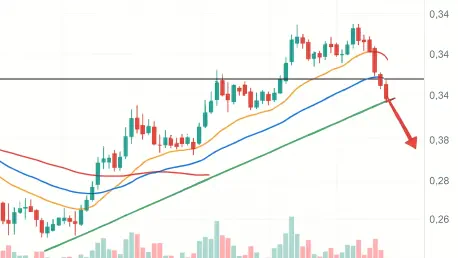

While the broader digital asset market experiences a renewed sense of vigor, TRON (TRX) is currently navigating a complex technical landscape that threatens its recent upward trajectory near the critical $0.34 threshold. Currently trading at $0.33, the asset is testing the patience of bulls who have enjoyed a steady climb but now face a formidable resistance zone that historically dictates the pace of mid-term trends. This specific juncture represents a crossroads where the prevailing bullish sentiment must contend with the cooling-off period that frequently follows rapid price appreciation in the cryptocurrency sector.
The relevance of this current market analysis lies in the subtle shift from unbridled optimism to calculated caution. Although short-term moving averages remain healthily positioned above long-term ones, momentum indicators are beginning to signal that the asset has overextended its immediate reach. By exploring the interplay between established support floors and psychological resistance levels, this examination provides a roadmap for navigating the anticipated volatility. A temporary retreat, rather than signaling a reversal, might actually serve as the necessary catalyst for a more sustainable and structured climb toward new yearly highs.
The Evolution of TRX: From Ecosystem Growth to Price Maturity
TRON’s journey to its current valuation is deeply rooted in its transition from a high-throughput decentralized application platform to a dominant global layer for stablecoin settlement. This evolution has provided a fundamental floor that supports the price even during broader market uncertainty, as real-world utility begins to outweigh speculative fervor. Over the past several months, the network has demonstrated an ability to maintain high transaction volumes, which has effectively transformed TRX from a volatile utility token into a more mature financial asset within the digital economy.
Past developments, particularly the alignment of shorter-term moving averages above long-term benchmarks, highlight a significant shift in market behavior compared to earlier cycles. In previous years, TRX often exhibited erratic price swings with little technical structure; however, the current landscape reveals a much more disciplined trading corridor. Understanding these background factors is essential because they contextualize potential price corrections as predictable technical necessities rather than alarming events. Historical data suggests that major resistance zones are rarely breached on a first attempt without a period of consolidation or a slight retracement to gather new liquidity from sidelined participants.
Examining the Resistance Barriers and Support Floors
The Critical Resistance at $0.34 and the Potential Breakout Path
The $0.34 price level stands as a massive hurdle for TRON, acting as a consistent rejection zone where previous upward momentum has frequently stalled. Technical data indicates that selling pressure intensifies as the price approaches this mark, primarily due to medium-term holders looking to lock in profits after a successful rally. However, if the bulls can manage a clean breakout and a daily close above this level, the narrative shifts toward an aggressive growth phase. Such a move would clear the path for a 12% upside target in the $0.37 region, emphasizing that while the resistance is stiff, it remains breakable if buying volume surges to absorb the current supply.
Evaluating the 65% Probability of a Pullback to $0.30
Despite the allure of an immediate breakout, a comparative analysis of momentum indicators suggests a 65% probability that TRX will undergo a corrective retreat toward the $0.30 support level within the next two weeks. This expected 9% decline is not viewed as a bearish reversal but rather as a healthy momentum reset that allows the Relative Strength Index to exit overbought territory. Emerging trends in price action show that TRX often performs best when it retests its previous breakout zones to confirm them as new support. Failing to correct now would likely lead to a much sharper and more chaotic drop later, making a controlled dip to $0.30 a preferred scenario for long-term stability.
Technical Invalidation Levels and Market Sentiment Shifts
Beyond the primary support and resistance levels, investors must keep a close watch on the $0.295 invalidation point, which serves as a line in the sand for the current trend. Should the price drop below this specific threshold, the broader bullish structure would be compromised, requiring a full reevaluation of the market’s underlying health. Monitoring trading volume during any anticipated pullback is the key to understanding market intent during these fluctuations. Low-volume selling during a retreat to $0.30 would signal a shallow correction, whereas heavy volume on the way down would suggest a deeper shift in sentiment from buying the dip to selling the rally.
Future Outlook: Navigating Volatility Toward Long-Term Targets
Looking ahead, the future of TRON appears robust, provided it can successfully navigate the current short-term turbulence without breaking its structural integrity. Innovations in the TRON ecosystem, specifically regarding its role in decentralized finance and cross-chain interoperability, are expected to keep demand consistently high. Analysts predict that once the anticipated correction is complete, the asset will be well-positioned to challenge targets between $0.37 and $0.40. This evolution will likely be influenced by broader regulatory shifts in the industry, which are increasingly favoring networks with high real-world utility and transaction volume over purely speculative projects.
Technological upgrades and potential institutional adoption of the TRON network could further decouple TRX from the general market’s more erratic movements. The speculative insight for the coming months is one of patience-first, as the landscape shifts toward a model where sustainable strength is built on the back of defended support levels rather than vertical, parabolic runs. As the industry matures, the ability of TRX to maintain its upward trajectory after a reset will be a litmus test for its long-term viability. This transition toward a more utility-driven valuation model suggests that the current volatility is merely a stepping stone toward a higher market cap.
Strategic Recommendations for Investors and Market Participants
For those looking to engage with TRX in the current environment, the primary takeaway is one of strategic caution rather than immediate action. Entering a new position at the $0.33 level offers an unfavorable risk-reward ratio, given the proximity to the $0.34 resistance and the high probability of a pullback. Instead, a more effective strategy involves waiting for the anticipated retreat to provide a better entry point. The optimal entry zone lies between $0.305 and $0.31, aligning with significant long-term moving average support and previous price reaction points that have shown resilience.
Best practices for traders include setting tight stop-losses near the $0.295 invalidation mark to protect against a deeper breakdown that could signal a trend reversal. For long-term holders, the recommendation was to view the potential 9% decline as an opportunity to accumulate rather than a reason for concern. By monitoring volume patterns during the retreat, market participants can gain real-world confirmation of whether the correction is ending or if a deeper trend shift is occurring. Patience, in this scenario, proved to be the most valuable asset in a trader’s toolkit as the market sought a more stable foundation for its next move.
Conclusion: Balancing Short-Term Caution with Long-Term Optimism
The technical evaluation of TRON revealed a market that was searching for a sustainable floor amid overextended growth signals. While the immediate risk centered on a correction near the $0.34 mark, the analysis showed that the long-term outlook remained decidedly positive due to strong network utility. The core themes identified—the formidable resistance, the necessity of a momentum reset at $0.30, and the identification of strategic entry points—all pointed toward a healthy market cycle. A successful defense of the $0.30 support was determined to be the defining factor in the ability of TRON to eventually reach its $0.40 target.
The significance of this topic rested on the realization that price corrections are a vital component of any healthy bull market. By acknowledging the risks near $0.34 and preparing for a potential retreat, investors positioned themselves to capitalize on future strength. TRON continued to be a significant player in the digital asset space, and its ability to weather this short-term volatility paved the way for a more robust and mature valuation. Ultimately, the findings suggested that short-term weakness was a necessary precursor to more sustainable and meaningful price appreciation in the months ahead.