
In a move that sends shockwaves through the autonomous vehicle industry, the AI-driven startup Waabi has successfully closed a monumental $1 billion funding and partnership deal, catapulting it from a trucking-focused innovator into a formidable contender in the robotaxi arena. This strategic alliance with the ride-hailing titan Uber not only infuses Waabi with an enormous capital runway but also officially marks its ambitious expansion into passenger mobility. The agreement signifies a powerful convergence of venture capital confidence and corporate strategy, validating Waabi’s distinct, simulation-first approach to solving the complex challenge of self-driving technology and setting the stage for a new phase of competition and collaboration in the race to deploy autonomous vehicles at scale.
A Landmark Partnership Takes Shape
The Billion Dollar Breakdown
The financial structure of this agreement is one of the most substantial in the autonomous vehicle sector’s history, bringing Waabi’s total capital raised to an impressive figure of approximately $1.28 billion. The bulk of the infusion comes from an oversubscribed $750 million Series C funding round, which was co-led by the influential venture capital firms Khosla Ventures and G2 Venture Partners. This round attracted a prestigious syndicate of investors, signaling widespread confidence in Waabi’s technological roadmap. Participants included Nvidia’s NVentures, Volvo Group Venture Capital, Porsche Automobil Holding SE, and investment giants like BlackRock, underscoring the deep-seated belief from both technology and automotive leaders in the company’s potential to redefine the industry. This diverse and powerful backing provides Waabi with not just capital, but also a network of strategic allies.
Complementing the venture funding is a strategic, milestone-based commitment of approximately $250 million directly from Uber. This element of the deal transforms a standard investment into a deeply integrated partnership, aligning the incentives of both the technology developer and the platform operator. This structure is indicative of an emerging trend within the industry, where stakeholders are moving away from purely transactional relationships toward symbiotic collaborations. By creating a financially integrated partnership, both companies effectively de-risk the immense challenge of commercial deployment. Uber gains a dedicated, technologically advanced partner for its robotaxi network, while Waabi secures a clear and scalable path to market, ensuring its groundbreaking technology has a direct route to real-world application on a global platform.
The Uber Robotaxi Commitment
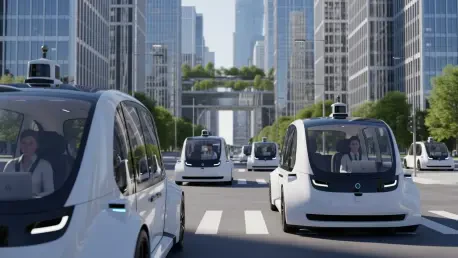
The centerpiece of this transformative alliance is a firm commitment for Waabi to deploy a substantial fleet of 25,000 or more robotaxis that will operate exclusively on Uber’s vast global ride-hailing platform. This strategic move is particularly significant as it reunites Waabi’s founder and CEO, Raquel Urtasun, with her former employer. Urtasun previously served as the chief scientist for Uber’s Advanced Technologies Group (ATG) before its eventual sale, giving her unique insight into the operational complexities and strategic needs of the ride-hailing giant. This prior relationship provides a foundation of trust and shared understanding, which is crucial for navigating the multifaceted challenges of deploying autonomous technology at such an unprecedented scale and ensuring a seamless integration into the existing Uber ecosystem.
While the agreement is ambitious in its scale, specific details regarding the operational timeline, the selection of an automotive manufacturing partner, and the initial cities for launch have not yet been disclosed. However, Raquel Urtasun has confirmed that Waabi will adhere to the same rigorous approach it has employed in the autonomous trucking sector. This involves pursuing a strategy of deep, factory-level integration with an original equipment manufacturer (OEM) to co-develop a fully redundant vehicle platform from the ground up. This method contrasts sharply with retrofitting existing vehicles, as it ensures that safety and autonomous functionality are embedded into the core design of the car. This commitment to a purpose-built vehicle underscores Waabi’s focus on safety, reliability, and scalability as it prepares to introduce its technology to the public.
Waabi’s Differentiated AI First Strategy
The One Stack Philosophy
Waabi’s strategic approach represents a potential paradigm shift away from the traditional “AV 1.0” model, which has been heavily reliant on amassing millions of real-world driving miles. Central to its innovation is the “One Stack” philosophy, which posits that a single, unified software and artificial intelligence system—the “Waabi Driver”—can be adeptly applied across multiple vehicle platforms, from heavy-duty commercial trucks to passenger cars. This unified architecture is a stark contrast to the strategies of some competitors, who have historically maintained separate and distinct development programs for their trucking and robotaxi divisions. Founder and CEO Raquel Urtasun asserts that Waabi’s core AI is fundamentally more generalizable, enabling a significantly more capital-efficient and scalable path to commercialization across different market verticals.
This dual-market strategy was not an afterthought but has been a foundational element of Waabi’s long-term vision since its inception. While the company’s initial focus and public-facing efforts were centered on the logistics and freight sector, it has been concurrently collecting and simulating data for passenger vehicles behind the scenes. This foresight allowed Waabi to build and refine its Waabi Driver with a broad range of scenarios in mind, ensuring that the underlying AI was robust enough to handle the nuanced differences between highway trucking and complex urban driving. By developing a single, adaptable brain for its vehicles, Waabi aims to streamline development, reduce redundant engineering efforts, and accelerate its entry into the robotaxi market without starting from scratch, giving it a significant competitive advantage.
Waabi World The Simulation Powerhouse
At the heart of Waabi’s capital-efficient strategy lies “Waabi World,” its proprietary, closed-loop simulation platform. This advanced system is far more than a simple testing environment; it functions as a high-fidelity digital twin of the real world, capable of recreating complex environments and sensor data with remarkable accuracy. Waabi World serves as the primary development and validation tool for the autonomous driver, enabling the company to accelerate its progress exponentially. The simulator can perform real-time sensor simulation and, more importantly, can automatically generate a virtually infinite array of complex and dangerous edge-case scenarios—situations that would be too rare, risky, or expensive to encounter and test repeatedly in the physical world. This capability allows Waabi to stress-test its AI against the most challenging conditions imaginable in a safe, controlled digital space.
A key differentiator of Waabi World is its ability to facilitate a self-learning AI. The system is designed to learn from its mistakes entirely within the simulation, without the need for constant human intervention or labeling of data. When the AI makes an error, the simulator can analyze the failure and generate new, targeted scenarios to help the AI master that specific challenge. This creates a powerful feedback loop that allows the Waabi Driver to develop sophisticated reasoning capabilities much faster and with significantly less real-world training data than traditional systems. Urtasun emphasizes that this simulation-first approach dramatically reduces the company’s reliance on large engineering teams, massive energy-consuming data centers, and extensive on-road test fleets, thereby lowering costs and making the entire development process more sustainable and efficient.
Navigating the Competitive Landscape
A Key Player in Ubers Ecosystem
The timing of this announcement strategically positions Waabi as a uniquely integrated partner within Uber’s expanding autonomous vehicle ecosystem. The deal was revealed just one day after Uber launched Uber AV Labs, a new division focused on leveraging its massive fleet to gather valuable driving data for its AV partners. Waabi now joins a growing roster of leading companies deploying on Uber’s platform, including established players like Waymo and Nuro. However, what sets Waabi’s relationship apart is its comprehensive nature. While other partnerships are focused solely on ride-hailing, Waabi’s collaboration now extends across both Uber’s mobility platform and its Uber Freight logistics business, creating a deeply synergistic relationship that spans two of the largest markets for autonomous technology.
This dual integration makes Waabi a cornerstone partner in Uber’s long-term vision for autonomy. By operating in both passenger and freight logistics, Waabi can provide a unified autonomous solution that could one day power a significant portion of Uber’s operations. The data and learnings from deploying autonomous trucks on highways can inform the development of the robotaxi system, and vice versa, creating a powerful flywheel effect. This unique, cross-platform role positions Waabi not merely as another provider on the Uber network, but as a deeply embedded technology partner poised to play a central role in shaping the future of how people and goods move, giving it a distinct and formidable advantage in the competitive landscape.
Progress Delays and the Road Ahead
While the Uber deal represents a significant expansion into the robotaxi market, Waabi has continued to make steady progress in its autonomous trucking division. The company is actively running commercial pilots with safety drivers on board in Texas, a key logistics hub, and is collaborating closely with Volvo to develop a purpose-built autonomous truck designed for mass production. However, the path to full autonomy has not been without its hurdles. The company had previously set an ambitious goal to launch a fully driverless truck on public highways by the end of 2025, but that milestone has now been delayed by a few quarters. Urtasun clarified that this setback is not a reflection of the AI’s readiness but is instead necessary for the final validation of the physical truck hardware itself, a critical step to ensure safety and reliability.
This billion-dollar validation provided a significant operational runway and a clear path to market, yet the true test for Waabi still lies ahead. The company has operated with a greater degree of stealth compared to its rivals, with fewer public demonstrations of its technology in action. The ultimate question is whether its highly touted, simulation-centric methodology can successfully and safely translate to the chaotic and unpredictable real world at a massive scale. Overcoming the immense complexities of deploying 25,000 autonomous vehicles on public roads is a monumental task. The conspicuous absence of a timeline for this robotaxi rollout, coupled with the slight delay in its driverless truck launch, underscored that the journey from a powerful technological foundation to large-scale commercial operation remained both long and arduous.