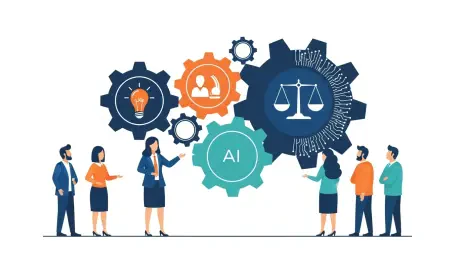

While global corporations are channeling unprecedented billions into artificial intelligence infrastructure, a startlingly small fraction feel genuinely prepared to harness its transformative power. This disconnect between investment and preparedness formed the central puzzle for global leaders gathered at the World Economic Forum. The answer that emerged from the snowy peaks of Davos was not found in lines of code or server racks, but in the vision, strategy, and cultural stewardship originating from the C-suite. The consensus was clear: the greatest barrier to realizing AI’s potential is not technological, but human.
The Stark Reality of AI Readiness
The global dialogue surrounding artificial intelligence has reached a critical inflection point, moving beyond abstract potential to the concrete challenges of implementation and adaptation. At the 2026 World Economic Forum, discussions pivoted sharply from the mechanics of AI to the human element at the heart of its deployment. Leaders grappled with the dual pressures of navigating profound technological disruption while contending with an increasingly volatile global landscape.
This environment has forced a strategic reevaluation across industries. The notion of workforce strategy as a siloed HR function has been rendered obsolete. Instead, a new understanding has taken hold: that a company’s approach to its people—its human capital strategy—is now a central pillar for navigating both economic and geopolitical currents. Investing in people is no longer a platitude but the primary mechanism for building organizational resilience and competitive advantage in the AI era.
Decoding the 13 Percent Who Lead the Way
A recent analysis casts this challenge in stark numerical terms. Cisco’s 2025 AI Readiness Index revealed a profound gap, indicating that a mere 13% of organizations are fully prepared to integrate and capitalize on artificial intelligence. This elite group, dubbed “Pacesetters,” stands in sharp contrast to the vast majority of companies that, despite significant investment, remain on the sidelines of the AI revolution.
The critical factor separating these Pacesetters from their peers is not superior infrastructure or larger budgets, but the proactive engagement and strategic direction of their leadership teams. This leadership differentiator creates a powerful trickle-down effect, shaping employee attitudes and fostering a culture of adoption. The data highlights a chasm in workforce sentiment: at Pacesetter companies, 64% of employees demonstrate high receptiveness to AI tools, a figure that plummets to just 27% at all other organizations. This gap underscores that technology adoption is fundamentally a cultural and leadership challenge.
Balancing AI’s Promise with Societal Peril
The conversations at Davos did not shy away from the immense societal risks accompanying the AI transition. Denis Machuel, CEO of Adecco Group, delivered a pointed warning, connecting the potential for widespread workforce disruption directly to the erosion of social cohesion and stability. His concerns were given a quantitative edge by Kristalina Georgieva, the IMF’s Managing Director, who projected that 40% of jobs globally could be impacted by AI within the next two years. Citing the IMF’s own experience, where AI adoption reduced its translation staff from 200 to 50, she illustrated how swiftly and deeply these changes can manifest.
However, this narrative of displacement was met with a compelling counter-vision focused on augmentation. Technology leaders, including Microsoft CEO Satya Nadella, argued passionately that AI should be viewed not as a replacement for human workers but as a powerful tool to enhance their capabilities. The prevailing view among this contingent was that the ultimate goal of AI must be to deliver positive outcomes for communities and countries, extending its benefits far beyond corporate profit margins. This frames the technology as a collaborator in human progress rather than a competitor.
A Leadership Blueprint for the AI Transition
To bridge the gap between AI’s potential and its practical application, a clear, actionable framework for leadership emerged. Francine Katsoudas of Cisco outlined a three-pronged approach centered on cultivating the right organizational culture. The first principle is that leaders must champion the culture, not just the code. This involves personally using AI to demonstrate its value, framing it as a tool for augmentation to foster psychological safety, and encouraging hands-on experimentation, which 91% of employees cite as their primary method for learning AI.
This leadership-first model is supported by compelling internal metrics. At Cisco, employees whose managers actively use and advocate for AI are twice as likely to adopt it themselves. This direct leadership influence translates into significant business outcomes, correlating with 40% higher retention rates and double the promotion recommendations for engaged employees. The evidence suggests that a leader’s actions are the most potent catalyst for driving an AI-ready culture.
Beyond cultural stewardship, the role of HR must be fundamentally elevated to that of strategic risk management. Its mandate must expand beyond traditional talent acquisition and management to proactively address the societal implications of workforce displacement. Simultaneously, organizations must prioritize the cultivation of uniquely human skills—such as critical judgment, creativity, and complex relationship-building—that AI cannot replicate. By focusing on both cultural adoption and strategic reskilling, leaders can build a workforce that is not just technologically adept but also deeply resilient.
The dialogues at Davos left little doubt that navigating the age of AI is the definitive leadership challenge of this decade. The 13% of companies that are truly ready have demonstrated that success is not bought with technology but built through trust, vision, and a profound commitment to human potential. As organizations move forward, the most critical investment they will make is in the leaders who can inspire their people to see AI not as a threat, but as a partner in creating a more productive and prosperous future.