
The once-futuristic notion of a digital counterpart, meticulously trained on an employee’s unique skills and thought processes to work alongside them, is rapidly transitioning from science fiction to a tangible reality within the modern enterprise. This is the emerging trend of the “AI Work Twin,” a proactive digital partner poised to fundamentally redefine individual productivity and team collaboration. More than just a sophisticated tool, the AI Work Twin represents a new class of colleague, capable of learning, anticipating needs, and executing complex tasks with a high degree of autonomy. This analysis will examine the powerful forces driving this evolution, explore its real-world applications, confront the critical questions it raises, and project its long-term impact on the very architecture of work.
Charting the Emergence of Digital Counterparts
The journey toward the AI Work Twin is not a sudden leap but a calculated progression, built on a significant shift in how organizations perceive and integrate artificial intelligence. What began as a series of isolated experiments has now matured into a strategic imperative, laying the groundwork for a new era of human-machine partnership. This transformation is visible in both the technological infrastructure of the enterprise and the evolving capabilities of the AI agents themselves.
The Foundational Shift From AI Tools to Core Infrastructure
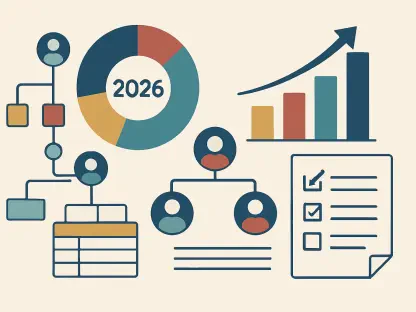
Recent data underscores a pivotal change in corporate strategy: artificial intelligence has moved beyond the pilot phase to become a central pillar of business operations. According to findings from the i4cp 2026 Priorities & Predictions report, organizations no longer view AI as an ancillary tool for marginal gains but as a core infrastructural component essential for competitive advantage. This evolution is the primary enabler for the development and widespread adoption of sophisticated AI Work Twins.
The trend is not merely about increasing the quantity of AI solutions but about the strategic redesign of entire business functions around AI capabilities. Companies are re-architecting workflows, decision-making processes, and talent management systems to operate on a foundation of intelligent automation. This deep integration creates the necessary ecosystem for AI to function not as a peripheral assistant but as a deeply embedded collaborator, paving the way for the seamless integration of human-AI teams as the new standard for high-performance work.
From Passive Assistants to Proactive Collaborators
The AI Work Twin marks a significant departure from the passive digital assistants and copilots that have become commonplace. While current tools react to commands, these advanced digital counterparts are being designed for proactive engagement. Concrete applications are already emerging where AI twins semi-autonomously manage intricate schedules, draft complex correspondence that perfectly mirrors the user’s voice and tone, and proactively surface critical data insights before a human even knows to ask for them.
What truly differentiates these “twins” is their capacity for deep personalization. They are trained on an individual employee’s specific expertise, communication patterns, and unique decision-making logic, allowing them to function as a genuine extension of the user. Consequently, organizations are beginning to envision a future where ongoing responsibilities can be delegated to these digital colleagues. This transforms them from a tool that one uses into an active team member that one manages, fundamentally altering the nature of individual contribution and accountability.
The Architect’s View Expert Perspectives on a New Workforce
The rapid emergence of the AI Work Twin is forcing a profound conversation among industry leaders about the future of talent, productivity, and organizational design. Experts like Kevin Oakes, CEO of i4cp, highlight that this trend moves beyond technological implementation and into the realm of strategic and ethical governance. The dialogue has decisively shifted from if this will happen to how organizations must prepare to manage a hybrid workforce of human and digital employees.
This new reality introduces a host of complex questions that leaders are now grappling with, reinforcing the trend’s significance. A primary concern is intellectual property: who legally owns the output and IP generated by a human-AI partnership? Furthermore, performance management frameworks are being challenged, as it becomes necessary to measure the productivity of a team where one member operates 24/7 without fatigue. This leads directly to the issue of accountability, demanding new protocols to assign responsibility for decisions made jointly by a human and their AI twin. Perhaps most critically, the question of asset continuity arises: if an employee leaves the company, does their highly trained and valuable digital twin remain behind as a corporate asset? The urgency of these questions signals that organizations must act now to build the ethical and operational guardrails for this new era.
Redesigning the Future The Human-Twin Workplace
The integration of AI Work Twins promises to unlock productivity gains on a scale not seen since the advent of the personal computer. By offloading complex, time-consuming tasks to a digital counterpart, human workers can be freed to concentrate on their most uniquely human strengths: strategic creativity, nuanced emotional judgment, and the cultivation of deep professional relationships. This shift has the potential to elevate the nature of work, making it more strategic, innovative, and fulfilling.
However, leaders must guard against the “myth of instant productivity.” The path to realizing these benefits will be iterative, much like the early, often clumsy, adoption of the internet, which required years of experimentation before it delivered transformative enterprise-wide value. Success will demand a disciplined approach, blending ambitious vision with robust governance. This requires an evolution in leadership itself, where managers transition from being supervisors of people to “talent orchestrators” of hybrid human-AI teams. This new role involves establishing clear principles around transparency and employee consent, developing novel performance metrics that capture combined output, and fostering a culture of continuous learning and adaptation for both human and digital team members.
Embracing Your Digital Colleague
The analysis of this trend has shown that the rise of AI Work Twins marks a pivotal evolution in the workplace, moving artificial intelligence from the category of a simple tool to that of a proactive and personalized collaborator. This development has fundamentally altered the nature of individual work and the composition of high-performing teams. This shift has presented both unprecedented opportunities for exponential productivity and a complex set of challenges in governance, ethics, and performance management that leaders must now address. Organizations that thrive in this new landscape have been those that acted as the architects of a new work paradigm, proactively designing the frameworks, policies, and cultural norms needed for effective and ethical human-AI collaboration. By doing so, they have built the agile and resilient enterprises best equipped for the future.