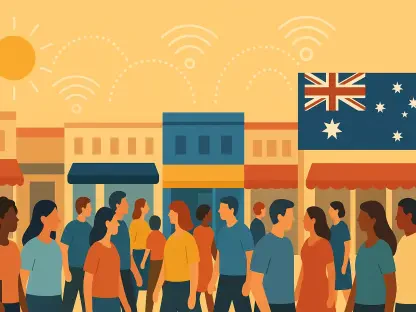

The modern Australian and New Zealand digital landscape has evolved into a high-stakes environment where capturing attention is expensive, but maintaining it is the ultimate currency for business survival. Marketing teams across the region are no longer satisfied with the fleeting nature of viral hits or the unpredictable surges of algorithmic favor. Instead, a profound structural transformation is underway, moving from a reliance on external platform discovery toward a strategy centered on audience ownership and data sovereignty. This shift reflects a maturing market that recognizes the volatility of “rented” attention and seeks the security of direct, unmediated relationships with consumers.
The Shift from Discovery to Ownership in the ANZ Market
Statistical Evolution of Reach and Engagement
Current data reveals a stark reality for brands operating in Sydney, Melbourne, and Auckland: organic social media reach has hit a historic floor, forcing a definitive transition to “pay-to-play” models. Recent industry metrics suggest that organic visibility on traditional social platforms now averages less than two percent for most regional brands. This decline has catalyzed a massive reallocation of budgets, as businesses realize that every interaction on a third-party platform carries an inherent cost that is rising annually. Consequently, there is a visible surge in the adoption of “owned media” frameworks, where companies prioritize building internal databases over expanding follower counts that they do not truly control.
Projections for the coming years indicate that the return on investment for personalized email sequences is expected to outpace social media advertising by a significant margin. While social media costs fluctuate based on auction dynamics and global events, the cost of sending a targeted email remains relatively stable. By focusing on first-party data collection, ANZ businesses are insulating themselves against the rising costs of customer acquisition. This evolution represents a shift in philosophy, viewing the digital presence not as a billboard in a public park, but as a private ecosystem where the brand sets the rules of engagement.
Real-World Applications of Integrated Channel Strategies
In practice, forward-thinking B2B firms in Auckland and Sydney are reinventing the role of LinkedIn, moving away from simple broadcasting toward a sophisticated lead-generation engine. These organizations use the platform for high-level thought leadership and brand positioning, but their ultimate goal is to move prospects into high-value email nurturing sequences. This approach acknowledges that while social media is excellent for building trust and establishing authority, the actual conversion and deep relationship-building happen in the sanctity of the recipient’s inbox. It is a strategic handoff that maximizes the strengths of both mediums without over-relying on either.
Retail brands across the ANZ region are successfully utilizing TikTok and Instagram as “front porch” discovery tools, specifically designed to drive newsletter sign-ups through exclusive offers or interactive content. A local apparel brand might use a viral video to spark interest, but the primary call to action is an invitation to join a community with direct benefits. Additionally, regional businesses are implementing automated feedback loops that use social media sentiment to refine the specific content sent via email. This integration ensures that the marketing ecosystem is self-correcting, using public engagement data to sharpen the precision of private communication.
Expert Insights on Navigating Algorithmic Volatility
Industry leaders are increasingly vocal about the dangers of building a business on “borrowed land,” a term that has become a rallying cry for marketers seeking long-term stability. The professional consensus emphasizes that while social platforms provide the infrastructure for discovery, they are inherently fickle partners whose priorities rarely align with those of individual businesses. Experts warn that a single change in a platform’s ranking logic can erase years of audience building overnight. To mitigate this, maintaining a direct line to the consumer through email or proprietary apps is no longer an optional luxury but a fundamental requirement for risk management.
Furthermore, there is a growing distinction in how professionals interpret “customer intent” across different digital touchpoints. Experts differentiate between the passive, entertainment-seeking behavior typical of social media users and the active, transactional mindset of email subscribers. When a user opens an email, they are signaling a level of commitment and readiness to engage that is rarely found in the casual scrolling of a feed. However, this comes with a warning: as more businesses flock to the inbox, the threat of digital “clutter” grows. The focus is therefore shifting toward high-value, privacy-conscious communication that prioritizes quality over frequency to avoid being relegated to the spam folder.
The Future Landscape of ANZ Digital Engagement
The long-term trajectory of the digital economy suggests that stricter privacy regulations will continue to favor businesses with robust internal databases. As third-party cookies and tracking technologies face increasing restrictions, the ability to communicate directly with a known audience becomes a significant competitive advantage. This regulatory environment is pushing ANZ companies to innovate in how they collect and utilize data, moving toward a model where every interaction is an opportunity to gather deeper insights. Businesses that have invested in their own data infrastructure will find themselves in a position of strength, while those relying on external trackers will struggle to maintain targeting accuracy.
Artificial intelligence is set to play a pivotal role in this landscape by enabling hyper-personalization at a scale previously unimaginable. In email marketing, AI can act as a counterbalance to social media noise by delivering content that is uniquely relevant to the individual’s current needs and historical behavior. For small and medium enterprises (SMEs) across Australia and New Zealand, this presents both a challenge and an opportunity. While they may have limited resources compared to global giants, the ability to maintain a distinct brand personality and foster genuine community through direct channels can lead to sustainable revenue growth that is not dependent on massive advertising spends.
Summary of Strategic Equilibrium for Growth
The investigation into the ANZ digital sector confirmed that the most resilient businesses were those that harmonized the discovery potential of social media with the retention power of email marketing. It was found that a symbiotic relationship between these channels created a more stable revenue stream than any single-platform strategy could offer. Successful organizations functioned as cohesive ecosystems, ensuring that visibility in public digital spaces was always leveraged to build a private, loyal audience. This balanced approach allowed brands to remain agile in the face of platform disruptions while maintaining the depth of connection required for long-term customer lifetime value.
Looking ahead, the priority for brands must be the aggressive pursuit of audience ownership to safeguard against future volatility. Strategies should focus on creating clear value propositions for direct communication, ensuring that the transition from a social follower to an email subscriber feels like an upgrade in the user experience. By investing in first-party data and refining personalization techniques, businesses can build a fortress around their customer relationships. The final takeaway for the ANZ market was that the era of passive reliance on external algorithms had ended, replaced by an age where the strength of a business is measured by the quality of its direct connections.