
With decades of experience shaping business strategy, Marco Gaietti has become a leading voice in the digital transformation of enterprise work. He has guided countless organizations through the complex process of replacing rigid, legacy software with agile, modern platforms. Today, he shares his insights on what truly drives success in this new era of work management, touching on the critical interplay between rapid implementation, user adoption, transparent costs, and the practical application of AI to solve real-world business challenges.
Many organizations are moving away from 12-month software implementations. For a platform that promises value in weeks, what are the critical first steps for a successful rollout, and what key metrics should leaders track to confirm they are achieving a fast return on investment?
That shift away from the year-long deployment is one of the most significant I’ve seen in my career. It’s a fundamental rejection of the old model where by the time a system goes live, the business has already moved on. For a successful rapid rollout, the first step is to forget boiling the ocean. Instead, you identify the most significant points of friction in your current processes and target those first. This means starting with pre-built templates for core workflows, which platforms like monday work management provide, allowing teams to launch and begin iterating in a matter of weeks, not quarters. You get immediate momentum, which feels fantastic for the teams involved. As for metrics, the most crucial one is user adoption, because without it, all other data is meaningless. The second is payback period. A Forrester study, for instance, found that organizations can achieve a return on investment in under four months with the right platform. When you’re seeing tangible value that quickly, while competitors are still stuck in consulting meetings, you know you’ve made the right choice.
When teams create workarounds for complex software, leadership loses visibility into project data. What are the most common design flaws that lead to low user adoption, and what practical steps can a company take to ensure a new platform becomes an indispensable daily tool?
Workarounds are a symptom of a deep-seated design failure. The most common flaw I see is a rigid, top-down structure that dictates how teams must work, rather than adapting to how they actually execute. When a tool feels like a compliance burden instead of a productivity enhancer, people will inevitably revert to spreadsheets and emails. Another major flaw is an overly complex interface that requires heavy, specialized training; it creates a barrier to entry that busy teams simply won’t cross. To make a platform indispensable, you must prioritize the user experience from day one. This means choosing a system with an intuitive, no-code environment where users can configure their own views and workflows. It’s about empowerment. When a marketing manager can build a campaign dashboard or an operations lead can automate a status update without calling IT, the platform becomes woven into the fabric of their daily work. That’s why we see platforms earning awards for user adoption—it’s not by accident, it’s by design. The goal is to create a single source of truth that people want to use, because it makes their lives easier.
Beyond the license fee, what are the most significant hidden expenses, such as consulting and retraining, that inflate a platform’s total cost of ownership? Could you share a specific example of how a transparent pricing model helps an organization better forecast and control these long-term costs?
The license fee is often just the tip of the iceberg, and it’s the hidden costs that truly sink budgets. The most significant hidden expense is almost always the reliance on specialized external consultants. Legacy systems are often so complex that they require an army of third-party experts for implementation, customization, and even routine maintenance. This can easily double or triple the initial software cost. Then you have the ongoing retraining cycles required every time the platform is updated or a new team is onboarded. A transparent, per-user pricing model completely changes this dynamic. For example, a platform that charges a clear $19 or $25 per user per month allows an organization to forecast its costs with near-perfect accuracy as it scales. There are no surprise implementation fees or mandatory consulting packages. Because these modern platforms are designed to be configured by internal teams, the massive expense of external experts and constant retraining simply evaporates, dramatically lowering the total cost of ownership and ensuring the investment delivers a much higher, and more predictable, return.
AI is often marketed as a surface-level feature. What are some tangible examples of how modern platforms use AI to proactively manage real-world work, such as predicting project risks or optimizing resource workloads, and how does this change a manager’s day-to-day decision-making?
You’re right, there’s a lot of AI “washing” happening, where it’s little more than a marketing gimmick. But true, practical AI is a game-changer for managers. A tangible example is proactive risk management. Instead of relying on manual status checks, an AI co-pilot can scan historical data from hundreds of projects to identify early warning signs of budget overruns or schedule delays. It might flag that a certain type of project consistently runs 15% over budget in its final phase, allowing a manager to allocate reserve funds proactively. Another powerful application is in resource optimization. AI can analyze team members’ skills, current capacity, and even performance patterns to suggest the ideal person for a new task. It moves resource allocation from a reactive, often emotional decision made in a spreadsheet to a proactive, data-driven strategy. For a manager, this means shifting from a firefighter who is constantly reacting to problems to a strategist who is anticipating and mitigating them weeks in advance. The AI handles the data crunching, freeing them up to focus on coaching their team and making high-level decisions.
Breaking down departmental silos is a major challenge for large organizations. How does a unified work management platform facilitate genuine cross-team collaboration between, for instance, marketing, finance, and operations? Please walk through how this improves visibility and execution on a complex project.
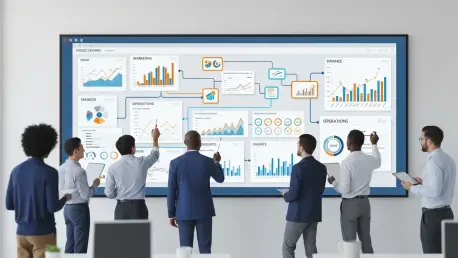
Silos are the natural enemy of enterprise agility. A unified platform dismantles them by creating a shared language and a single source of truth. Imagine a complex product launch. In a siloed organization, marketing runs its campaign in one system, operations manages logistics in another, and finance tracks the budget in yet another. The project manager spends their days chasing updates and manually stitching together reports that are outdated the moment they’re sent. With a unified platform, the entire workflow lives in one space. The marketing team’s campaign timeline is directly linked to the operational team’s production schedule. When a deliverable on the critical path is delayed, a dependency automation instantly notifies both teams. Finance doesn’t have to wait for a month-end report; they can see real-time budget burn against project milestones in a shared dashboard. This level of interconnected visibility is transformative. It fosters a sense of shared ownership and allows leaders to see a holistic, real-time view of execution, turning what was once an administrative nightmare into a streamlined, collaborative effort.
What is your forecast for enterprise work management?
My forecast is that the line between a work management platform and a true business operating system will completely dissolve. We’re moving beyond simple project tracking into an era of intelligent, interconnected work hubs. The future isn’t about having a tool for every single task; it’s about having a single, flexible platform that unifies strategy, execution, and data across the entire organization. AI will become less of a feature and more like the central nervous system of the platform, not just predicting risks but actively optimizing workflows and automating substantive tasks performed today by a “Digital Workforce.” The winning platforms will be those that masterfully combine this deep intelligence with an almost effortless user experience, empowering every employee—not just IT—to build, adapt, and innovate. The ultimate goal is to create an environment so seamless that the technology fades into the background, allowing teams to focus purely on delivering value.