In an era where the relentless growth of e-commerce collides with the finite availability and soaring costs of industrial real estate, logistics companies are urgently seeking innovative solutions to maximize their existing operational footprint. The AirRob automated warehouse storage system represents a significant advancement in this high-stakes environment. This review will explore the technology’s first European deployment, detailing its key features, its performance in a real-world setting, and the profound impact it is having on warehouse operations. The purpose of this analysis is to provide a thorough understanding of the AirRob system, its current capabilities as demonstrated in a landmark project, and its potential for future growth in the market.
An Introduction to the AirRob System
The AirRob automation solution, developed by Libiao Robotics, is a sophisticated goods-to-person system engineered to address the most pressing operational challenges in modern logistics. Its core design principle is to deliver high-density storage and rapid fulfillment within the constraints of standard warehouse environments. By doing so, it provides a direct response to the intense pressures created by the e-commerce boom, which demands faster, more accurate order processing than ever before.
This technology arrives at a critical juncture for the logistics industry. With industrial real estate costs escalating and spatial availability dwindling, the traditional model of expanding a warehouse’s physical footprint is becoming increasingly unsustainable. AirRob’s relevance lies in its ability to unlock latent capacity within existing structures, offering a strategic alternative to costly new construction and enabling businesses to grow without relocating. It is a solution conceived for a landscape where efficiency is measured not just in labor hours but in cubic meters.
Core Technology and System Features
Dual Robot Architecture for High Density Operations
The ingenuity of the AirRob system lies in its unique dual-robot architecture, which combines two distinct types of autonomous machines into a single, cohesive fleet. The first component is a series of vertical-climbing robots designed to ascend standard pallet racking, capable of reaching heights of up to eight meters to access stored goods. These climbers are the key to unlocking a warehouse’s vertical potential, an area often underutilized in manual operations.
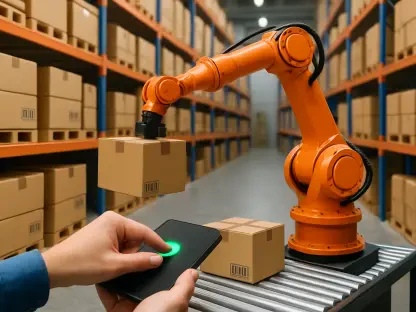
Working in perfect coordination with the climbers are autonomous floor-based robots, or “floorbots,” which navigate the warehouse floor to transport retrieved items. When a climber retrieves a tote or carton, it passes it down to a waiting floorbot, which then swiftly delivers the goods directly to a picking workstation. This synchronized partnership enables a continuous and highly efficient goods-to-person workflow, drastically reducing the time and travel required for manual order fulfillment and ensuring both speed and precision.
Seamless Integration and Retrofitting Capabilities
A standout feature of the AirRob system is its technical design, which prioritizes seamless integration into existing warehouse infrastructure. This retrofitting capability represents a significant departure from many large-scale automation solutions that demand bespoke facilities or extensive structural modifications. The system is engineered to be non-invasive, allowing for deployment without the disruptive and costly process of overhauling a building’s core design.
This adaptability is made possible by several key technical advantages. The system operates effectively in extremely narrow aisles, as tight as 850mm, which immediately increases the potential storage density of a facility. Furthermore, the robots have minimal floor load requirements, meaning they can function on standard concrete floors without the need for reinforcement or specialized surfaces. These attributes make AirRob a cost-effective and accessible pathway to advanced automation, offering a compelling alternative to greenfield construction projects.
A Strategic Shift in Automation Drivers
The inaugural European deployment of the AirRob system highlights a significant evolution in the business case for warehouse automation. Historically, the primary justification for investing in robotics has been the mitigation of labor shortages and the reduction of payroll expenses. While these factors remain important, the AirRob implementation demonstrates a market shift toward a new set of priorities.
In the case of the Geis Group project, located in a region with a relatively stable labor market, the decision to automate was driven by a more strategic imperative. The compelling value proposition was found in the system’s ability to dramatically enhance the speed and accuracy of order fulfillment while achieving unprecedented storage density. This indicates a broader trend where the optimization of physical space and the precision of operations are becoming primary drivers for automation investment, rivaling, and in some cases surpassing, the traditional focus on labor.
Real World Implementation The Geis Group Case Study
The first European deployment of the AirRob system at the Geis Group facility in CTPark Ostrava-Poruba, Czechia, stands as a testament to successful strategic collaboration. The project brought together the expertise of three key partners: the technology creator, Libiao Robotics; the regional implementation specialist, SLUNO; and the end-user, logistics leader Geis Group. This partnership navigated the project from its initial stages to full operational status.
The journey began with a Proof of Concept (POC) pilot designed to test the system’s capabilities in a real-world environment. The POC proved so successful in demonstrating its value—particularly in terms of speed, accuracy, and space optimization—that Geis Group moved swiftly to commission it for live customer operations. According to Petra Tylová, Director at SLUNO, Geis Group’s innovative culture and agility were instrumental in this rapid transition, turning a successful demonstration into a functional asset in a remarkably short timeframe.
Overcoming Modern Warehousing Challenges
At its core, the AirRob technology is designed to solve one of the most fundamental challenges in logistics: the limitations of finite warehouse capacity. As Pavel Křížek, Director of Logistics at Geis Group, aptly noted, logistics spaces are “not inflatable.” The system directly confronts this reality by enabling businesses to maximize the use of their facility’s vertical and horizontal space. By operating independently in narrow aisles and servicing high racks, it allows companies to “free up part of the capacity” within their current footprint.
This capability provides a powerful strategic advantage by deferring the massive capital expenditure associated with constructing new facilities. For growing businesses facing the constraints of their existing warehouses, AirRob presents an optimal solution when land for expansion is unavailable or new construction is financially prohibitive. It empowers them to scale operations efficiently and sustainably. The initial feedback from the live system reinforces its effectiveness, with Křížek describing the robots as both “accurate and fast.”
The Future of AirRob in the European Market
Following its successful European debut, the future trajectory for the AirRob system appears highly promising. Libiao’s Global Head of Sales, Ronan Shen, described the Czechia installation as a “significant milestone,” establishing a crucial foothold for the company’s flagship system on the continent. While Libiao’s ‘mini-yellow’ sorting floorbots are already widely deployed, this project serves as a powerful showcase for its more advanced high-density storage solution.
The potential for wider adoption across Europe is strong, as the system’s core benefits align directly with pressing market trends. Widespread labor shortages and escalating per-square-meter warehouse costs are challenges faced by logistics operators throughout the region. By offering a competitive investment that optimizes the current storage footprint, AirRob is well-positioned to meet this demand. Libiao’s established global credibility, with a client roster including major brands like Skechers and Procter & Gamble, further solidifies its position for future growth.
Summary and Final Assessment
The AirRob system presents a compelling and proven solution for the modern warehouse. Its key strengths lie in its unique dual-robot architecture, which masterfully unlocks storage density by utilizing vertical space, and its remarkable ability to be retrofitted into existing facilities with minimal disruption. This combination of high performance and practical implementation makes it a uniquely accessible form of advanced automation. The system stands out as a scalable and flexible technology that directly addresses the dual pressures of operational efficiency and spatial optimization.
Ultimately, the AirRob technology proves its value as a strategic asset that extends far beyond a simple response to labor challenges. Its successful European launch demonstrates that the primary justification for automation is increasingly centered on maximizing the value of existing real estate and meeting the rigorous demands of modern commerce. As a result, the AirRob system establishes a new benchmark for accessible, high-efficiency goods-to-person automation, showcasing what is possible within the existing four walls of a warehouse.