
With decades of experience in management consulting, Marco Gaietti is a seasoned expert in Business Management whose expertise spans a broad range of areas, including strategic management, operations, and customer relations. Having navigated the complexities of various industrial sectors, Gaietti offers a unique perspective on how specialized manufacturing firms maintain a competitive edge through innovation and precision. In this discussion, we explore the intersection of modular design and robotic automation, focusing on how tailored engineering solves the most pressing bottlenecks in modern logistics. We look into the technical evolution of aluminum-based systems and the strategic importance of feasibility-led design in high-stakes production environments.
The following conversation explores the transformation of client-specific requirements into high-performing automated systems, the engineering logic behind modular aluminum profiles, and the shift toward smarter, more flexible logistics solutions.
Since founding the company in Reggio Emilia in 1993, how has the mission evolved under current leadership? What specific core competencies in aluminum profiles and robotics allow a team of 50 to compete with larger industrial manufacturers? Please provide a detailed example of your organizational culture.
The journey since 1993 has been one of constant refinement, moving from a specialized component provider to a comprehensive leader in automated end-of-line solutions. Under the leadership of Francesca Maioli since 2024, our mission has sharpened its focus on integrating ISO 9001 and ISO 14001 standards into every bespoke project we undertake. Our core strength lies in our agility; while larger competitors offer rigid, off-the-shelf products, our team of 50 specialists leverages the versatility of aluminum profiles and Cartesian robotics to pivot quickly based on specific client needs. This is visible in our organizational culture, where we treat every project as a collaborative partnership rather than a simple transaction. For instance, when a client comes to us with only a vague idea of a product’s dimensions, our engineers don’t just send a catalog—they initiate an immersive feasibility study that draws on decades of collective technical expertise. This culture of deep listening and in-house design ensures that we remain small enough to care about the fine details of a single assembly line, yet sophisticated enough to deliver world-class automation.
A solution-based approach focuses on the client’s unique problems rather than off-the-shelf products. Could you walk us through the step-by-step process of a feasibility study? How do you ensure a bespoke design remains reliable under intense, real-world production conditions without sacrificing quality or safety?
A feasibility study is the heartbeat of our operation, starting with a meticulous analysis of the client’s existing production constraints and their ultimate efficiency goals. We take those initial, often incomplete details provided by the customer and transform them into a concrete technical blueprint using our in-house design capabilities. This involves calculating load capacities for conveyor belts and determining the precise reach and speed required for Cartesian robots to ensure they meet the demands of a high-speed factory floor. To guarantee reliability, we subject our designs to rigorous testing under simulated real-world conditions, essentially recreating the stresses of a 24/7 production cycle before the equipment ever leaves our facility. This commitment to “real” solutions means we never settle for theoretical performance; we verify that every joint, slot, and sensor can handle the vibration and repetitive motion of intensive industrial use. By maintaining this high level of internal oversight, we ensure that safety standards are never compromised, providing a system that is as robust as it is innovative.
In logistics, Cartesian palletizers and chain-driven conveyors must handle heavy-duty loads while optimizing warehouse space. How do these systems integrate into existing workflows to improve efficiency? Can you share an anecdote or metric showing how a custom installation solved a specific material-handling bottleneck?
Integrating Cartesian palletizers into an existing workflow is like adding a high-precision conductor to an orchestra; it synchronizes the flow of goods with millimetric accuracy. These systems are specifically designed to maximize vertical space and reduce the footprint of the end-of-line process, which is a critical advantage in crowded warehouse environments. When we pair these palletizers with heavy-duty chain-driven or roller conveyors, we create a continuous loop capable of moving massive loads without the stop-and-go delays common in manual handling. I recall a project where a client struggled with pallet movement during peak production times, leading to a massive bottleneck that slowed down their entire shipping department. By installing a custom-designed, intensive movement system, we were able to transition them to a continuous operation model that significantly improved their throughput and reliability. The result was not just a faster line, but a safer environment where the rhythmic, automated movement of goods replaced the chaotic and potentially dangerous manual transport of heavy materials.
Modular systems utilize aluminum profiles with various slot configurations for flexible assembly. What are the engineering advantages of using specific slot versions for different industrial applications? How does this modularity allow clients to reconfigure their lines as production requirements shift over time?
The engineering genius of our modular system lies in the variety of our aluminum profiles, which come in 5, 6, 8, and 10-slot versions to accommodate a wide spectrum of structural needs. A 5-slot version might be perfect for lightweight sensor mounting or light-duty framing, whereas the 10-slot profile provides the heavy-duty structural integrity required for massive Cartesian robot frames or assembly lines. This modularity acts as a “mechanical LEGO” system for industry, where each profile can be cut, drilled, and joined with a vast array of accessories to create a completely unique structure. The true value for the client, however, is realized months or years down the line when their production needs inevitably change. Instead of scrapping an entire machine, they can simply reconfigure the existing profiles, adding new modules or adjusting the layout to accommodate a new product size or a different workflow. This flexibility ensures that the initial investment remains productive for a much longer period, as the hardware is designed to evolve alongside the market’s dynamic challenges.
Automation for 2026 focuses on smarter systems with simpler programming and faster format changes. How will these advancements specifically benefit sectors with strict standards, like food or pet food? What technical steps are required to achieve millimeter-level precision in these upcoming modular designs?
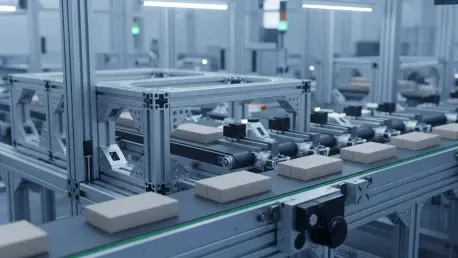
As we look toward 2026, the focus on simplicity in programming is a game-changer for the food and pet food industries, where hygiene and rapid turnover are paramount. These sectors require systems that can be cleaned easily and reprogrammed in minutes to handle different packaging formats without a lengthy shutdown. By simplifying the interface, we allow factory floor operators to make adjustments on the fly, which significantly boosts overall equipment effectiveness. Achieving millimeter-level precision in these designs requires a combination of high-resolution sensors and advanced control algorithms integrated directly into the modular framework. We are refining the mechanical tolerances of our Aluflex slat and tabletop conveyors to ensure that even at high speeds, the placement of products remains flawless. These technical enhancements mean that a pet food manufacturer, for example, can switch from small pouches to large bags with minimal downtime, all while maintaining the strict safety and quality standards their industry demands.
What is your forecast for the industrial automation and logistics industry?
My forecast for the industry is a move toward “liquid” manufacturing, where the boundaries between fixed production lines and flexible logistics become increasingly blurred. I expect to see a surge in the adoption of modular systems that can be rapidly deployed and redeployed, as companies can no longer afford to wait months for custom, static machinery. The integration of smarter, more intuitive Cartesian systems will allow smaller firms to adopt high-level automation that was once the exclusive domain of giant corporations. We will also see a much stronger emphasis on sustainability, with companies choosing aluminum-based modular designs specifically because they are easily recyclable and long-lasting. Ultimately, the winners in this space will be those who prioritize flexibility and “real-world” testing over theoretical speed, ensuring that their automation investments can survive the unpredictable shifts of the global economy.