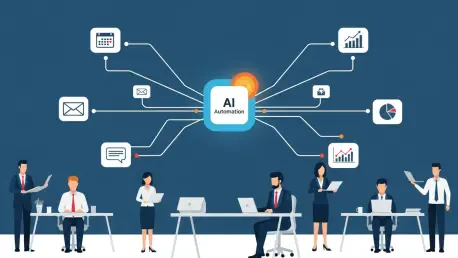

For many small and medium-sized businesses, the path to expansion is often obstructed by a relentless barrage of manual, repetitive tasks that consume valuable time while contributing little to the bottom line. This persistent operational drag, from chasing leads to managing disparate data streams, effectively creates an invisible ceiling on growth, leaving owners and their teams feeling perpetually stuck in a cycle of maintenance rather than momentum. The critical conversation for today’s business leaders is shifting from whether technology can offer a solution to how intelligent, AI-powered automation can serve as the definitive key to shattering that ceiling. This evolution represents a strategic pivot, transforming automation from a simple efficiency tool into a foundational pillar for sustainable and scalable success, enabling businesses to finally realize their full potential.
The Hidden Costs of Manual Operations
The daily operational reality for a vast number of SMBs is an exhausting grind of manual processes that quietly undermine strategic objectives. This includes the laborious, often unrewarding work of cold outreach and lead generation, the intricate and error-prone task of orchestrating data between different systems, and the endless cycle of content creation and administrative duties. These operational bottlenecks do more than just consume hours; they drain a team’s creative energy and focus, diverting attention from high-value activities like nurturing key client relationships, engaging in long-term strategic planning, and closing significant deals. This constant immersion in low-impact work not only limits productivity but also fosters an environment of “manual burnout,” where the consistency and volume of critical functions, such as lead flow, become severely restricted, directly impacting the company’s ability to grow.
The cumulative effect of these deeply embedded inefficiencies is far more damaging than a simple loss of daily productivity; it represents a fundamental stunting of a business’s growth trajectory. When a team’s entire capacity is consumed by the effort required to merely maintain the status quo, the very idea of scaling operations becomes a distant and seemingly unattainable goal. Businesses find themselves trapped in a reactive cycle, constantly addressing immediate operational fires rather than proactively pursuing new market opportunities. This environment fosters the creation of data silos and convoluted workflows as manual processes fail to connect seamlessly, leading to friction and miscommunication. Ultimately, this operational drag solidifies into a tangible barrier, preventing the business from evolving and effectively capping its potential for expansion and increased profitability in a competitive marketplace.
A Strategic Shift to Intelligent Systems
In direct response to these pervasive challenges, a more sophisticated approach has emerged: the implementation of custom-built, AI-driven automation systems. This strategy moves far beyond the limitations of generic, one-size-fits-all software, instead focusing on the meticulous engineering of a bespoke “ecosystem” precisely tailored to a company’s unique operational DNA and specific business logic. A powerful application of this concept can be seen in omnichannel outreach automation, where intelligent systems seamlessly integrate channels like professional networking sites and cold email campaigns. This allows a business to execute complex, multi-touchpoint prospecting campaigns at scale, consistently filling sales calendars with high-quality meetings without requiring any manual intervention. This system is not merely a scheduler but an intelligent engine that learns from interactions to continuously refine its targeting, messaging, and follow-up sequences, thereby automating the most critical part of the sales pipeline.
The technological foundation for these transformative solutions lies in the powerful fusion of leading no-code platforms with the advanced cognitive capabilities of Large Language Models (LLMs). This combination enables the creation of highly flexible and robust workflows that can connect disparate applications, effectively eliminating data silos and streamlining processes without the need for extensive and costly custom coding. For SMBs, this represents a significant breakthrough, providing access to a level of sophisticated automation previously reserved for large enterprises. By infusing workflows with AI, these systems can perform complex tasks such as in-depth data analysis, dynamic content generation, and intelligent decision-making. This accessibility empowers smaller businesses to build powerful, integrated operational frameworks, leveling the playing field and allowing them to compete more effectively, all without the necessity of maintaining a large, dedicated engineering team.
Redefining Human Potential in the Workplace
A frequent misconception surrounding automation is that its primary purpose is to replace human workers. The modern, more enlightened perspective, however, frames automation as a powerful tool for human augmentation. This philosophy is centered on the idea that technology should not aim to eliminate jobs but rather to remove the ceiling on human potential. The strategic goal is to “automate the grind”—the monotonous, repetitive, and low-value tasks—thereby freeing up a company’s most valuable asset: its people. When unburdened from such tasks, employees can redirect their focus and energy toward the uniquely human skills that truly drive business growth, including strategic thinking, creative problem-solving, innovation, and the cultivation of deep, lasting client relationships. This approach represents a new paradigm for scaling, one that replaces heavy, linear investment in additional staff with a smarter, more efficient model based on AI-driven operational leverage.
The tangible impact of this strategic shift from manual labor to intelligent automation has been substantiated by concrete and transformative outcomes. Businesses that have embraced this custom approach report significant improvements across their operations. One notable case involved a company that successfully transformed a complex and time-consuming data qualification process into a completely seamless, hands-off system, effectively solving a major data orchestration problem. This change resulted in quantifiable savings of approximately 15 team hours per week. Beyond the numbers, the implementation also delivered profound qualitative benefits, including a marked reduction in the team’s overall mental load and enhanced coordination, particularly among members working across different time zones. This reclaimed time and cognitive space empowered the team to refocus its collective energy on core business functions essential for expansion, such as content strategy, client coaching, and long-term growth initiatives.
The Ultimate Validation of a New Approach
This strategic move toward intelligent automation has done more than just streamline internal workflows; it has fundamentally altered the growth potential for small and medium-sized businesses. The documented success stories, where teams reclaimed significant portions of their workweek and shifted focus from operational drag to strategic growth, provided clear evidence of the model’s efficacy. The ability to not only solve intricate data management challenges but also improve team morale and coordination demonstrated that this was not merely an efficiency play but a holistic business transformation. These outcomes translated abstract technological concepts into concrete returns, proving that a well-designed automation ecosystem could directly address the most pressing pain points that hinder scalability. This shift has established a new standard for how SMBs can leverage technology to compete and thrive.
The real-world results achieved by early adopters have been further solidified by formal industry validation. Prestigious accolades, such as a recent 2026 award recognizing a firm as the “Best AI Automation Agency for SMBs,” served as a powerful third-party endorsement of this innovative approach. Such recognition underscored the leadership and effectiveness required to engineer practical and impactful AI systems that genuinely empower businesses to overcome long-standing operational hurdles. This industry-level acknowledgment confirmed that the focus on custom-built, intelligent automation was not a fleeting trend but a proven and effective strategy. It solidified the position of specialized agencies as key enablers for SMBs seeking to achieve sustainable, scalable growth and unlock their true competitive potential in the modern marketplace.