
The persistent erosion of trust between rural producers and corporate processors has created a fundamental crisis in global agricultural supply chains. While contract farming was theoretically designed to provide rural producers with reliable market access and price stability, its practical implementation has often been marred by a significant power imbalance. Smallholder farmers frequently find themselves at the mercy of large-scale corporate agribusinesses that can dictate terms, delay payments, or arbitrarily reject produce based on subjective quality standards. This systemic vulnerability has necessitated a technological intervention that can move beyond simple digital record-keeping toward a model of verifiable integrity. Recent research into the Decentralized Legal Farming Contract (DLFC) framework represents a significant step in this direction by integrating advanced cryptographic protocols with the traditional legal requirements of the agricultural sector.
The emergence of this decentralized framework comes at a time when traditional centralized farming models are failing to meet the transparency needs of a globalized economy. In many regions, oral agreements or loosely written paper contracts are easily repudiated, leaving farmers without legal recourse when corporate buyers default on their obligations. Conversely, agribusinesses are often wary of “side-selling,” where producers bypass their contractual commitments to take advantage of temporary spikes in local market prices. The DLFC framework seeks to resolve these dual anxieties by creating an immutable, multi-layered architecture that ensures both parties are held accountable to a single, unalterable source of truth. By utilizing the Ethereum blockchain as a foundational layer, the system provides a level of security and automation that was previously unattainable through conventional administrative methods.
Building a Transparent Agricultural Architecture
The shift toward a more equitable farming environment requires a foundational rethink of how data is captured and how legal intent is manifested in a digital space. The DLFC framework addresses this by moving away from siloed databases and toward a decentralized structure that prioritizes data provenance and contract synchronization. In 2026, the challenge is no longer just about digitizing records but about ensuring those records are inherently trustworthy and legally binding. This architecture is designed to handle the complexity of rural operations while maintaining the rigorous standards required by international corporate compliance. It represents a departure from “black box” systems where farmers have little visibility into the criteria used to evaluate their performance or trigger their payments.
To be effective, this architecture must operate across multiple levels of the supply chain, from the physical soil of the farm to the digital ledgers of the processing plant. It focuses on removing the need for intermediary trust by replacing it with mathematical certainty. The integration of high-fidelity sensors and automated spraying systems allows for a continuous stream of operational data, which is then processed through a decentralized identity system. This ensures that every action taken on the farm—whether it is the application of fertilizer or the harvesting of a specific plot—is tied to a verified identity and a specific contractual agreement. This multi-layered approach ensures that the digital twin of the farm remains an accurate and honest reflection of the physical reality on the ground.
Creating the Physical-to-Digital Bridge
The first operational layer of the DLFC framework establishes a secure connection between the physical farm environment and the digital ledger through advanced Internet of Things (IoT) hardware. By deploying a network of sensors, including Raspberry Pi units and ESP32 boards, the system monitors environmental variables such as soil pH, moisture levels, and chemical application rates in real-time. To prevent the injection of false data by malicious actors, every physical device is cryptographically bound to a specific farmer and a contract hash. This is achieved using elliptic curve digital signature algorithms, specifically the secp256k1 curve, which ensures that every data packet is signed by a unique private key before it is transmitted. This creates a verifiable chain of custody for all agronomic data, making it virtually impossible for either party to claim that sensors were tampered with or that data was falsified during the production cycle.
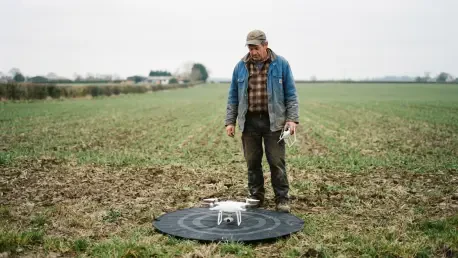
Furthermore, the use of unmanned aerial vehicles (UAVs) equipped with automated sprayers adds a layer of precision and verification to resource application. These drones record their exact flight paths and application volumes, submitting this information directly to the blockchain as proof of compliance with sustainability protocols. Because the data is hashed using the Keccak-256 algorithm, any attempt to retroactively alter the records would be immediately detected. This level of granular monitoring protects the interests of agribusinesses concerned with product quality and sustainability certifications, while simultaneously protecting farmers from unfair rejections. By the time a data point reaches the blockchain, its origin and integrity have been verified multiple times, providing a solid foundation for the subsequent layers of the contract to execute financial transactions without human intervention.
Integrating Identity and Ricardian Logic
The second layer of the framework manages the complex interplay between human legal intent and automated digital execution through the use of Ricardian contracts. Unlike standard smart contracts, which consist solely of executable code that is often unreadable to non-programmers, a Ricardian contract is a natural-language legal document that is cryptographically linked to the blockchain. The DLFC framework drafts these agreements in plain English, covering all operational terms, dispute resolution clauses, and pricing structures. This document is then hashed and stored on the InterPlanetary File System (IPFS), a decentralized storage network that ensures the file cannot be deleted or altered. The resulting Content Identifier (CID) is embedded within the Ethereum smart contract, creating an inseparable link between the legal prose and the code that enforces it.
This integration is vital for the legal recognition of blockchain-based agreements in 2026, as it provides a document that can be presented in a traditional court of law if necessary. However, the system is designed to minimize the need for judicial intervention by making the contract “tamper-evident.” If even a single character in the off-chain legal document is changed, the SHA-256 hash will no longer match the CID stored on the blockchain, immediately triggering a dispute flag and halting automated payments. This ensures that neither the corporate buyer nor the farmer can unilaterally change the terms of the deal once the harvest has begun. By combining this with a challenge-response authentication routine to prevent replay attacks, the DLFC provides a secure environment where identities are verified through 256-bit random nonces, ensuring that every contractual action is performed by an authorized and authenticated user.
Measuring and Enforcing Contractual Integrity
A successful agricultural contract relies on more than just the successful delivery of a crop; it depends on the consistent performance of both parties throughout the growing season. To address this, the third layer of the DLFC framework serves as an intelligent trust orchestration engine that transforms raw event logs and IoT data into dynamic reputation indicators. This engine moves away from static “pass/fail” assessments and toward a continuous evaluation of behavior. In 2026, trust is treated as a quantifiable asset that can be tracked and rewarded. This layer monitors every transaction and data point, applying complex logic to determine if the spirit and the letter of the agreement are being honored. It provides the “brain” for the entire system, ensuring that the automation of the smart contract is guided by actual performance metrics.
The enforcement of integrity in this system is not merely about punishment but about providing a transparent roadmap for success. When farmers or buyers know exactly how their actions are being scored, they are more likely to adhere to the agreed-upon standards. This layer bridges the gap between raw sensor data and the final financial settlement, ensuring that payments are not just released but adjusted based on performance quality. By making every participant’s reputation visible to the entire network, the DLFC creates a self-regulating ecosystem where reliability is the primary currency. This transparency helps level the playing field, ensuring that even a high-performing smallholder farmer can prove their worth to global corporate partners through data rather than through expensive certifications or third-party audits.
Powering the Trust Orchestration Engine
The trust orchestration engine operates by calculating a composite reputation score based on five critical Key Performance Indicators (KPIs) that cover the entire agricultural lifecycle. The Compliance Rate, weighted at 30 percent, monitors whether the environmental and agronomic readings from the IoT sensors remain within the boundaries defined in the Ricardian contract. This is followed by the Sustainability Index, which accounts for 25 percent of the score and measures resource-use efficiency, such as the optimized use of water and chemical inputs. The system also tracks Yield Performance at 20 percent, comparing the actual harvest volume against the initial targets. Delivery and Payment Reliability, weighted at 15 percent, ensures that both the physical produce and the digital currency move according to the agreed-upon schedule. Finally, Peer Feedback provides a 10 percent qualitative component based on satisfaction ratings from both parties.
By using this multifaceted scoring system, the DLFC prevents a single outlier from unfairly skewing a participant’s reputation; for instance, a farmer who experiences a slightly lower yield due to uncontrollable weather patterns but maintains a perfect sustainability and compliance record will not see their score plummet. This nuanced approach mimics the complexity of real-world farming while removing the subjectivity that often leads to disputes. The engine processes these inputs through a decentralized logic gate, ensuring that the reputation score is calculated on-chain, where it cannot be manipulated by any single party. This provides a clear, data-driven profile for every participant, allowing agribusinesses to identify reliable producers and helping farmers identify processors with a history of timely payments and fair quality assessments.
Applying Recursive Scoring and Decay
To ensure that a participant’s reputation is a true reflection of their current reliability, the DLFC utilizes a recursive scoring formula and an exponential time-decay factor. Trust is not a static achievement but an active metric that must be maintained over time. The algorithm weights the most recent performance epoch at 20 percent of the total score, while the historical average accounts for the remaining 80 percent. This structure ensures that while a long-term positive track record is respected, it cannot be used as a “reputation shield” to hide recent delinquency or contractual breaches. If a producer who has been reliable for years suddenly begins side-selling or neglecting sustainability protocols, their trust score will reflect this decline almost immediately, alerting the counterparty to a shift in behavior.
Additionally, the system implements a daily time-decay rate of 0.01 to penalize prolonged inactivity within the network, reflecting the reality that an entity’s reliability is an active asset. A farmer or buyer who has not participated in the market for several cycles may no longer have the same operational capacity or infrastructure as they once did. Beyond simple scoring, this layer also manages automated escrow triggers that enforce immediate financial consequences for breaches. If a corporate buyer delays a payment past the contractually mandated period, the smart contract can autonomously deduct a penalty from the escrowed funds and transfer it to the farmer. These penalties, which can range from 0.01 to 0.2 ETH depending on the severity and duration of the delay, ensure that contractual terms are backed by tangible economic incentives, providing a powerful deterrent against the “late payment culture” that often cripples rural economies.
Validating Technical Performance and Economic Impact
The practical viability of the DLFC framework has been rigorously tested through empirical validation on the Sepolia testnet, proving that the system can handle the rigors of real-world agricultural operations. Technical benchmarks focused on two primary areas: the accuracy of the trust scoring algorithm and the resource efficiency of the blockchain deployment. In 2026, as decentralized systems scale, efficiency is paramount to ensure that transaction costs do not eat into the already thin margins of smallholder farmers. The results of these simulations indicated that the system could effectively isolate and penalize “bad actors” by showing a sharp decline in trust scores—sometimes dropping from a healthy 0.60 to a critical 0.39—following a series of simulated breaches. This level of responsiveness is essential for building a resilient supply chain where risks can be identified and mitigated before they lead to systemic failure.
Beyond the technical metrics, the economic impact of such a system is profound, as it shifts the incentive structure toward “automated fairness.” By linking high trust scores to concrete economic benefits, the DLFC provides a structured environment for sustainable growth. Data revealed that contracts linked to high-trust participants consistently resulted in higher yield-to-cost efficiency, as both parties were more willing to invest in the success of the partnership when the risk of non-performance was minimized. This transition from blind trust to verified integrity allows for the stabilization of marginal farming regions, where the lack of formal legal infrastructure has historically hindered development. By providing a cryptographic guarantee of payment and performance, the framework empowers producers to adopt more complex and sustainable farming techniques that require long-term commitment.
Benchmarking System Efficiency and Scalability: Strategies for Evaluating Performance and Resource Optimization
A critical concern for any blockchain-based agricultural solution is the problem of “state bloat” and the associated gas costs of storing data on the ledger. The DLFC framework mitigates this by adopting a hybrid storage model where the bulk of the legal and agronomic data is stored off-chain on IPFS. The on-chain footprint for a standard contract is kept under 1 KB, primarily consisting of the IPFS Content Identifier (CID), the farmer’s identity hash, and the current trust score. Benchmarking revealed that the initial upload and activation of a contract cost an average of 51,200 gas, which is remarkably low for an agreement of this complexity. Because the smart contract only needs to verify the hash and manage financial triggers, the computational overhead remains manageable even when scaling to dozens of concurrent contracts.
During stress testing, the system demonstrated linear resource utilization as the number of active agreements increased from 10 to 50. Transaction latencies remained well within the practical requirements of agricultural cycles, typically ranging from 18 to 95 seconds. Since farming is not a high-frequency trading environment, these speeds are more than sufficient for recording daily sensor logs or triggering weekly payments. The research confirmed that the system could handle seasonal peaks in data volume—such as during harvest time when sensor pings and delivery logs increase—without a significant spike in costs or a degradation in performance. This efficiency makes the DLFC a viable tool for small cooperatives as well as large agribusinesses, ensuring that the benefits of blockchain technology are accessible regardless of the scale of the operation.
Promoting Automated Fairness in Agriculture
The ultimate goal of the DLFC framework is to usher in a new era of “Smart Agriculture” defined by automated fairness. This involves moving beyond the use of technology for simple productivity gains toward using it to correct systemic inequalities. By creating a “carrot-and-stick” environment, the system provides high-trust farmers with financial bonuses of up to 10 percent, which are automatically triggered by the smart contract when performance KPIs exceed certain thresholds. This incentivizes producers to adhere to rigorous environmental standards that might otherwise be seen as too costly or burdensome. Conversely, the transparency of the system protects these farmers from the predatory practices of buyers who might seek to exploit a lack of documentation to avoid paying for high-quality produce.
In 2026, this model of automated fairness is becoming essential for meeting global sustainability targets and ensuring food security. When buyers have a transparent and verifiable record of a farmer’s reliability, they are more likely to offer better terms and long-term partnerships, which provides the financial stability necessary for rural communities to thrive. This reduces the need for expensive third-party mediation and lowers the barriers to entry for farmers in developing regions. By making trust a mathematically verifiable metric, the DLFC framework removes much of the uncertainty that has historically plagued agricultural supply chains. The result is a more resilient and equitable system where the interests of the soil, the producer, and the consumer are all protected by the immutable logic of the blockchain.
Frequently Asked Questions and Comprehensive Information Regarding the Operations and Guidelines of the DLFC
1. What specific mechanisms does the system utilize to ensure data integrity and prevent the incorporation of false or inaccurate information?
The prevention of data spoofing is achieved through a rigorous “device-to-ledger” authentication pipeline where each IoT sensor or physical hardware component used on the farm is cryptographically bound to the specific contract and the farmer’s decentralized identity. Using elliptic curve digital signature algorithms, every piece of data—whether it is a soil moisture reading or a spray log from a drone—is signed at the source before being transmitted to the network. This means that an attacker cannot simply inject false data into the stream because the system would reject any packet that does not have a valid signature from a registered device. Furthermore, the use of Keccak-256 hashing ensures that if any data is altered in transit, the digital fingerprints will no longer match, and the information will be flagged as untrustworthy. This creates a secure, verifiable chain of physical-to-digital custody that ensures the integrity of the farm’s performance record.
2. Is it possible for the legal terms and conditions associated with this agreement to be modified or updated at any point during the duration of the contract?
The system is designed to be “tamper-evident,” meaning that once a contract is signed and the harvest cycle begins, the terms are locked in a way that neither party can unilaterally alter. This is made possible by the Ricardian contract module, which stores the natural-language legal document on the decentralized IPFS network. The unique SHA-256 hash of that document is then hard-coded into the Ethereum smart contract. If any party attempts to modify the off-chain legal text—even by changing a single punctuation mark—the resulting hash will change, and it will no longer match the cryptographic identifier stored on the blockchain. The smart contract is programmed to detect this mismatch immediately and will halt all automated processes or trigger a dispute flag. This ensures that the human-readable agreement and the machine-executable code remain in perfect synchronization, providing legal security and operational certainty for both the farmer and the agribusiness.
The implementation of the Decentralized Legal Farming Contract (DLFC) framework represented a significant milestone in the technological evolution of the agricultural sector. By successfully merging the flexibility of Ricardian legal prose with the immutable enforcement of Ethereum-based smart contracts, the researchers provided a robust solution to the long-standing crisis of trust in farming supply chains. The empirical data showed that this architecture increased counterparty trust scores by up to 100 percent, effectively isolating bad actors and rewarding those who adhered to sustainable and reliable practices. As these systems matured, they moved from experimental testnets into real-world rural ecosystems, proving that decentralized governance could effectively level the playing field between small-scale farmers and corporate giants. The shift toward a data-driven reputation model offered a practical path forward for a global industry that had struggled with opacity and power imbalances. Looking ahead, the wider adoption of such frameworks will likely lead to more resilient food systems where cryptographic proof replaces subjective judgment. For stakeholders throughout the supply chain, the next logical step involves the integration of these protocols into standard procurement workflows to ensure long-term stability and fairness.