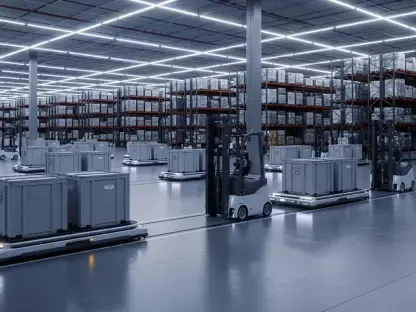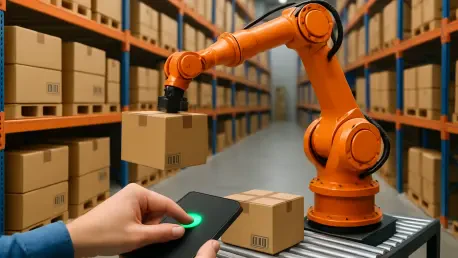

The rapid acceleration of consumer demand for next-day delivery has pushed traditional warehouse models to a breaking point where manual intervention often becomes the primary bottleneck in the entire supply chain. In a landscape where speed is the ultimate competitive advantage, the concept of one-touch fulfillment has moved from a theoretical ideal to a functional necessity. By utilizing advanced automated storage and retrieval systems like the OPEX Perfect Pick, facilities can now move inventory from deep storage to a shipping container with minimal human interaction. This shift is not merely about replacing physical labor but about re-engineering the flow of goods to ensure that every movement adds direct value to the order cycle. As facilities face rising SKU counts and shrinking delivery windows, the integration of high-speed consolidation systems allows for the simultaneous management of hundreds of open orders. This operational density enables distribution centers to maximize their existing footprint while drastically reducing the time an item spends sitting idle between the pick face and the outbound dock.
Building on these mechanical efficiencies, the recent introduction of the Xtract system represents a significant leap forward in high-speed order consolidation and automated sortation. This technology functions by delivering items directly into shipping containers or onto waiting conveyors, effectively removing the manual “put” wall process that has historically slowed down e-commerce operations. By automating the transition from retrieval to packing, companies can achieve a level of throughput that was previously unattainable without massive increases in headcount. Furthermore, the inclusion of actively controlled temperature zones within these automated systems allows for the handling of diverse product categories, ranging from pharmaceuticals to perishable groceries, within a single unified workflow. This versatility ensures that a wide array of industry sectors can leverage the same hardware to meet their specific logistical challenges. The result is a streamlined process where the distance between a customer’s click and a dispatched parcel is compressed into a singular, cohesive motion that minimizes error and maximizes speed.
The Role of Software Orchestration in Warehouse Reliability
While the physical machinery of automated systems often captures the headlines, the true success of these installations hinges on the underlying software orchestration that governs every movement. Industry experts have observed that even the most advanced hardware can fail to deliver expected returns if it cannot communicate effectively with existing warehouse management systems. To address this, modern fulfillment solutions are built with flexible integration protocols that allow for seamless message exchange between various control layers. This strategic focus on software interoperability reduces the inherent risks associated with large-scale automation projects and provides a pathway for businesses to scale their operations in manageable phases. By maintaining a modular approach to both hardware and software, organizations can adapt to seasonal fluctuations or sudden market shifts without requiring a complete overhaul of their infrastructure. This adaptability is crucial in a market where consumer behavior can change overnight, necessitating a distribution network that is as agile as it is efficient.
The pursuit of a zero-touch workflow is no longer just about operational cost reduction; it is about establishing a standard of reliability that human-centric processes cannot consistently replicate. Automated systems provide a level of precision that eliminates common picking errors, which in turn reduces the high costs associated with returns and customer dissatisfaction. As labor markets remain tight and the physical demands of warehouse work continue to challenge recruitment efforts, technology serves as a stabilizing force that maintains production levels regardless of external labor availability. Beyond simple task replacement, these intelligent systems offer real-time data insights that allow managers to identify bottlenecks before they impact the bottom line. By analyzing the flow of inventory through the SRS systems, businesses can optimize their slotting strategies and improve inventory accuracy to near-perfect levels. This data-driven approach transforms the warehouse from a static storage space into a dynamic engine of growth that responds proactively to the needs of the global supply chain.
Strategic Implementation for Long-Term Distribution Success
To capitalize on these advancements, logistics leaders must move beyond viewing automation as a standalone purchase and instead treat it as a fundamental shift in their operational philosophy. The transition to a one-touch or zero-touch environment requires a comprehensive evaluation of current workflows to identify where manual touches can be consolidated or removed entirely. Practical next steps involve prioritizing the integration of high-speed sortation tools that can handle the most complex aspects of the order cycle, such as returns processing and small-item replenishment. Organizations should look toward solutions that offer tangibility and proven reliability, such as those demonstrated at major industry events like LogiMAT. Investing in systems that support modular expansion ensures that the initial capital expenditure remains relevant as the business grows. Rather than attempting a total facility transformation at once, a phased implementation strategy allows for the fine-tuning of software interfaces and operator training, ensuring a smoother transition to fully automated fulfillment.
Looking ahead, the focus of supply chain management must shift toward creating resilient systems that prioritize throughput density and labor productivity over traditional facility expansion. The integration of advanced machinery with robust software control layers is the only viable path for maintaining a competitive edge in an increasingly automated world. Stakeholders were encouraged by the performance of the latest consolidation technologies, which proved that reducing human touchpoints leads directly to faster order cycles and lower operational overhead. Future considerations should include the expansion of temperature-controlled automation to support a wider range of specialty goods, further diversifying the capabilities of the modern distribution center. By adopting these high-speed picking and sortation solutions, companies did not just improve their current metrics; they established a foundation for a scalable, future-proof logistics network. The successful implementation of one-touch systems demonstrated that the fusion of mechanical precision and intelligent software is the ultimate catalyst for revolutionizing global order fulfillment.