
Marco Gaietti brings decades of strategic management and operations expertise to the forefront of the industrial packaging sector. As a seasoned consultant, he has guided numerous manufacturers through the complex transition from traditional plastics to resource-efficient materials. In this discussion, he explores the latest advancements in paper-based sleeve wrapping, focusing on how specific machine technologies and kraft paper innovations are redefining transport stability, energy efficiency, and environmental compliance for global FMCG and retail operations.
Many manufacturers are moving away from traditional shrink film and heavy cardboard. How does using a 70 gsm kraft paper maintain the necessary tension for transport, and what specific stability advantages does this provide for FMCG producers?
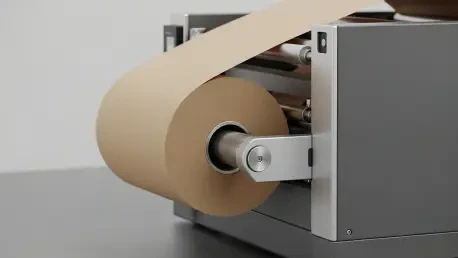
The shift toward 70 gsm kraft paper is a masterclass in material engineering, as it provides a surprisingly robust alternative to bulkier materials. By utilizing a specific overlap technique combined with optimized hot-melt gluing, the machine creates a tight, secure wrap that grips the product—whether it is sitting in a tray or bundled alone. This tension is vital for FMCG producers because it ensures that items do not shift or rub against one another during the vibrations of transit. Even at a weight as low as 70 gsm, the paper provides a stable, “retail-ready” bundle that maintains its structural integrity from the warehouse floor to the store shelf.
Facilities often have limited floor space for new equipment. How does a compact sleeve wrapper integrate into existing production lines, and how does the hot-melt gluing process ensure a secure bundle without the need for a heat-shrink tunnel?
The beauty of the new sleeve wrapper lies in its compact, operator-friendly design, which was specifically engineered to fit into tight footprints where traditional, sprawling lines might fail. It integrates seamlessly as an inline system or can function as a standalone unit, offering maximum flexibility for facility managers. By replacing the massive, energy-hungry heat-shrink tunnels with a precise hot-melt gluing system, the machine achieves a secure bond instantly. This process removes the thermal stress on the product and the environment, focusing instead on a mechanical “lock” that keeps the paper wrap drum-tight without needing to bake the entire package.
Packaging must withstand significant stress during the supply chain. What specific puncture resistance and tensile characteristics allow thin paper to secure heavy bundles, and how does the use of uncoated materials impact recyclability in standard paper streams?
When we look at materials like the Ad/Vantage StretchWrap, we are seeing paper that punches far above its weight class in terms of durability. This uncoated kraft paper possesses exceptional tensile energy absorption and high puncture resistance, which means it can flex and stretch under the pressure of heavy loads without tearing or failing. Because the material remains uncoated and is developed in close collaboration with industry leaders like Mondi, it doesn’t require specialized facilities for disposal. It is fully recyclable in conventional paper streams and is even industrially compostable, closing the loop on the circular economy while protecting the goods inside.
Transitioning to sustainable materials often raises concerns about operational costs. Could you break down the energy savings compared to heat-based shrink wrapping and explain how reduced material consumption impacts the overall bottom line for large-scale retail operations?
The financial argument for this technology is quite compelling, especially when you factor in the elimination of the shrinking process. Traditional shrink tunnels require constant, high-intensity heat to contract plastic film, whereas the paper sleeve wrapper operates with significantly lower energy inputs. Beyond the utility bills, the reduction in material volume—moving away from heavy cardboard or thick films to 70 gsm paper—drastically cuts down on the raw material spend. For large-scale retail operations, these incremental savings on every bundle quickly aggregate into substantial bottom-line improvements, all while meeting the high performance standards required for logistics.
Modern retail requires high levels of customization and traceability. What options exist for integrating digital printing or labeling directly into the wrapping process, and how does this automation help companies meet evolving regulatory demands for secondary packaging?
To stay ahead of regulatory demands, the sleeve wrapping system can be outfitted with a variety of integrated modules, such as digital printing units and automated labeling systems. This allows manufacturers to print batch codes, tracking data, or branding directly onto the paper during the wrapping phase, eliminating the need for a secondary offline process. This level of automation ensures that every bundle is fully traceable and compliant with emerging transparency laws. By streamlining these steps into one compact machine, companies can pivot quickly to meet specific customer requirements or regional labeling regulations without losing operational speed.
What is your forecast for sustainable transport packaging?
I foresee a rapid acceleration toward “monomaterial” ecosystems where the distinction between primary and secondary packaging becomes increasingly blurred through material science. We are moving toward a future where transport packaging is no longer viewed as “waste” to be managed, but as a high-value resource that is fully integrated into the global recycling stream. In the coming years, expect to see paper technologies evolve even further, perhaps reaching even lower weights while maintaining the same protective qualities of plastic. The winners in this space will be those who embrace modular, energy-efficient machinery that can handle these high-performance papers with the same reliability we once expected from traditional film.