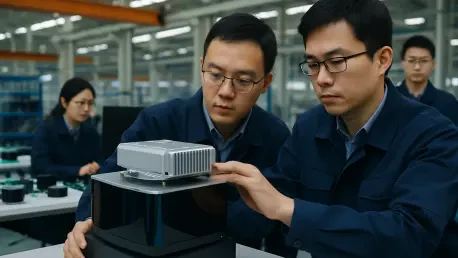

RoboSense’s decision to divest its robot manufacturing assets aims to transform the company into a neutral, Tier-1 supplier for the broader embodied intelligence ecosystem. This strategic pivot comes at a time when the LiDAR industry is experiencing an unprecedented level of market saturation and price erosion that has forced even the most established leaders to reconsider their long-term viability. As the automotive industry moves toward level three and level four autonomous driving capabilities, and the robotics sector shifts toward “embodied intelligence,” the landscape for high-precision sensors has become increasingly complex. The three dominant Chinese players—Hesai Technology, RoboSense, and Innovusion—now find themselves at a strategic crossroads where the traditional hardware-only business model is no longer sufficient to ensure survival. While their primary objective remains the achievement of sustainable profitability in an environment characterized by thin margins, their tactical approaches have diverged into three distinct mathematical philosophies: subtraction, addition, and multiplication. This transition period is defined by a paradox where shipment volumes are reaching record highs, yet the revenue generated per unit continues to decline, creating a volatile environment for innovation and growth. To maintain a competitive edge, these firms are now looking beyond simple hardware sales to redefine their roles within the physical AI infrastructure.
Strategic Subtraction: Specializing in Core Components
Part 1: The Transition to Core Component Specialization
The recent proposal by RoboSense to sell its embodied robot complete machine business for approximately 59.878 million yuan represents a clear move toward “strategic subtraction.” In an industry currently obsessed with vertical integration, this decision to exit the finished robot market highlights a focused attempt to minimize capital-intensive risks. Building complete machines involves significant overhead, including complex production lines, massive inventory management, and the high cost of customer acquisition in a fragmented market. For a company that has navigated a challenging path toward consistent profitability, these finished products represented a high-risk venture with unpredictable gross margins. By shedding these assets, the company can redirect its research and development resources toward its “comfort zone”—the high-precision sensors and modular components that serve as the fundamental perception layer for other manufacturers. This strategy prioritizes balance sheet stability over the allure of becoming a full-stack robotics company, allowing for a more streamlined operation that can react faster to technological shifts in the core LiDAR market.
Part 2: Neutrality and the Embodied Intelligence Ecosystem
By exiting the finished robot market, RoboSense has effectively eliminated a fundamental conflict of interest that previously hindered its growth as a component supplier. In the emerging era of embodied intelligence, robot manufacturers are often hesitant to source critical components from companies that are also their direct competitors in the consumer or industrial machine space. This “subtraction” allows the firm to position itself as a neutral, Tier-1 partner that provides the “eyes” for the entire industry without threatening the market share of its clients. This strategic neutrality is essential for securing high-volume contracts with major global robotics firms that require specialized, reliable, and non-competitive supply chains. Furthermore, focusing on the sensor layer allows the company to refine its manufacturing processes to achieve higher yields and lower unit costs, which is critical during a period of aggressive price-cutting across the global market. The goal is to become an indispensable part of the broader ecosystem, providing the essential building blocks that enable a wide variety of autonomous platforms to function across different environments.
Part 3: Financial Constraints and Quality Control Challenges
The pivot toward subtraction is also a direct response to the harsh financial realities of the current year. Despite a 510.4% year-on-year increase in robot LiDAR shipments, the company recently returned to a deficit after a brief period of quarterly profitability. The automotive sector, which remains the primary revenue driver, is currently embroiled in a price war that has significantly compressed profit margins across the board. While Advanced Driver Assistance Systems sales grew by nearly 100% in the first half of the year, the market share has come under intense pressure from both domestic and international rivals. Additionally, the industry has faced significant quality control hurdles, as evidenced by a large-scale recall of approximately 93,000 vehicles due to internal power IC issues in certain sensor modules. Such incidents introduce new variables regarding after-sales costs and the long-term trust of brand partners. By narrowing its focus, the company can dedicate more rigorous attention to quality assurance and supply chain reliability, ensuring that its core products meet the stringent safety standards required by the next generation of autonomous vehicles.
Strategic Addition: Diversifying the Customer Portfolio
Part 4: Diversification as a Hedge Against Market Volatility
Innovusion has historically faced criticism for its extreme dependency on a single major client, which at one point accounted for over 90% of its total revenue. To counter this vulnerability, the company is aggressively pursuing a strategy of “strategic addition,” focusing on expanding its roster of original equipment manufacturers. This transition was marked by a series of successful mass production deliveries for the GAC Group, including its Aion, Trumpchi, and Hyper brands, as well as a significant new cooperation agreement with Wuhan Chuneeng Auto. By adding these high-volume players to its portfolio, the company is effectively hedging against the inherent risks of a single-customer model, where a shift in a client’s strategy or a decline in their sales could prove catastrophic for the supplier. This diversification not only provides a more stable revenue stream but also enhances the company’s reputation as a versatile partner capable of meeting the diverse technical requirements of different automotive architectures. The move toward a broader client base is a necessary step to ensure long-term resilience in an increasingly crowded and competitive marketplace.
Part 5: Scaling Operations through Strategic OEM Partnerships
The success of the “addition” strategy is reflected in the company’s ability to achieve substantial revenue growth while simultaneously narrowing its net losses. In the first half of the year, the firm recorded a 127.9% revenue increase, the highest among its immediate peers, while its gross margin improved to 11.17%. This dual achievement suggests that the company is successfully utilizing its new partnerships to reach the economies of scale required for modern manufacturing. By onboarding more original equipment manufacturers, the firm can spread its fixed costs over a much larger volume of units, which is the only viable way to survive in a market where unit prices are being driven down by competition. This approach has allowed the company to rapidly close the revenue gap with its larger rivals, trailing some by only a small margin. For this firm, the constant addition of new clients is the primary engine for reaching the critical mass necessary to transition from a venture-backed startup to a self-sustaining industry leader that can compete on price without sacrificing its technological edge.
Part 6: Balancing Revenue Growth and Sustainable Efficiency
Despite the thin margins associated with high-volume automotive contracts, the aggressive expansion of the customer base provides the necessary data and feedback loops to improve product efficiency. Every new partnership brings unique challenges and technical specifications that force the company to innovate and optimize its hardware designs. This iterative process has allowed the company to refine its long-range detection capabilities while reducing the physical footprint of its sensors, making them more attractive to a wider range of vehicle types, from luxury sedans to mass-market SUVs. The focus is no longer just on high-end performance but on providing a cost-effective solution that can be integrated into millions of vehicles. As the market continues to consolidate, the ability to serve a wide array of domestic and international brands will be the deciding factor in which companies remain relevant. The strategy of addition is not just about quantity; it is about building a robust and diverse network of partners that can support the company through the inevitable cycles of the automotive industry.
Strategic Multiplication: Moving Toward Physical AI
Part 7: Beyond Hardware: The Architecture of Spatial AI
Hesai Technology, which currently holds a dominant 43% share of the global ADAS LiDAR market, is pursuing a “multiplication” strategy that leverages its hardware leadership to move up the value chain. Rather than simply selling a sensor, the company is evolving into a provider of “Spatial Intelligence” and Physical AI infrastructure. This evolution is built upon a three-tier architectural framework: perception, understanding, and action. Through its Strategic Growth Business segment, the company is no longer content with providing raw data; it is developing the software and intelligence layers required for machines to truly comprehend their environments. This move transforms the company from a component vendor into an essential ecosystem partner. By integrating its sensors with sophisticated processing capabilities, the firm is creating a “multiplication effect” where the value of the integrated system far exceeds the price of the individual hardware components. This strategy targets the high-value software and services market, which offers significantly higher margins than traditional hardware manufacturing.
Part 8: Intelligent Perception and Cloud-Based Integration
The centerpiece of this multiplication strategy is the Kosmo platform, which integrates AI spatial cameras and cloud services to transform physical environments into sophisticated 3D spatial assets. Through partnerships with 3D native world model companies, the firm is positioning its technology as the foundational layer for “digital twins” and real-time environmental mapping. This allows the company to sell intelligence and spatial data as a service, providing a recurring revenue model that is less susceptible to the price wars of the hardware market. By focusing on the “understanding” layer of the autonomous stack, the firm ensures that its technology remains indispensable even as the cost of basic sensors continues to fall. This shift toward software-defined perception allows for continuous updates and improvements to the sensor’s capabilities long after it has been installed in a vehicle or robot. As physical AI becomes more prevalent in urban planning, logistics, and industrial automation, the ability to provide a comprehensive spatial intelligence solution will likely become the company’s most significant competitive advantage.
Part 9: Engineering the Muscles and Joints of Future Machines
In addition to its focus on spatial intelligence, the company is expanding its physical footprint into the “action” layer of robotics by manufacturing specialized power modules. These modules, which serve as the joints and muscles for autonomous machines, represent a natural extension of the company’s engineering expertise. Having already delivered over 10,000 sets, the firm expects shipments to exceed 100,000 units by 2027. This move toward hardware multiplication ensures that the company is providing both the sensory inputs and the physical outputs required for robot movement. This integrated approach allows for better synchronization between perception and action, leading to more fluid and responsive robot behavior. By diversifying into mechanical power systems, the firm is effectively insulating itself against the commoditization of the LiDAR market. This broader focus on the entire physical AI stack—from the eyes to the limbs—positions the company as a comprehensive infrastructure provider for the next generation of autonomous machines, moving far beyond the limitations of the traditional sensor industry.
Navigating the Volume-Price Paradox
Part 10: The Widening Discrepancy Between Volume and Value
A critical challenge facing all three industry leaders is the widening gap between shipment growth and revenue growth, a phenomenon often described as the “volume-up, price-down” cycle. While companies like Hesai and RoboSense have seen shipment increases of 100% to 170%, their revenue growth has lagged significantly, often sitting between 25% and 30%. This data highlights a brutal reality: the average selling price of a LiDAR unit is plummeting as the technology becomes more standardized and competition intensifies. To survive this paradox, companies must find ways to lower their production costs faster than the market drives down prices. This requires massive investments in automated manufacturing and the development of proprietary chips that reduce the total bill of materials. The market has shifted from a race for technical superiority to a race for manufacturing efficiency. Those who cannot achieve significant cost reductions while maintaining high shipment volumes will likely find themselves squeezed out of the market as profit margins continue to tighten.
Part 11: Competitive Resilience in a Commoditized Market
The financial resilience of these companies is increasingly determined by their cost structures and ability to maintain gross margins in the face of aggressive pricing. Hesai, for instance, maintains a gross margin of nearly 40% due to its use of self-developed chips, which provides a significant unit gross profit cushion of roughly 556 yuan. This financial fortitude allows the company to reinvest heavily in research and development while still remaining competitive in price wars. In contrast, firms with thinner margins, such as Innovusion at 235 yuan per unit, must rely on extreme volume to achieve profitability. RoboSense sits in the middle, but its recent “subtraction” strategy suggests that it lacked the margin necessary to sustain high-risk peripheral businesses. The industry is reaching a point where only the most efficient producers can afford to innovate. As the price war continues, the ability to generate enough profit per unit to fund future technology cycles will be the primary separator between the industry’s winners and losers.
Part 12: Strategic Realities and the Path Toward Consolidation
The current market landscape indicated that a “dual oligopoly” had effectively formed in the Chinese LiDAR space, with Huawei and Hesai securing the top positions. Together, these two entities controlled roughly 65% of the market, which left a highly competitive environment for the remaining players. The battle for the third-place spot between RoboSense and Innovusion remained the most volatile segment of the industry, as each company utilized different tactical philosophies to protect its market share. Ultimately, the financial performance of these firms in the recent cycles proved that the industry moved beyond its initial hype and into a phase of structural consolidation. The winners were those who recognized that a hardware-only strategy was no longer viable and took decisive steps to integrate their products into the broader AI and robotics ecosystems. Moving forward, the industry must prioritize the creation of standardized software interfaces and high-reliability hardware to support the mass adoption of level four autonomy. The transition from selling a physical sensor to providing a comprehensive spatial intelligence solution became the only sustainable path for long-term growth and financial stability in the post-price-war era.