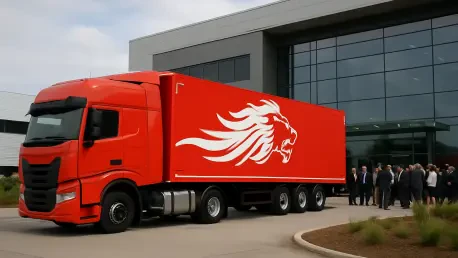

The sight of a single truck navigating a narrow English lane rarely signals a global economic shift, yet the evolution of a firm’s identity can define the future of international trade. At its sprawling headquarters in Dartford, Kent, Europa Worldwide Group recently gathered industry leaders and partners to celebrate its 60th anniversary. This diamond jubilee served as the backdrop for a major reveal: a bold new corporate livery and brand identity. Far from a simple cosmetic update, this transformation represents the culmination of a decade-long journey from a respected regional carrier to a formidable global powerhouse.
From Regional Carrier to Global Powerhouse: A Diamond Jubilee Transformation
The logistics industry often operates in the shadows, yet its efficiency dictates the pulse of the global economy. For Europa Worldwide, the last sixty years have served as a grueling but rewarding climb toward the top of the British transport sector. This anniversary event showcased more than just new paint on a fleet of trucks; it highlighted a fundamental shift in how the company perceives its role on the world stage. By transitioning from a localized operator into an international titan, the firm has proven that heritage and agility can coexist in a rapidly changing marketplace.
This metamorphosis is particularly striking given the myriad of challenges that have faced the sector recently. From fluctuating fuel prices to shifting geopolitical alliances, the company has managed to maintain its upward trajectory through sheer operational discipline. The unveiling of the new brand identity signifies a departure from the old guard, ushering in an era where the firm stands as a primary architect of supply chain reliability. It is a testament to the idea that longevity is not just about surviving time, but about mastering the art of the pivot.
A Decade of Unprecedented Growth Amidst Global Volatility
To grasp the magnitude of this rebranding, one must evaluate the company’s trajectory since CEO Andrew Baxter took ownership over ten years ago. Under his visionary leadership, the firm has achieved a staggering feat by quadrupling in size over the last 13 years. This period of expansion occurred while the broader industry grappled with some of the most turbulent economic conditions in modern history. The group’s ability to scale aggressively while others retreated into survival mode has redefined what it means to be an independent player in the logistics field.
The success of this growth strategy lies in a refusal to be intimidated by the complexities of international trade. While competitors viewed global volatility as a barrier, the leadership at Europa saw it as an opportunity to gain market share through superior service and infrastructure. Today, the company employs 1,300 people across 30 global sites, operating in 160 countries. This scale provides a critical case study in resilience, demonstrating that a heritage brand can maintain its core values while expanding its reach across every continent.
The Powered by Better Manifesto and the Three Pillars of Excellence
The new “Powered by Better” strategy serves as the conceptual heartbeat of the rebranding effort. This manifesto was meticulously designed to cement the company’s position as the essential link between the United Kingdom and the European Union. The identity rests on three specific operational pillars: delivering smarter logistical solutions, providing a “wow” factor in every customer interaction, and maintaining a competitive edge through value-driven results. This framework ensures that every employee, from the warehouse floor to the executive suite, is aligned with a singular vision of excellence.
Central to this philosophy is the concept of “marginal gains.” This approach, popularized in high-performance sports, suggests that small, incremental improvements across every department culminate in a massive, market-leading advantage. Whether it is refining a customs protocol or optimizing a delivery route, the focus remains on being better today than yesterday. By institutionalizing this mindset, the firm has created an environment where innovation is constant, ensuring that they do not just meet industry standards but actively set them.
Mastering the Post-Brexit Landscape with Proprietary Technology
The company’s recent dominance is largely credited to its proactive stance on shifting trade regulations. While much of the industry was paralyzed by the new customs requirements between the UK and the EU, Europa invested heavily in “Europa Flow.” This specialized, proprietary software system was engineered to facilitate frictionless delivery by automating complex paperwork and tax requirements. This technological leap has allowed the road freight division to move over £11.2 billion worth of goods since 2020, positioning the firm as a vital bridge for exporters who require certainty in an uncertain world.
Beyond its software achievements, the group has diversified its physical assets to support a truly end-to-end global supply chain. The company now manages over one million square feet of automated and manual fulfillment space across major UK hubs, providing a cushion against labor shortages and inventory fluctuations. Furthermore, the Air & Sea division has rapidly expanded its footprint, establishing strategic hubs in the UAE, China, India, and Hong Kong. This blend of digital innovation and physical infrastructure allows the firm to offer a unique money-back guarantee, a rarity in the high-stakes world of international freight.
A Strategic Framework for Navigating Future Trade Corridors
As the global trade map continues to redraw itself, the firm’s transition offers a practical blueprint for the next generation of logistics providers. The strategic framework established here combines deep-seated domestic customs expertise with a footprint that touches every major emerging market. By maintaining independent ownership, the company has retained the freedom to invest in long-term technological solutions rather than being beholden to short-term shareholder demands. This autonomy has been the secret ingredient in their ability to outpace larger, more rigid competitors.
The “Powered by Better” campaign went beyond a simple visual update; it functioned as a declaration of intent for the coming decades. Moving forward, the focus shifted toward deepening investments in automation and expanding reach into the Indo-Pacific trade corridors. Organizations looking to replicate this success would do well to prioritize the integration of customs technology early in their expansion phase. By bridging the gap between old-world reliability and new-world innovation, the firm ensured its relevance for the next sixty years of global commerce.