
The modern distribution center has become a high-stakes battlefield where the relentless demand for lightning-fast delivery speeds frequently crashes against the hard physical reality of skyrocketing urban real estate costs. As logistics providers struggle to keep pace with consumer expectations, the available floor space in prime locations has effectively become a vanishing commodity. This spatial crisis forces a difficult choice: either invest in massive, sprawling facilities far from customer hubs or find a way to do significantly more with significantly less. Historically, the industry accepted a direct correlation between high-volume output and a massive equipment footprint, but that compromise is no longer sustainable in a market defined by scarcity.
The Vanishing Square Foot: Solving the Logistics Space Crisis
The paradox of modern logistics lies in the widening gap between the soaring demand for localized fulfillment and the dwindling availability of affordable warehouse space. As companies move closer to metropolitan centers to facilitate “same-day” shipping, they find themselves operating in facilities with fixed walls and premium price tags. This shift has turned “densification” into the primary metric for any future-proof distribution strategy. A system that can process ten thousand items an hour is no longer an asset if it requires a football field of space to operate.
Traditional sortation systems were designed for a different age, one where land was cheap and retail replenishment was the dominant workflow. These legacy machines often utilized expansive loops that traded physical length for sorting capacity. However, in the current landscape, the ability to compress these operations is the only way to maintain profitability. By focusing on verticality and condensed exit points, innovators are moving toward a model where every square foot of a facility must justify its cost through extreme productivity.
Navigating the Pressures of Modern E-Commerce Fulfillment
Order profiles have undergone a radical evolution, shifting from the predictable, massive waves of retail store replenishment to the granular complexity of individual consumer orders. Today, a sorter might need to manage thousands of unique destinations for orders containing only one or two items. This fragmentation creates a critical bottleneck known as “exit density.” When a traditional sorting loop lacks enough physical diversion points to match the number of active orders, the entire fulfillment process slows to a crawl, leading to missed shipping windows and increased labor costs.
The economic impacts of these shifting profiles are particularly visible in the rise of micro-fulfillment centers. These localized hubs require the same high-speed capabilities as massive regional hubs but must function within the footprint of a converted retail space or a small urban warehouse. Consequently, the bottleneck is no longer just about how fast an item travels down a conveyor; it is about how many distinct orders can be finalized simultaneously within a cramped environment. Without high-density exit technology, the promise of rapid urban delivery remains an expensive logistical nightmare.
Engineering the E-Sort: High-Throughput Efficiency in a Compact Frame
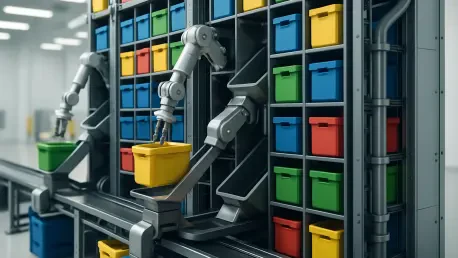
The E-Sort represents a fundamental mechanical bridge between high-speed loop sorters and intelligent “Smart Wall” technology, designed specifically to eliminate the traditional footprint penalty. By integrating a modular put wall directly into the sortation flow, the system achieves an unprecedented density of nearly 100 exits within a mere three-meter linear span. This engineering feat allows warehouses to multiply their sorting capacity without expanding their physical perimeter, effectively miniaturizing the most space-intensive part of the fulfillment cycle.
Modularity serves as the backbone of this design, allowing operators to customize exit sizes and pocket configurations to match their specific Stock Keeping Unit (SKU) profiles. Whether a facility handles small cosmetics or bulky electronics, the system can be adjusted to ensure that no space is wasted on oversized chutes. Furthermore, the E-Sort offers flexible workflow integration, allowing companies to choose between direct-to-pack stations for immediate fulfillment or mobile trolley systems that transport sorted batches to centralized packing zones.
The Expert Perspective: Insights from EuroSort’s Strategic Leadership
Gerbrand van Schooneveld, EuroSort’s Technical Strategic Sales Manager, views the E-Sort as the culmination of 25 years of technical evolution, particularly following the success of the Chute Pitch Reducer. He explains that the design philosophy centers on “Simple Technology,” which prioritizes standardized components to reduce mechanical complexity. By stripping away unnecessary bells and whistles, the system remains robust and easy to maintain, ensuring that downtime is kept to an absolute minimum even in high-pressure 24/7 environments.
This simplicity does not come at the expense of capability; rather, it enables a single machine to bridge the operational divide between disparate business models. Van Schooneveld notes that the breakthrough lies in the machine’s ability to manage the requirements of B2B, B2C, and returns processing on a single platform. This unified approach eliminates the need for redundant systems, allowing a warehouse to pivot between different fulfillment needs throughout the day without reconfiguring the entire floor.
Strategies for Implementing High-Density Automation
Successfully deploying high-density automation requires a clinical, data-driven analysis of annual volumes and picking labor to accurately calculate the potential Return on Investment (ROI). Many facilities find that by implementing the E-Sort, they can reduce their labor requirements for manual sorting by over 50% while simultaneously increasing their accuracy rates. Transitioning to a truly omnichannel platform involves using these modular frameworks to consolidate retail and e-commerce streams, which significantly simplifies the reverse logistics process for handled returns.
To optimize for physical constraints, managers should focus on retrofitting existing facilities with these high-density modules rather than seeking costly expansions or new construction. Practical steps include auditing current “dead zones” in the warehouse where legacy equipment takes up excessive space and replacing them with modular units that offer higher exit counts per square meter. This proactive approach allowed companies to reclaim valuable floor space for additional inventory, effectively turning their existing real estate into a much more powerful asset. The focus moved toward integrating smart software that synchronized the high-density hardware with real-time order demands, ensuring the facility remained agile in an unpredictable market. Organizations prioritized training internal maintenance teams on these standardized systems to foster self-sufficiency and long-term operational resilience.