
With decades of experience in management consulting, Marco Gaietti is a seasoned expert in Business Management. His expertise spans a broad range of areas, including strategic management, operations, and customer relations, with a particular focus on solving the complex material handling challenges that define the modern logistics landscape. Today, we delve into the common points of failure on conveyor lines—from chaotic transfer points to hazardous gaps—and explore how targeted engineering can bring predictability and safety to high-speed parcel operations. We’ll discuss how specific components not only prevent product damage and loss but also work together to create a more resilient, efficient, and safer logistics ecosystem.
Accumulation at conveyor transfer points often leads to damaged parcels. How do your segmented transfer plates prevent this pile-up, and what role does the bright yellow design play in day-to-day maintenance? Could you share a specific scenario where this has made a difference?
This is one of the most persistent headaches in the industry, especially in places like airports where the mix of luggage and parcels creates a perfect storm for jams. Our segmented transfer plates solve this by creating an incredibly smooth, low-friction surface. Instead of items catching and creating a bottleneck, they just glide seamlessly from one belt to the next. Think of it like a smooth slide versus a bumpy road. We’ve designed them to handle wide belts, up to 1,524 millimeters, and bridge common gaps from 75 to 250 millimeters. The bright yellow color is a simple but brilliant feature for maintenance. In a bustling, visually noisy facility, that yellow stands out. A technician can spot a worn or damaged segment from a distance during a routine walkthrough, long before it fails, and replace it in minutes. This turns a potential system-stopping disaster into a minor, preventative task.
Small items like polybags often get lost between rollers, leading to system jams. How exactly do your transfer plates solve this common issue, and could you walk us through the resulting improvements in both productivity metrics and employee safety?
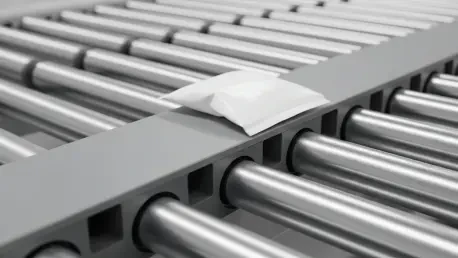
Ah, the dreaded polybag disappearance. It’s a classic problem; these small, flexible items slip into the gaps between rollers, causing the whole line to grind to a halt. Our Roller Conveyor Transfer Plates, or RCTPs, are essentially custom-fit covers that eliminate that gap entirely. By creating a continuous surface, there is simply nowhere for that envelope or small parcel to fall. The impact on productivity is immediate because you slash the number of unscheduled stops for jam-clearing. But the biggest win, in my opinion, is for safety. We no longer have employees needing to reach into the machinery, often while it’s still partially active, to fish out a stuck item. This drastically reduces the risk of hand injuries, which are unfortunately all too common. It’s a solution that protects both the product and the people handling it.
Open conveyor edges can cause product loss and expensive downtime. You developed a Belt Edge Protector using recycled UHMW. What makes this material ideal for the job, and how does its simple installation process directly contribute to minimizing unplanned operational stops?
Open edges are an invitation for trouble. Packages can easily get snagged, fall off, or get pulled underneath the belt, leading to damaged products and potentially wrecking the belt itself. We chose recycled UHMW for our Belt Edge Protector because it’s the perfect material for this application. It is exceptionally wear-resistant, so it can withstand constant contact with packages, but it’s also very slick, preventing items from catching on the edge. The fact that it’s recycled is an added bonus. Furthermore, we designed it for incredibly simple and quick installation. A maintenance team can fit it in individually adjustable lengths without needing specialized tools or extended downtime. This proactive installation means you prevent the problem from ever happening, turning what could be an expensive, unplanned shutdown into a non-issue.
You offer three distinct components for conveyor systems. Can you describe how the segmented plates, roller conveyor plates, and edge protectors work together in a real-world logistics system? Please elaborate on how this combination helps make maintenance work and operational downtime more predictable.
In a real-world distribution center, these three components create a truly cohesive and protected system. Imagine a parcel’s journey: it moves down a belt, protected from falling off by the Belt Edge Protectors on the sides. When it reaches a 90-degree turn or transfers to another belt, the Segmented Transfer Plates ensure it glides across the gap without tumbling or getting crushed. Then, as it moves onto a section of roller conveyors for sorting, the Roller Conveyor Transfer Plates prevent it from getting lost between the rollers. Each component addresses a specific, high-risk point of failure. By systematically eliminating these vulnerabilities, the entire operation becomes far more reliable. Downtime and maintenance are no longer chaotic emergencies; they become plannable, predictable events. This allows managers to keep costs low, maintain throughput, and uphold the highest safety standards across the facility.
What is your forecast for parcel logistics?
I believe the future of parcel logistics will be defined by a relentless pursuit of “micro-efficiency.” The days of accepting small, recurring problems like jams or product loss as a cost of doing business are over. Instead, the focus will shift to smart, targeted solutions that eliminate these minor points of friction, because at the scale of modern logistics, thousands of tiny improvements add up to massive gains in throughput, safety, and profitability. We will see more modular, easily replaceable components and a greater emphasis on creating systems that are not just fast, but fundamentally more reliable and safer for the workforce.