
With decades of experience in management consulting, Marco Gaietti is a seasoned expert in Business Management. His expertise spans a broad range of areas, including strategic management, operations, and customer relations. Today, we delve into a case study where a move to a new facility became the perfect catalyst for a complete logistics overhaul. The discussion will explore the practical challenges of material flow in a busy production environment, the critical role of human-machine collaboration, and how customized automation is not just a luxury but a necessity for specialized operations. We’ll also touch on how advanced safety features are making mixed-use warehouses safer and more efficient than ever before.
Your move to a new building was a catalyst for automating logistics. What specific material flow challenges did you face previously, and how do the two mobile robots directly address those inefficiencies between production, the warehouse, and shipping?
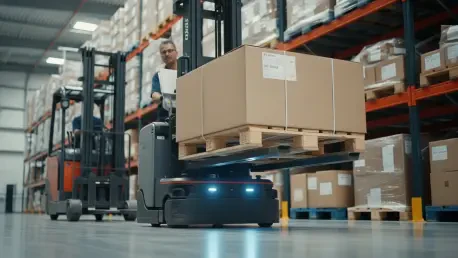
Moving to our new Roermond facility was the perfect opportunity to hit the reset button on our entire internal logistics process. Previously, our material flow was heavily dependent on manual transport, which created significant bottlenecks. We were constantly dealing with the strain of repetitive, heavy lifting, especially moving large pallets from goods receipt to production and then finished displays to shipping. These manual handoffs were not only slow but also created potential for error and injury. The two EKS 215a mobile robots have completely transformed this. They now handle these repetitive transport tasks autonomously, creating a seamless, predictable flow of materials. This has not only accelerated our processes but also freed our skilled forklift drivers from monotonous routes, allowing them to focus where their expertise is truly needed.
Your employees operate the mobile robots using a web-based tablet interface. Could you describe how this system works in practice and what steps you took to overcome the initial skepticism from forklift drivers?
The tablet interface was a game-changer for adoption. It’s a custom-configured, web-based system that is incredibly intuitive, meaning any employee can learn to dispatch the robots with minimal training. It feels less like operating heavy machinery and more like using a simple app. Initially, of course, there was skepticism. Our experienced forklift drivers saw these machines and wondered if they were being replaced. We addressed this head-on by involving them from day one, emphasizing that the robots were tools to help them, not replace them. The turning point was seeing the robots in action. One driver realized he could dispatch a robot to pick up a pallet of raw materials from the warehouse while he prepared a complex, urgent shipment, effectively being in two places at once. That’s when they stopped being “the robots” and started being seen as reliable “team players” that handle the grunt work.
The mobile robots were customized with a special multi-fork and advanced safety sensors. Why was it critical to handle oversized paper pallets, and how does the unique sensor technology that detects obstacles above the standard height work to ensure safety in your mixed-use environment?
Customization was absolutely non-negotiable for us. Our business revolves around large-format displays, which are built on oversized paper pallets measuring 1,600 by 1,200 millimeters. A standard mobile robot simply couldn’t handle our core materials. The specially developed multi-fork allows the EKS 215a to transport these massive pallets as easily as it does a standard Euro pallet. Equally critical was the advanced safety. Standard sensors only scan about 20 centimeters above the floor, but in a dynamic environment like ours, a forklift might have a slightly raised load or other obstacles could be present at a higher level. Our customized sensors monitor the surroundings above that usual detection height. If they detect a protruding load or any other unexpected object, the mobile robot immediately slows down or stops completely, preventing collisions that a standard system might miss. This was a first in the Netherlands and gives us immense confidence in running a safe, mixed-operation facility.
Implementing mobile robots has reportedly allowed employees to focus on more demanding activities. Can you provide specific examples of these higher-value tasks and describe how this shift in responsibility has impacted your team’s overall productivity and job satisfaction?
Absolutely. Before the mobile robots, a significant portion of a skilled operator’s day was spent simply driving pallets back and forth along the same routes. Now, that time is reallocated to tasks that require human problem-solving and expertise. For example, instead of just moving a pallet from A to B, our operators are now focused on quality control checks at goods receipt, optimizing warehouse storage for upcoming production runs, or preparing complex, multi-item shipments that require careful staging and verification. This shift has had a profound impact. Productivity has naturally increased because our most valuable assets—our people—are now focused on value-added work. More importantly, job satisfaction is up. The work is more engaging and less physically taxing, and our team feels they are contributing in a more meaningful way to the company’s success.
What is your forecast for the adoption of customized mobile robots in specialized manufacturing and logistics environments?
I believe we are moving past the era of one-size-fits-all automation. My forecast is that customized mobile robots will become the standard, not the exception, in specialized industries within the next five to ten years. Companies are realizing that off-the-shelf solutions can only take them so far. The real competitive advantage comes from automation that is tailored to their unique products, processes, and safety needs—whether it’s handling unusually shaped materials like our oversized pallets, navigating complex layouts, or integrating with bespoke software. As the technology becomes more flexible and integrators become more adept at creating these tailored solutions, we will see a surge in adoption. Businesses will no longer ask “if” they should automate, but “how” they can customize automation to unlock the next level of efficiency and safety in their specific niche.