
Marco Gaietti is a seasoned expert in business management and industrial operations with decades of experience navigating the complexities of logistics and customer relations. As global shipping volumes surge and consumer demands shift toward sustainable, rapid delivery, Marco has become a leading voice in how integrated automation can transform a warehouse from a cost center into a competitive advantage. His deep understanding of the intersection between mechanical automation and digital integration provides a unique lens through which to view the future of order fulfillment.
In this conversation, we explore the shift toward flexible packaging systems that adapt to real-time operational flows rather than forcing products into rigid templates. We discuss the elimination of “empty space” in shipping, the ergonomic advancements for warehouse staff through automated bag selection, and how modular architecture allows facilities to scale their technology as throughput needs evolve. Marco also sheds light on the role of collaborative robotics in modern palletizing and provides a strategic outlook for the e-commerce sector.
With shipping volumes increasing and orders becoming more fragmented, how does an integrated approach to packaging and palletizing specifically improve warehouse flexibility? What measurable results should a facility expect to see from day one when moving away from manual format selection processes?
In the modern e-commerce landscape, every order has become its own unique case, featuring different products, dimensions, and timing requirements. By integrating packaging and palletizing into a single, cohesive flow, we move away from a “one-size-fits-all” mentality and allow automation to adapt to the real flow of operations. From the very first day of implementation, a facility can expect to see a drastic reduction in the time wasted on manual format selection, which often acts as a massive drag on productivity. We see immediate improvements in operational efficiency and a significant optimization of packaging materials, as the system intelligently selects the right container for the right item. This eliminates the hidden costs associated with human error and mismatched packaging, ensuring that the warehouse remains agile even as order fragmentation increases.
The manual selection of paper bags often creates significant bottlenecks during fulfillment. When implementing a system that handles five different formats at high speeds, what ergonomic benefits do operators experience, and how does automated scanning ensure that material waste is minimized for every unique order?
Manual bagging is traditionally a repetitive, physically taxing process where operators must constantly search for the correct size, which leads to fatigue and slowdowns. Our automated solutions, like the SELECTA system, take that burden away by managing five different bag formats, ranging from 300×250 mm up to 600×450 mm. The system receives dimensional data—either from the management software or through a direct scan—and presents the opened bag to the operator in an optimized ergonomic position for quick loading. This allows the operator to focus solely on the product while the machine handles the picking, opening, sealing, and labeling. By using high-speed scanning to match the bag perfectly to the product, we achieve a throughput of up to 530 pieces per hour while ensuring that no excess material is wasted on oversized packaging.
Shipping empty space leads to higher costs and increased environmental impact. How does a continuous height-adjustment system for corrugated boxes function without requiring mechanical changeovers, and what role does modular architecture play in helping a warehouse scale its automation as throughput needs evolve over time?
Shipping “air” is a cost that the manufacturer, the distributor, and the planet ultimately pay, which is why we’ve moved toward continuous height adjustment. In a platform like ELEVA, the system reads the height of the product already inside the box and automatically adjusts the cardboard to fit that specific height without needing to stop for mechanical adjustments. This allows the line to process up to 600 units per hour while maintaining a steady flow of different box bases in sequence. The modular architecture is the backbone of this flexibility; it allows a warehouse to start with a single module, such as box erecting or labeling, and add others as their needs grow. This “plug-and-play” capability means that a business can configure its layout according to its current footprint while remaining ready to scale as its logistics volume intensifies.
Modern distribution requires handling variable flows of products with different dimensions. When integrating collaborative robots for palletizing, how does a simplified configuration interface reduce setup times, and what are the primary operational advantages of using these systems alongside human workers in high-speed logistics environments?
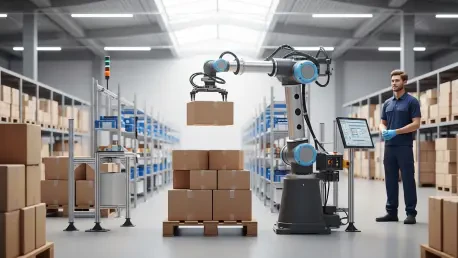
The RC12 collaborative palletizer is designed specifically to tackle the unpredictable nature of e-commerce flows where pallet patterns change constantly. By utilizing a simplified configuration interface, we enable warehouse staff to define new palletizing patterns in a matter of minutes, which virtually eliminates the downtime associated with traditional robotic programming. The primary advantage of this collaborative approach is that it allows the robot to take over the heavy, repetitive lifting and re-organization of pallets while working safely alongside human staff. This synergy boosts overall speed and reliability, ensuring that the final stage of the logistics chain is just as flexible as the packaging stage. It’s about creating a harmonious environment where the technology facilitates the transfer operations, allowing the human workers to manage the oversight and more complex tasks.
The market for automated e-commerce packaging is projected to grow by over 16% annually. Beyond just speed, how do these systems address the rising demand for traceability and accuracy, and what steps should companies take to ensure their automation strategy remains adaptable to future shipping standards?
While a 16% annual growth rate highlights the industry’s urgency, the true value lies in how automation secures the integrity of the data stream through every touchpoint. Modern systems integrate digital labeling and tracking directly into the packaging process, ensuring that every shipment is 100% accurate and fully traceable from the moment it is sealed. For a company to remain adaptable, their automation strategy must prioritize modularity and digital integration rather than rigid, static machinery. They should look for technology partners that offer platforms capable of evolving with new shipping standards and packaging materials. By investing in systems that can be reconfigured or updated through software, companies ensure their logistics centers don’t become obsolete as consumer expectations and environmental regulations continue to shift.
What is your forecast for e-commerce packaging automation?
I expect to see a total shift toward “on-demand” packaging where the machine and the product communicate in real-time to create a custom fit for every single order. As the market continues its double-digit growth, the line between the warehouse and the packaging line will blur even further, leading to fully autonomous loops that prioritize sustainability as much as speed. We will see a move away from discrete, separate machines toward fully integrated ecosystems that use AI to predict volume surges and adjust throughput automatically. Ultimately, the future belongs to modular, digital-first solutions that can handle the extreme variability of global commerce while reducing the carbon footprint of every box delivered to a customer’s doorstep.