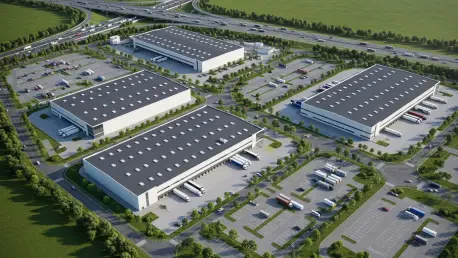

Marco Gaietti, a seasoned veteran in strategic management and operations, brings a wealth of experience in navigating the complexities of industrial efficiency and customer relations. His expertise is particularly vital as we analyze the newly completed Grade A logistics facility at Logistics City Milton Keynes, a project that signals a shift toward future-ready distribution. By examining the synergy between architectural precision and operational necessity, we gain a window into how the physical structures of our supply chains are evolving to meet unprecedented global demands. This conversation highlights the benchmarks of modern industrial real estate, where security, connectivity, and thermal integrity are no longer optional extras but the very foundation of successful commerce.
Our discussion explores the strategic advantages of hyper-connectivity within national distribution networks and the critical role of advanced security protocols in protecting high-value assets. We delve into the technical nuances of loading bay integration, highlighting how specialized equipment facilitates high-intensity movement without sacrificing safety. Furthermore, we address the essential infrastructure required for cold chain integrity, focusing on how thermal stability is maintained through innovative sealing technologies to support the growing needs of the food, pharmaceutical, and e-commerce sectors.
Logistics hubs located near major highway junctions often serve as the backbone for national distribution. How does the specific positioning of this new facility influence the speed and reach of a modern supply chain?
The strategic placement of a facility is the most influential factor in determining its operational heartbeat, and being just 1.9 miles from Junction 14 of the M1 is a massive tactical advantage. When you realize that 87% of the entire UK population can be reached within a 4.5-hour drive time, the facility moves from being a simple storage unit to a high-velocity distribution engine. This proximity drastically reduces the “first-mile” friction that often plagues logistics, allowing for more frequent rotations and tighter delivery windows. In an era where consumers expect near-instant fulfillment, cutting down transit time to major arteries is essential for maintaining a competitive edge. This specific location ensures that goods are not just sitting in a warehouse, but are actively moving toward their destination with minimal delay, which is the ultimate goal of any efficient supply chain.
Security has moved from a peripheral concern to a primary design driver in industrial real estate. Could you elaborate on how the architectural choices here reflect the need for enhanced asset protection?
We are seeing a significant shift where the building envelope itself must act as a sophisticated security barrier, and the use of the Crawford OH1042P Secured by Design doors is a perfect example of this. These aren’t just standard entrances; they are engineered with dual cylinder locks and are over four meters wide, providing a formidable defense against unauthorized access while remaining incredibly functional. The fact that the locking system is installed internally allows for a controlled environment where access can be restricted to the inside only, which is a critical feature for high-value cargo. Beyond just the locks, the use of deadman down operations ensures that every closing cycle is controlled with precision, preventing accidental openings or security lapses during the hectic pace of daily operations. It creates a sense of resilience that gives operators peace of mind, knowing that their physical assets are protected by a building that was literally designed for security.
With 14 loading bays designed for high-intensity use, how does the integration of specialized docking technology improve the daily flow and safety of a busy distribution center?
Managing 14 loading bays—consisting of 10 standard and four tall bays—requires a seamless synchronization of technology and human effort to avoid bottlenecks. Each bay is a microcosm of efficiency, utilizing telescopic lip dock levellers like the ASSA ABLOY DL6220T to bridge the gap between the warehouse floor and various vehicle types with absolute precision. We also have to look at the sensory details that keep workers safe, such as the external traffic lights and internal dock lighting that provide clear, visual communication in a noisy environment. The inclusion of dock buffers and wheel guides might seem like small additions, but they are vital for ensuring vehicles are positioned accurately every single time, which minimizes the risk of structural damage or personal injury. It’s this level of integrated engineering that allows a facility to handle high-intensity throughput day and night without the wheels coming off the operation.
Cold chain integrity is becoming increasingly vital for the pharmaceutical and food sectors. What specific infrastructure choices allow a facility like this to maintain strict temperature controls during the loading process?
The cold chain is only as strong as its weakest link, which is almost always the point where the vehicle meets the building. To combat this, the installation of DS6070R inflatable dock shelters is a game-changer because they create a near-perfect seal around the docked vehicle, virtually eliminating thermal exchange. The roller-top design is particularly impressive as it automatically adapts to the height of the truck, ensuring that whether a driver is bringing in a small van or a tall trailer, the temperature stability inside remains uncompromised. Even during the vertical movement that happens naturally as a vehicle is being loaded or unloaded, the inflatable system follows that motion to maintain a tight seal against the elements. This level of protection is essential for protecting sensitive goods from spoilage and ensures that the facility meets the rigorous standards required by modern pharmaceutical and e-commerce logistics.
What is your forecast for the evolution of these “Logistics City” concepts as we look toward the end of this decade?
My forecast is that we will see a complete move away from the “four walls and a roof” mentality toward these highly engineered, intelligent environments that we see emerging in the 2025 completion of the Milton Keynes site. As supply chains become more fragmented and specialized, the demand for facilities that can provide “plug-and-play” cold chain and high-security infrastructure will skyrocket. We will likely see even more automation integrated into the building’s envelope, where the doors, levellers, and climate systems are all part of a singular, data-driven ecosystem. Resilience will be the primary currency, and developers who invest in high-specification environments like this today will find themselves miles ahead of those who stuck to traditional warehousing models. Ultimately, the future belongs to facilities that can protect product integrity and optimize human efficiency through superior engineering and strategic connectivity.