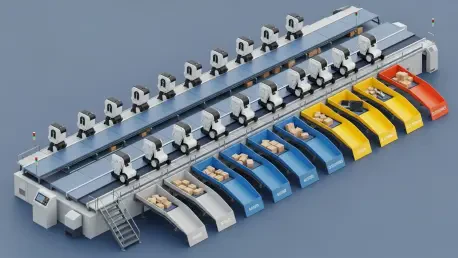

The logistics industry currently faces a volatile landscape where consumer expectations for rapid delivery meet the increasingly complex demands of global supply chain management. In this high-pressure environment, traditional warehouse fulfillment methods often buckle under the weight of seasonal spikes and the sheer volume of diverse stock-keeping units across beauty, nutrition, and electronics sectors. THG Fulfil has addressed these structural challenges by fundamentally reimagining its internal operations through a strategic partnership with Libiao Robotics. By pivoting away from rigid, legacy infrastructure, the organization has integrated an intelligent sorting ecosystem that prioritizes flexibility and speed. This transformation is not merely about replacing human labor but about augmenting existing workflows to ensure that high-velocity trading periods are handled with unprecedented precision. As global commerce continues to accelerate through 2026 and beyond, this shift toward modular automation marks a critical turning point for large-scale logistics providers seeking to maintain a competitive edge.
Technical Integration and the Robotics-as-a-Service Model
The technological backbone of this logistical evolution rests upon the deployment of 430 autonomous robots and 80 Libiao 3D sorters, which together manage over 3,800 unique sortation destinations. Central to the success of this rollout was the adoption of a Robotics-as-a-Service (RaaS) financial model, which enabled the company to scale its automated capacity without the heavy burden of massive upfront capital expenditure. This approach allowed for a remarkably rapid deployment cycle; the entire robotic suite achieved full compatibility with the existing Warehouse Management System in just 35 days. Within a week of going live, the facility reached its full volume capacity, demonstrating the plug-and-play nature of modern robotic hardware. This level of technical agility is essential for modern enterprises that must adapt to fluctuating market conditions without being tethered to permanent, immovable conveyor systems. The system’s ability to seamlessly communicate with proprietary software ensures that every unit is tracked with absolute transparency.
Measurable Gains in Operational Throughput and Accuracy
Quantifiable results from the recent integration highlight a dramatic shift in operational efficiency, as daily sortation capacity at primary facilities rose from 250,000 units to a staggering 625,000 units. The robotic fleet consistently delivers a throughput increase of more than 11,000 units per hour, which effectively represents a 34% improvement over the initial performance benchmarks set during the planning phase. Beyond sheer speed, the system maintains a 99.9% accuracy rate and nearly perfect uptime, virtually eliminating the costly errors associated with manual sorting processes. This reliability has tangible impacts on customer satisfaction, enabling late-night dispatch cut-offs as late as 1:00 AM, a feat that would be nearly impossible under traditional labor-intensive models. Furthermore, the automation has allowed for the reallocation of 45 full-time equivalent positions at specific volume tiers, significantly lowering the overall cost-to-serve. These optimizations prove that precision and volume can coexist when advanced machine learning is applied to the physical movement of goods across a facility floor.
Strategic Directions for Scalable Global Fulfillment
In light of these successes, the transition toward highly modular and intelligent automation moved beyond internal improvements to position THG Fulfil as a central figure in the distribution of Libiao Robotics technology. The integration of AI-driven fulfillment software with an expansive network of over 250 courier partners created a cohesive global solution that mitigated traditional operational risks. For stakeholders looking to replicate this success, the primary takeaway was the necessity of balancing human expertise with technological precision through flexible hardware. Moving forward, logistics leaders should prioritize investments in systems that offer rapid deployment and minimal structural modification to existing warehouses. The focus shifted from static, permanent automation toward dynamic ecosystems that could be expanded or reconfigured based on real-time data. By adopting such a forward-looking perspective, organizations ensured that their supply chains remained resilient. This strategic evolution successfully bridged the gap between complex logistical requirements and the necessity for lean global operations.