
The landscape of modern logistics is undergoing a significant transformation as companies seek a balance between high-performance capabilities and the practical economic realities of medium-intensity operations. While the industry has often focused on heavy-duty machinery designed for around-the-clock cycles, a substantial segment of the market requires equipment that is both agile and cost-effective for standard single- or double-shift schedules. Linde Material Handling has addressed this specific demand by introducing the Ri series, featuring the Ri14 through Ri18 models, which effectively bridges the gap between basic utility vehicles and premium specialized reach trucks. These new models are engineered to provide the same level of reliability and safety expected from a market leader while optimizing the total cost of ownership for businesses in the retail, automotive, and food distribution sectors. By focusing on essential performance metrics rather than unnecessary complexity, this series offers a streamlined solution for modern warehousing challenges.
Optimizing Space and Performance in Modern Warehouses
Engineering for Compact Maneuverability
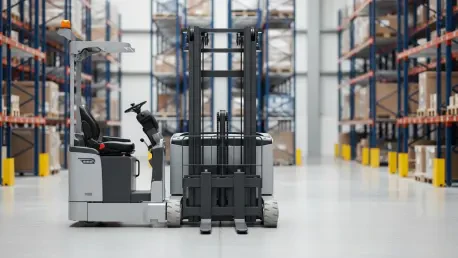
The architectural foundation of the Ri series is built upon a radical commitment to spatial efficiency, allowing these trucks to thrive in increasingly congested warehouse environments. By integrating lithium-ion technology as a core design element rather than a secondary modification, engineers have successfully reduced the chassis length to a mere 1,215 millimeters. This compact footprint, paired with a remarkably tight turning radius, enables operators to navigate narrow aisles with a degree of precision that was previously difficult to achieve in this load class. Such agility is crucial for companies attempting to maximize storage density without investing in expensive warehouse reconfigurations or specialized very-narrow-aisle equipment. The ability to pivot effortlessly within block or rack storage systems ensures that every square foot of the facility remains accessible, directly contributing to higher operational efficiency and more flexible inventory management strategies for growing businesses.
Beyond mere physical dimensions, the performance profile of these trucks is specifically tuned to maximize pallet throughput during critical peak periods. Despite their small stature, the Ri14 to Ri18 models offer impressive lift heights of up to 11 meters, supported by high-stability mast designs that maintain significant residual load capacities even at full extension. To further enhance productivity, operators can utilize optional PowerDrive and PowerLift packages, which increase travel and lifting speeds by up to 18 and 16 percent, respectively. This hardware-driven boost allows for faster replenishment and retrieval cycles, ensuring that logistical bottlenecks are minimized during high-demand windows. Control is maintained through the Linde Load Control system, which provides millimeter-precise handling of all mast functions, while the iconic dual pedal system remains a standard feature to facilitate rapid, intuitive changes in travel direction without tiring the driver.
Driving Throughput With Advanced Technology
The digital infrastructure of the Ri series serves as a backbone for performance optimization, integrating the vehicles seamlessly into the broader logistical ecosystem of a modern facility. These trucks feature a contemporary electronic architecture that supports over-the-air software updates, allowing companies to maintain their fleet at peak efficiency without the need for physical service interventions. This connectivity ensures that the latest performance calibrations and safety protocols are always active, protecting the long-term value of the investment. Moreover, the trucks are equipped with energy-efficient lithium-ion batteries, with a standard 14.3 kWh unit that can be upgraded to 21.4 kWh for operations with higher power requirements. The inclusion of opportunity charging means that vehicles can be quickly topped up during breaks, virtually eliminating the downtime associated with traditional battery swaps and ensuring that the fleet is always ready for action.
Maintenance-free components and robust engineering further distinguish these reach trucks as high-value assets for companies prioritizing operational uptime and low long-term costs. The use of induction-hardened mast guide rails and other wear-resistant materials reduces the frequency of service intervals, allowing the equipment to stay on the floor where it is most productive. This focus on durability does not come at the expense of precision; the hydraulic systems are calibrated to provide smooth, jerk-free movements even when handling sensitive or fragile goods at significant heights. By combining these mechanical strengths with sophisticated software controls, the Ri series offers a balanced approach to material handling that emphasizes both speed and stability. Consequently, businesses can achieve higher throughput rates while maintaining the integrity of their stock, ultimately leading to a more streamlined and profitable supply chain operation that can adapt to changing market conditions.
Prioritizing Driver Safety and Operational Longevity
Innovative Safety Systems for Personnel Protection
Safety remains a non-negotiable priority in the design of the Ri series, which incorporates advanced protective technologies that were once reserved only for the most expensive heavy-duty models. A standout feature is the all-wheel hydraulic braking system, which provides consistent and short braking distances regardless of the load weight or the current mast elevation. This is complemented by the Linde Curve Assist system, which is included as standard equipment to automatically moderate the vehicle’s speed during cornering based on the steering angle. By preventing high-speed turns that could lead to load shifts or vehicle instability, these systems significantly reduce the risk of workplace accidents and damage to valuable goods. Furthermore, the inclusion of the Linde Safety Guard option provides an active warning system that alerts drivers and pedestrians to potential collisions, creating a safer shared environment within busy distribution centers.
In addition to preventing vehicle-related accidents, the Ri series is designed to protect the very infrastructure it operates within through specialized sensing technology. The Rack Protection Sensor is a particularly valuable addition for high-density storage environments, as it helps prevent accidental collisions with racking uprights during the delicate process of pallet retrieval or storage. Structural enhancements, such as a reinforced glass roof for superior upward visibility and dedicated shoulder guard protection, ensure that the operator is shielded from falling objects while maintaining a clear line of sight to the task at hand. This comprehensive approach to safety does more than just protect individuals; it minimizes the financial impact of equipment downtime and infrastructure repairs. By fostering a secure working environment, companies can maintain a steady operational rhythm, reduce insurance liabilities, and demonstrate a commitment to the well-being of their workforce in a competitive labor market.
Ergonomic Design and Operator Wellness
Operator comfort is a primary driver of productivity, and the Ri series addresses this through a fully decoupled workstation that significantly reduces the physical toll of long shifts. By isolating the operator’s cabin from the main chassis, the truck effectively absorbs the vibrations and shocks caused by uneven warehouse floors or high-speed travel. This engineering choice, paired with a suspension-mounted seat and an adjustable steering column, allows each driver to customize their environment for optimal posture and comfort. A low, wide entry step with a non-slip surface further enhances accessibility, making it easier for drivers to mount and dismount the vehicle repeatedly throughout the day. These ergonomic features are essential for preventing chronic musculoskeletal issues and fatigue, ensuring that operators remain alert and efficient from the beginning of their shift until the end, regardless of the workload.
The integration of intuitive controls and high-visibility displays ensures that the operator remains in full command of the vehicle with minimal cognitive load. All primary mast functions are grouped within easy reach, allowing for precise adjustments without the need for repetitive or awkward stretching. This focus on user-centric design extends to the cabin’s layout, which provides ample legroom and storage for essential tools or personal items. By reducing the physical and mental strain associated with reach truck operation, the Ri series helps businesses improve employee retention and reduce the likelihood of errors caused by exhaustion. The ultimate result is a more harmonious interaction between man and machine, where technology serves to enhance human capability rather than complicate it. This investment in ergonomic excellence proved to be a decisive factor for companies looking to modernize their fleets while maintaining a high standard of operational performance and employee satisfaction.