
A seemingly minor system update is deployed without warning, and within hours, the customer portal grinds to a halt while two separate departments find themselves locked out of their critical data—a catastrophic but entirely preventable scenario. This kind of operational chaos plays out daily in organizations where changes, though constant and necessary, lack the structured oversight required to prevent conflicts and cascading failures. Change control management provides the essential framework to formally evaluate, approve, and track every modification across the business ecosystem. It establishes a crucial balance between necessary adaptation and operational stability, ensuring that every implemented change genuinely improves processes and systems instead of inadvertently breaking them. This approach transforms change from a source of risk into a well-managed driver of progress, enabling organizations to evolve confidently and predictably.
1. Understanding the Core Principles of Change Control
Change control management is the systematic and formalized process organizations use to direct and manage the lifecycle of all modifications to projects, systems, processes, or products. Rather than allowing ad-hoc adjustments, it creates a defined pathway where every proposed change is documented, assessed for its potential impacts, reviewed by authorized decision-makers, implemented in a controlled environment, and finally verified to confirm its success. This disciplined approach is not confined to a single industry; it is a universal principle of operational excellence. In IT environments, it governs system updates and software deployments to prevent outages. In construction, it manages design alterations and material substitutions to maintain project integrity. In manufacturing, it controls updates to production processes and equipment to uphold quality standards. The foundation of great change control rests on standardized request forms that capture all necessary details from the outset, allowing teams to apply the right level of scrutiny based on risk and ensuring that every modification leaves a clear and comprehensive audit trail from conception to closure.
A common point of confusion is the distinction between change control and change management, which are often used interchangeably despite being fundamentally different disciplines. Change control is tactical, focusing on the process governance and approval workflows for specific, individual modifications. It answers the practical, technical questions: What exactly is being changed? Who needs to approve it? How will it be implemented without causing disruption? In contrast, change management operates at a much broader, strategic level, addressing the human dimension of organizational transitions. It concerns itself with how a change will affect people, what cultural resistance might arise, and how to build the necessary support, communication, and training to ensure successful adoption. These two disciplines are not competitors but partners in achieving successful organizational evolution. Change control provides the rigid, structural framework for implementing modifications correctly, while change management offers the flexible, human-centric framework to ensure those changes are embraced and utilized effectively by the people they impact.
2. The Business Case for Structured Change Oversight
In organizations lacking formal change control, uncontrolled modifications frequently become the root cause of significant operational disruptions and financial losses. The absence of a centralized review process allows for conflicting changes to be implemented simultaneously, leading to debilitating system outages that can impact customers and internal teams alike. Furthermore, unapproved scope changes, often introduced informally, can quietly consume project budgets and push deadlines far beyond their original targets, jeopardizing strategic initiatives. Without a thorough impact assessment, a seemingly simple change in one area can trigger a cascade of downstream problems in another, requiring expensive and time-consuming remediation efforts. This environment forces teams into a perpetual state of reactive firefighting, where resources are constantly diverted from innovation to fixing preventable errors. The lack of visibility and coordination means that teams operate in silos, unaware of how their actions might negatively affect the broader organization until it is too late.
Implementing a robust change control management system delivers tangible business outcomes that directly enhance organizational performance and resilience. By requiring formal evaluation, it prevents poorly conceived or strategically misaligned changes from ever proceeding, while its structured implementation protocols drastically reduce execution errors, leading to significantly higher project success rates. The mandatory impact assessment phase shifts the organization from a reactive to a proactive stance on risk mitigation, revealing critical dependencies and potential conflicts that would otherwise go unnoticed. This foresight allows for intelligent resource allocation, as leadership gains a clear, enterprise-wide view of all pending and in-progress changes, enabling them to prioritize initiatives that deliver the most value. Ultimately, a centralized review process ensures that every modification is evaluated not just on its technical merits but also on its alignment with overarching strategic priorities, fostering a culture of disciplined execution and accountability across all departments.
3. Navigating the Five Essential Stages of the Process
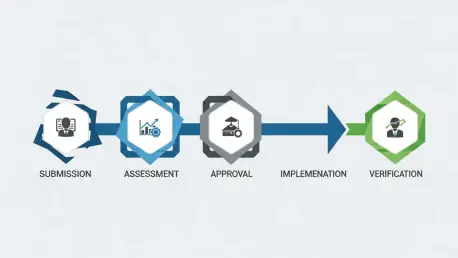
An effective change control process unfolds across a structured, five-stage lifecycle that ensures every modification receives the appropriate level of evaluation and oversight. The journey begins with the first stage, change request submission, where an individual or team identifies a need and submits a formal proposal. To enable a proper assessment, this initial request must capture comprehensive information, including a detailed description of the change, a clear business justification, the expected benefits, an analysis of potential risks, and the required resources. Following submission is the second stage, impact assessment, which is a critical evaluation of the change’s implications across multiple dimensions. Technical experts examine system dependencies and potential conflicts, while business stakeholders assess cost implications, timeline impacts, and alignment with organizational goals. This thorough analysis surfaces potential issues early in the process, when they are far easier and less costly to address, culminating in a comprehensive impact statement that informs all subsequent decisions.
Once the impact assessment is complete, the change moves to the third stage, review and approval, where stakeholders with the appropriate authority make a formal decision. Approval workflows are typically tiered, routing changes based on predefined criteria such as risk level, cost, and affected systems. Low-risk changes might only require a manager’s sign-off, whereas high-risk modifications may demand review by a formal change advisory board or even executive leadership. Upon approval, the change enters the fourth stage, implementation, which is executed in a controlled manner according to the agreed-upon plan. This stage includes critical controls like rigorous testing procedures to verify functionality, detailed rollback plans to provide a safe exit strategy in case of failure, and continuous progress monitoring. The lifecycle concludes with the fifth stage, verification and closure. Here, a post-implementation review confirms that the change delivered its intended benefits without creating unintended negative consequences. All relevant documentation is updated to reflect the new state, and lessons learned are captured to refine and improve the change control process over time.
4. Building a Robust and Scalable System
Establishing an effective change control infrastructure requires creating both the necessary organizational structures and the supporting technical systems. The cornerstone of the organizational component is the change control board (CCB), also known as a change advisory board (CAB), which serves as the primary decision-making body for changes that require cross-functional review and approval. The composition of this board is critical; it must include representatives from diverse areas such as IT operations, development, security, key business units, and project management to ensure that decisions are well-rounded and consider all potential impacts. The board should be chaired by a facilitator who can guide discussions and ensure timely decisions, and its members must possess sufficient authority to approve changes within their domain, which promotes an efficient review process. The board’s operating rhythm, typically weekly meetings, should be established, along with clear procedures for handling emergency changes that cannot wait for a scheduled review.
Alongside the organizational framework, the technical components must be designed to facilitate a smooth and efficient process. This begins with creating standardized request forms that are designed to collect all critical information needed for a comprehensive review while remaining straightforward enough for submitters to complete without undue burden. These forms should capture essential fields like a change description, business justification, implementation plan, risk assessment, and a list of affected systems. To manage the flow of these requests, efficient approval workflows are paramount. These workflows should incorporate risk-based routing to automatically send changes to the appropriate approvers based on their complexity and potential impact. Utilizing parallel approval paths, where multiple stakeholders can review simultaneously, can significantly accelerate processing times. Furthermore, comprehensive documentation requirements must be established to create a clear audit trail for compliance, enable organizational learning, and provide critical context for future changes.
5. A Practical Seven-Step Implementation Roadmap
Implementing a formal change control system is a gradual process of building structure and reinforcing it over time, not an overnight transformation. The journey begins with the first step: evaluating current change processes. Most organizations already have informal, often undocumented and inconsistent, methods for handling changes. A thorough assessment of this current state reveals what is working, what is broken, and where critical gaps exist. The next step is to categorize change types, recognizing that not all modifications carry the same level of risk. Changes are typically grouped into categories such as standard (pre-approved, low-risk), normal (requiring formal review), emergency (urgent fixes with an expedited process), and major (high-impact changes needing extensive review). With this framework in place, the third step is to formally constitute the change control board. This governance body, with members from key stakeholder groups, provides the central authority for reviewing and approving non-standard changes, and defining its operating procedures is essential for consistent decision-making.
Once the foundational elements are established, the next phase involves operationalizing the system. The fourth step is to develop standardized change procedures for each category, specifying the requirements for requests, documentation, evaluation, approval, and implementation. Following this, the fifth step is to create the approval workflows that translate these procedures into action, defining how requests move from submission to decision. These workflows should be automated where possible to route requests, send notifications, and escalate pending approvals. The sixth step is to deploy a robust tracking system. This central platform provides enterprise-wide visibility into all changes, allowing anyone to see a change’s status, owner, and timeline, thereby eliminating the “black box” effect of opaque approval processes. Finally, the seventh step is to train and monitor. Successful adoption requires training teams on both the new processes and the systems that support them. Performance must then be continuously monitored through key metrics like approval cycle time and change success rates to identify bottlenecks and drive ongoing improvement.
6. Leveraging Artificial Intelligence for Advanced Change Management
As an organization’s change volume grows into the hundreds or thousands, manual review processes and spreadsheets inevitably break down, creating bottlenecks that stifle innovation. This is the point where artificial intelligence transitions from a futuristic concept to a practical necessity, transforming a labor-intensive change control process into a smart, scalable system. A primary application of AI is in automated risk detection. By analyzing the content of new change requests, AI algorithms can automatically identify potential risks, conflicts, and dependencies that human reviewers might easily overlook. These systems can recognize when two different changes affect the same critical system simultaneously, flag changes scheduled during high-risk business periods, and identify patterns in a request that correlate with past implementation failures. This proactive identification of potential issues allows teams to address conflicts before they ever impact operations, shifting the entire paradigm from reactive problem-solving to predictive risk avoidance.
Beyond risk detection, AI enhances change control through intelligent approval routing and continuous compliance monitoring. Instead of relying on static, manually configured workflows, AI-powered routing algorithms can dynamically direct change requests to the most appropriate approvers based on a variety of factors, including the change category, the specific systems affected, the approvers’ areas of expertise, and even their current workload distribution. This ensures that requests reach the right decision-makers immediately, significantly accelerating approval cycles while also improving the quality of the review. In parallel, AI can continuously monitor all ongoing changes to ensure they adhere to internal governance policies and external regulatory requirements. Compliance monitoring algorithms can automatically flag when a change deviates from required procedures, is missing mandatory documentation, or has bypassed a necessary approval step. This provides real-time alerts, enabling immediate corrective action long before a minor violation could become a major issue discovered during a formal audit.
7. Achieving a State of Controlled Agility
The successful implementation of change control management transformed what was once organizational chaos into a model of structured execution. By adopting a disciplined framework, organizations prevented the costly failures and operational disruptions that had previously hindered progress, all while enabling the necessary adaptations to remain competitive. The five-stage lifecycle provided the foundational blueprint for every modification, ensuring consistency and thoroughness from request to closure. Following the practical seven-step implementation roadmap allowed for a progressive and non-disruptive rollout, building organizational capability and buy-in along the way. The subsequent integration of AI-driven capabilities then scaled these processes far beyond what manual systems could ever handle, introducing a level of proactive risk detection and efficiency that was previously unattainable.
Teams that embraced this structured approach to change gained a distinct competitive advantage. They found they could ship changes faster and with greater confidence, as the process eliminated ambiguity and minimized the risk of unforeseen errors. The visibility provided by a centralized system kept all stakeholders aligned with overarching business goals, ensuring that resources were always directed toward strategically valuable initiatives. Decisions were no longer second-guessed, as the ripple effects of each change had already been mapped and assessed. When it came time for implementation, teams followed battle-tested procedures that worked reliably. Ultimately, organizations discovered that a well-designed change control system did not slow innovation. On the contrary, it created the stable and predictable environment required for agile and ambitious transformation to flourish.