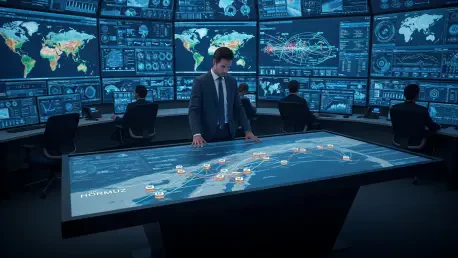

In the complex theater of global logistics, few figures possess the strategic foresight of Marco Gaietti. With decades of experience in management consulting and a deep mastery of operational resilience, Gaietti has guided countless multinational firms through the most turbulent market shifts of the last twenty years. Today, we sit down with him to discuss the escalating tensions in the Middle East and how the fragility of strategic chokepoints is forcing a total rethink of modern supply chain architecture.
Security concerns at the Strait of Hormuz have triggered a surge in insurance premiums and fuel costs. How are these overheads altering your routing decisions, and what specific risk-management protocols can firms implement to stabilize their logistics costs in this volatile environment?
The financial weight of these security concerns is heavy, as insurers are rapidly reassessing regional exposure and implementing war-risk surcharges that eat into thin margins. We are seeing a decisive shift toward contingency routing, where the immediate cost of a longer voyage is weighed against the catastrophic risk of a vessel being caught in a hot zone. To stabilize costs, firms must move away from reactive spot-market buying and instead implement rigorous risk-mitigation protocols that prioritize long-term carrier partnerships and fixed-rate insurance contracts. It is no longer enough to look at a map; logistics leaders must use real-time data to trigger “if-then” routing scenarios the moment a surcharge threshold is met. This proactive approach allows a company to absorb the sensory shock of a sudden price hike without paralyzing their entire distribution network.
Several global shipping lines have suspended non-essential cargo bookings to Gulf states like the UAE and Qatar. What operational hurdles does this create for businesses handling consumer goods, and what steps should they take to utilize inland gateways effectively?
The suspension of bookings announced on March 4, 2026, has sent a shockwave through the consumer goods sector, effectively halting the flow of everything except food and medicine for major hubs. This creates a massive inventory vacuum for retailers, who suddenly find their primary maritime lanes severed. To survive this, businesses must pivot their focus toward ports that remain operational, such as Jeddah, King Abdullah, and Salalah, which are currently serving as vital lifelines. By utilizing these locations as inland gateways, companies can truck goods across the peninsula, bypassing the restricted waters of the Gulf. It is a grueling, multi-modal process that requires intense coordination with local ground transporters, but it is currently the only way to keep the shelves from going empty.
Maritime traffic is currently experiencing staggered departures and slower transit speeds as vessels await security guidance. How does this “ripple effect” impact the reliability of global schedules, and what metrics should planners monitor to adjust their inventory lead times?
The “ripple effect” is subtle yet devastating, manifesting not as a visible line of ships, but as a ghost-like slowing of the global pulse where vessels hold position for security clearance. This lack of predictability destroys the “just-in-time” model, as a three-day delay in the Gulf can result in a two-week backlog at the final destination port. Planners must stop relying on historical transit data and instead monitor “vessel idle time” and “real-time schedule deviation” as their primary KPIs. When you see transit speeds dropping or departures being staggered, it is a sensory cue that the lead time must be padded by at least 15 to 20 percent immediately. Building these inventory buffers is the only way to protect the end-to-end supply chain from the inevitable delays born of caution.
Airspace restrictions in major Gulf hubs are currently limiting capacity for high-value shipments like electronics and pharmaceuticals. What alternative modes of transport, such as rail or sea-air combinations, are becoming more viable, and how should companies manage the resulting cost trade-offs?
When the skies over Dubai, Abu Dhabi, and Doha tighten, the impact on high-value sectors like pharmaceuticals is instantaneous because these goods cannot sit in a warehouse. We are seeing a renewed interest in sea-air combinations, where cargo is moved by ship to a safe port and then flown out of a non-restricted region, or even long-haul rail options where geography permits. The trade-off is inherently financial; air freight is already expensive, and restricted capacity makes it a premium luxury. Companies must conduct a ruthless “value-to-weight” analysis to decide which products justify the 3x or 4x cost increase of a multi-modal detour. It is a painful calculation, but for life-saving medicines or high-demand electronics, the cost of an empty shelf is always higher than the cost of a complex route.
The disruption of key transit corridors is raising concerns regarding the steady export of LNG and fertilizers. How might these interruptions destabilize global energy and agricultural markets, and what long-term sourcing strategies would you suggest to build resilience against these specific regional risks?
The potential interruption of LNG and fertilizer flows from the Gulf is a threat to both global energy security and the very foundation of the food supply chain. These are markets that are hypersensitive to flow; even a temporary bottleneck in the Strait of Hormuz can send global prices into a frantic upward spiral. To build resilience, I advise a strategy of geographical diversification, where firms purposefully source at least 30 percent of these critical raw materials from outside the Middle Eastern corridor. While the initial sourcing costs might be higher in more stable regions, this “resilience tax” serves as an insurance policy against regional volatility. Long-term stability depends on reducing the dependency on any single chokepoint, ensuring that a regional conflict does not become a global famine or energy crisis.
What is your forecast for Middle Eastern supply chain stability over the next year?
I expect the next twelve months to be defined by “persistent volatility,” where the threat of disruption remains as impactful as any actual closure of the waterways. We will see a permanent shift in how logistics networks are structured, moving away from a single-lane reliance to a web-like architecture that utilizes multiple ports and inland gateways. For the savvy professional, this means the era of cheap, easy logistics is over, and the era of strategic, data-driven resilience has begun. Success will go to those who treat their supply chain not as a cost center, but as a dynamic, living system that must be protected with constant vigilance and diversified routing.