
With decades of experience in management consulting and a deep focus on strategic operations, Marco Gaietti has become a leading voice in the evolution of business management. His work frequently explores the intersection of high-capacity logistics and consumer-driven demand, particularly in sectors where speed and freshness are non-negotiable. In this conversation, we delve into the transformation of modern distribution centers from simple storage hubs into the high-performance “first violins” of a global supply chain orchestra, examining the delicate balance between massive automation and the human culture required to steer it.
The following interview explores the operational intricacies of a major fresh logistics center, the technical challenges of managing millions of storage locations, and the shift toward end-to-end network optimization in retail.
Modern logistics centers are often described as the “first violin” in a supply chain orchestra rather than the conductor. How does this shift from a standalone buffer to an integrated organ change daily operations, and what metrics prove the consumer is actually setting the pace?
This shift represents a fundamental change in how we view the warehouse; it is no longer an isolated box at the end of a road but a living, breathing organ within a larger organism. In daily operations, this means the facility doesn’t just store goods until someone asks for them, but instead acts as a real-time control instrument that synchronizes with 725 stores across the Netherlands and Belgium. We see the consumer setting the pace through the sheer volume and variety of the 3,000 fresh items moving through our 40,000-square-meter facility every single day. The primary metric of success is the “just-in-time” dispatch from our automated shipping buffer, ensuring that the 1.06 million picking units we handle at peak capacity match the exact replenishment needs of the store shelves. By focusing on maximum availability and speed, the logistics center proves its value not by leading the strategy, but by flawlessly executing the demands dictated by the end shopper.
Managing 3,000 ultra-fresh items at 35 degrees Fahrenheit requires extreme agility. When weather shifts suddenly impact demand, what specific steps does the system take to ensure products reach the table without delay, and how do you handle the trade-offs between speed and waste?
Agility in our fresh logistics center is defined by our ability to respond to environmental variables, such as a sudden heatwave that spikes demand for salads and chilled beverages. When these shifts occur, our integrated WITRON warehouse management system recalibrates the flow across 670,000 storage locations to prioritize high-velocity items and ensure they move through the 30 COM machines without bottlenecking. We maintain a strict ambient temperature of +2 degrees Celsius (approximately 35 degrees Fahrenheit) throughout the entire picking and buffering process to protect the cold chain. To balance speed and waste, we utilize advanced forecast and replenishment processes that allow us to deliver exactly what the stores need, reducing the time products spend sitting in the warehouse. This “ultra-fresh” approach ensures that even sensitive products like fresh fish or meat reach the consumer’s table with maximum shelf life remaining, effectively turning speed into a tool for sustainability.
Massive facilities now utilize dozens of COM machines and over a million storage locations. How do you coordinate various subsystems to ensure roll containers are stacked according to a specific store’s shelf layout, and what are the mechanical challenges of maintaining such high-volume precision?
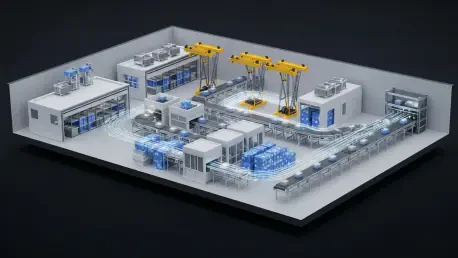
Coordination is achieved through a perfectly tuned overall concept where the OPM, AIO, and CPS modules work in a synchronized dance to consolidate different product types. We use more than 200 stacker cranes to pull items from over 1.1 million storage locations, ensuring that cases, pieces, and totes are merged into a single, store-friendly sequence. The mechanical challenge is immense, as we must maintain high-speed precision across a conveyor network that handles up to 1.6 million picks on a peak day across our combined dry and fresh sites. Each roll container must be stacked in a “store-friendly” manner, meaning the items are organized to match the specific aisle layout of the destination store to minimize handling for retail staff. This requires the IT system to calculate the optimal stacking order for stability and efficiency while the physical machinery executes those movements with millimeter accuracy in a cold environment.
Transitioning from manual labor to an automated production environment requires significant change management. How do daily shopfloor meetings and autonomous problem-solving impact employee morale, and what specific steps are taken to ensure the control room team can balance these complex systems during peak periods?
Moving from manual picking to an automated environment is a profound cultural shift, which is why we implemented the Jumbo Production System (JPS) based on lean principles. We hold a central control meeting every single day right in the heart of the work area, rather than in a distant office, to review the previous day’s performance and set goals for the next shift. This transparency and the half-hour spent on shift stand-ups foster a sense of ownership, allowing employees to engage in autonomous problem-solving rather than just following orders. During peak periods, our control room team relies on the deep expertise they gained through extensive exchanges with experienced users and WITRON’s global project teams. By treating the facility as a production plant rather than a traditional warehouse, our staff feels empowered to steer the technology, which keeps morale high even when we are pushing toward a capacity of over a million units a day.
Automation relies heavily on the quality of carton design, adhesives, and pallet stability. How do you work with suppliers to standardize packaging for thousands of different SKUs, and what happens to the material flow when a supplier fails to meet these technical requirements?
Standardization is the bedrock of automation, so we have dedicated teams who specialize in the technical nuances of packaging, from adhesive properties to the quality of stretch film. We take early action by providing clear transparency and training to our suppliers, ensuring they understand that a sub-par cardboard box can cause a significant stoppage in a system with 670,000 tray and tote locations. If a supplier fails to meet these requirements, it triggers an enhanced inbound control process where the non-standard items are identified before they enter the automated flow. This prevents unstable loads from causing mechanical failures or sensor errors within the COM machines or the conveyor network. By treating packaging as a core competence, we ensure that the thousands of different SKUs—ranging from tapas to dairy—move through the machinery with the stability required for high-speed automated picking.
The next phase of logistics involves moving beyond individual warehouses to end-to-end network optimization. How will integrating manual e-commerce channels into automated systems change your strategy, and what practical hurdles must be cleared to connect suppliers and transport routes into one seamless flow?
Our strategy is evolving to view the entire supply chain as a single, end-to-end network where automation is a tool for total optimization rather than an end in itself. Integrating e-commerce, which is currently handled manually, into our automated systems will require us to blend high-volume store replenishment with the granular, piece-picking needs of individual home deliveries. The practical hurdles involve creating a seamless data flow between our suppliers, the distribution center, and our transport routes to ensure that every “touch” of a product adds value. We are already moving toward this by consolidating processes that were previously direct-to-store, such as fresh fish, into our centralized hub in Nieuwegein. The next chapter will be about removing the silos between these channels, using our automated foundation to drive efficiency across the entire route from the supplier’s dock to the consumer’s front door.
What is your forecast for high-performance warehouse automation?
I believe we are entering an era where the distinction between “logistics” and “production” will completely disappear, as warehouses become highly sophisticated processing hubs that customize output for every individual store and customer. We will see a shift where automation is no longer judged by the number of machines, but by its ability to facilitate a “zero-buffer” supply chain where goods are constantly in motion and perfectly synchronized with real-time demand. My forecast is that the next five to ten years will focus heavily on end-to-end optimization, where AI-driven forecasting and fully automated transport routes connect directly to these hubs, making the supply chain nearly invisible to the consumer while providing unprecedented freshness. Success will belong to those who can marry this extreme technical precision with a strong corporate culture, ensuring that technology serves the human strategy rather than the other way around.