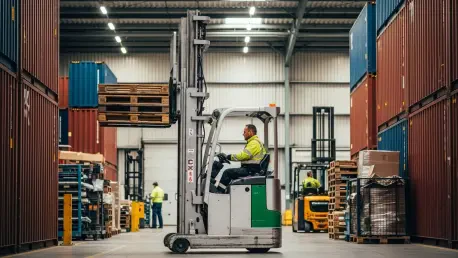

I’m thrilled to sit down with Marco Gaietti, a veteran in the field of business management with decades of experience shaping strategic operations and customer relations in the material handling industry. Today, we’re diving into the groundbreaking launch of a new electric reach stacker that’s setting benchmarks in eco-efficiency and performance. Our conversation explores the innovation behind its impressive battery life and fast-charging capabilities, the strategic design choices for diverse global markets, and how this machine aligns with a vision for sustainable material handling while boosting productivity and safety in high-intensity environments.
How did your team approach the challenge of achieving up to 16 hours of operation on a single charge with this electric reach stacker, and what hurdles did you encounter along the way?
Well, Richard, getting to 16 hours of operation was a marathon, not a sprint. We started with a deep dive into battery technology and energy management, focusing on optimizing every watt of power. One major hurdle was balancing capacity with weight—larger batteries mean more runtime but also add bulk, which can impact maneuverability. We collaborated closely with engineers to integrate high-density cells and tested countless configurations in real-world simulations, often running prototypes through grueling 24-hour cycles in mock warehouse settings. I remember one late-night session where a test unit overheated, and we had to rethink cooling systems from scratch. That failure pushed us to innovate with a more efficient thermal management setup, which ultimately became a game-changer. It’s incredibly rewarding now to see operators rely on this machine for a full shift without a hitch, knowing the sweat and setbacks that went into it.
Can you walk us through the thought process behind the fast-charging feature that takes just 1-3 hours, and how you ensured safety wasn’t compromised in pursuit of speed?
Absolutely, speed in charging was a priority, but never at the expense of safety. We knew that downtime is a killer in high-intensity operations, so a 1-3 hour charge window, depending on battery size, was our target to keep workflows uninterrupted. Our team engineered a smart charging system that dynamically adjusts power input to prevent overheating or overcharging—think of it as a conversation between the charger and the battery, constantly checking in. Safety-wise, we embedded multiple fail-safes, like automatic shutoffs if anomalies are detected, and ran stress tests where we’d push the system to its limits in controlled environments. I recall a test where we simulated a power surge, and the system cut off instantly, protecting the battery integrity. For operators, this means they can plug in during a break and be back on the floor without worrying about risks, which has been a huge relief for site managers we’ve spoken to.
With this reach stacker rolling out across regions like Asia-Pacific and South America, and plans for Europe and North America soon, how are you adapting it to meet the unique demands of these diverse markets?
Tailoring to different markets is always a complex puzzle, Richard. Each region has its own operational quirks—think climate extremes, infrastructure variations, or even regulatory nuances. In Asia-Pacific, for instance, we’ve had to account for humid, tropical conditions that can strain electrical systems, so we beefed up weatherproofing and corrosion resistance, learning from early feedback on other equipment in those areas. In South America, where port operations often deal with uneven terrain, we’ve emphasized stability features and durability in our training programs for local teams. I remember visiting a site where dust and gravel were constant issues, and we adjusted maintenance protocols based on that gritty reality. Our goal is to ensure this stacker feels like a natural fit no matter where it’s deployed, and we’re already planning for colder climates in Europe and North America with enhanced battery performance for low temperatures.
The stacking heights of 5/5-high or 6/5-high for containers are impressive—can you explain how this capability transforms efficiency in demanding environments?
Stacking at those heights, up to 6/5-high for 8’6” or 9’6” containers, is a real game-changer for space-constrained, high-turnover sites. It maximizes vertical storage, which means fewer movements to handle the same volume of containers—think of it as getting more done with less effort. In a busy port, for instance, where every square foot counts, an operator can stack higher without needing to relocate containers as often, cutting down cycle times significantly. We’ve had early users report that this capability shaves off critical minutes per load in peak hours, which adds up fast over a shift. I can still picture the satisfaction on a manager’s face at a trial site when they saw their yard utilization jump without adding more equipment. It’s not just numbers; it’s about giving operators the confidence to push limits safely in the most chaotic settings.
This launch ties into the broader vision of Ecolifting™ to reduce carbon footprints—how does this electric reach stacker contribute compared to traditional diesel models, and what’s the real-world impact you’re seeing?
Ecolifting™ is at the heart of why we’re so passionate about this shift to electrification. Compared to diesel models, this electric reach stacker slashes emissions dramatically since there’s no exhaust—just clean, quiet power. While I don’t have exact emission reduction figures to share today, I can tell you that moving away from fossil fuels in material handling aligns with global decarbonization goals, and our early data shows a clear drop in operational carbon footprint for customers who’ve adopted it. I recall a conversation with a logistics manager in Shanghai who was thrilled not just by the environmental benefits but also by how much quieter the site became—no more roaring engines disrupting nearby workers or communities. Customers are responding with enthusiasm, often telling us this shift helps them meet their own sustainability targets while cutting fuel costs. It’s a win-win that feels personal when you see the cleaner air and hear the reduced noise on-site.
The TRUCONNECT® system provides real-time data on energy consumption and braking recovery—how does this technology empower operators to enhance productivity?
TRUCONNECT® is like having a co-pilot for every operator, feeding them actionable insights right from the cab. It tracks metrics like energy use and how much power is recaptured through braking, which helps operators fine-tune their driving habits to save battery life without slowing down. For example, we had a case at a test facility where an operator noticed, via the portal, that aggressive braking was costing energy that could be recovered with smoother deceleration—they adjusted on the fly, extending their runtime by nearly an hour that day. The data also flows to managers through the customer portal, letting them spot inefficiencies or maintenance needs before they become problems. I’ve seen firsthand how this transparency turns guesswork into precision, and operators often say it feels like the machine is teaching them to be better. It’s not just tech; it’s a partnership that keeps the whole operation humming.
The compact design with a short wheelbase for tight maneuvering stands out—can you share what went into prioritizing this feature and any tough decisions your team had to make?
Designing for compactness was non-negotiable given the tight spaces operators often navigate, like crowded container yards or narrow warehouse aisles. We prioritized a short wheelbase to let the stacker pivot and turn on a dime, which meant rethinking the entire frame layout to keep stability with heavy loads. One tough trade-off was sacrificing some undercarriage space that could’ve housed additional components, but we decided agility trumped extras—every inch saved meant less chance of clipping a corner. I remember a design review where we scrapped a bulkier prototype after watching it struggle in a simulated tight spot; that frustration drove us to refine until it felt effortless. Customers have shared stories of squeezing through spaces they couldn’t before, and that feedback—knowing we nailed the balance—still gives me a rush.
Safety features like advanced systems and a spacious cabin are central to this reach stacker—what drove these choices, and how do they elevate the operator’s day-to-day experience?
Safety isn’t just a checkbox for us; it’s personal. We’ve heard too many stories of close calls in this industry, so we designed the most spacious cabin in the market for clear visibility and comfort, paired with advanced systems like alarms and intelligent controls to preempt risks. During testing, we had a moment where a proximity alert stopped an operator from backing into an unseen obstacle—it was a tense second, but the system worked flawlessly, and the relief was palpable. That incident reinforced why we obsessed over every detail, from ergonomic seating to cut down on fatigue to alerts that keep operators aware. Feedback has been overwhelmingly positive; operators tell us they feel more in control and less stressed, even on 12-hour shifts. Knowing they go home safe at the end of the day is the kind of impact that keeps us pushing.
Looking ahead, what is your forecast for the future of electrified lift truck technologies and their role in transforming material handling?
I’m incredibly optimistic about where electrified lift trucks are headed, Richard. I see them becoming the standard, not the exception, as battery tech advances and costs continue to drop, making the switch even more accessible for smaller operations. We’re likely to see smarter integration of AI and IoT, pushing efficiency and predictive maintenance to new levels—imagine a fleet that practically manages itself. The bigger picture is sustainability; with global pressure to decarbonize, these machines will be key to reshaping how goods move without harming the planet. I believe in the next decade, we’ll look back and wonder how we ever relied so heavily on diesel. It’s an exciting time, and I can’t wait to see how far we can take this revolution.