
The development of a multi-million dollar logistics hub was recently stalled not by planning permission or labor shortages, but by the simple inability to get enough power from the grid, a scenario that is forcing the industry to confront a critical vulnerability and a powerful new opportunity. This is an operational reality for a growing number of businesses, signaling that energy has shifted from a background utility cost to a primary factor determining growth, profitability, and competitive positioning. For forward-thinking operators, mastering energy management is no longer optional; it is the next frontier of operational excellence.
When the Barrier to Growth Is the Plug Socket
A perfect storm of pressures is converging on the logistics sector, fundamentally changing its relationship with energy. Decades of relatively stable electricity prices have given way to volatility, while national grids struggle to keep pace with demand. This strain is compounded by the industry’s own modernization. The essential and accelerating moves toward fleet electrification and sophisticated warehouse automation are creating sharp, costly peaks in energy demand that legacy power strategies are ill-equipped to handle.
This new energy-constrained environment has turned grid connection into a significant bottleneck. Developers and operators are now frequently abandoning prime real estate locations not because of cost or accessibility, but due to insufficient power availability. In an industry where location is paramount, the inability to secure adequate energy access has become a primary constraint on expansion. This reality makes it clear that a passive approach to energy procurement is no longer viable for any organization with ambitious growth plans.
The Anatomy of an Intelligent Energy Solution
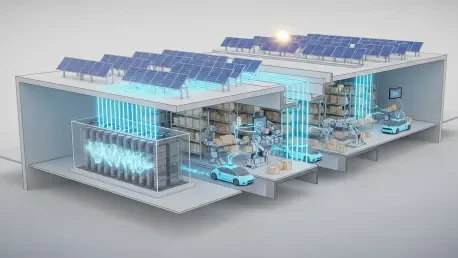
The most effective response to this challenge is an integrated system that turns an unpredictable liability into a controllable asset. This approach is built on three interconnected pillars: onsite generation, battery storage, and intelligent management. Onsite generation, primarily through solar panels, allows a facility to produce its own low-cost, clean power directly where it is needed. Battery storage systems capture this energy, or cheaper off-peak grid power, holding it in reserve to be deployed strategically. The entire system is orchestrated by a smart management platform that dynamically balances generation, storage, and grid usage to achieve maximum efficiency and cost reduction.
A key strategy enabled by this integrated system is “peak shaving.” Logistics operations often experience intense bursts of energy use, such as when a fleet of electric vehicles returns for simultaneous charging. These peaks trigger high demand charges from utility providers, which can constitute a significant portion of an electricity bill. By storing low-cost energy and releasing it during these high-demand periods, a business can flatten its consumption profile, dramatically cutting both energy consumption bills and fixed network charges. Pharmaceutical distributor Mawdsleys provides a compelling case study, having leveraged this integrated approach to overcome local grid limitations, secure cost certainty for its operations, and confidently support its ongoing expansion.
An Expert Viewpoint on Gaining Control
According to industry veteran Nick Hay, a sophisticated, proactive energy strategy is now a necessity, not a luxury. The traditional model of simply buying power from the grid exposes businesses to uncontrollable price volatility and supply constraints. “Gaining control over energy is about more than just reducing a monthly bill,” Hay advises. “It’s about insulating your core operations from market shocks and building a more resilient, predictable business model for the future.” This perspective reframes energy from a simple expenditure to a strategic input that requires active management.
The long-term prize for logistics operators is unprecedented control over their “fuel” expenses, a game-changing advantage in an industry defined by tight margins. By combining an electrified fleet with a stable, predictable electricity price locked in for years, a company can forecast its transportation energy costs with remarkable accuracy. This stability transforms a volatile cost center into a strategic asset, enabling more competitive pricing, reliable budgeting, and confident investment in further electrification and automation. Intelligent energy management, therefore, becomes a core enabler for future growth and a key competitive differentiator.
A Practical Framework for an Energy Advantage
The first step for any operator is to conduct a thorough audit of its energy profile. This involves understanding the unique consumption patterns of a site, identifying the specific times of peak demand, and quantifying the full cost of its current dependency on the grid. This data forms the foundation upon which an effective strategy can be built, revealing the precise nature of the problem and the scale of the opportunity.
With a clear energy profile, the next step is designing an integrated system tailored to the operational needs. This involves determining the right scale of solar generation and battery storage, which is then paired with an intelligent management system. The final stage is implementation, activating the system to achieve immediate cost savings through peak shaving while creating the long-term energy security needed to underpin future electrification and expansion plans. This methodical approach ensures the solution directly addresses the site’s specific challenges and goals.
Leveraging Financial Certainty for Strategic Growth
Ultimately, the goal is to convert a volatile expense into a predictable operational budget line. This is achieved not only through physical infrastructure but also through innovative financial tools that de-risk energy procurement. Models that offer fixed-price tariffs and price caps, such as Wattstor’s “Price Protect” tariff, provide a crucial layer of financial security. This model guarantees prices below the market rate and provides a ceiling, while still allowing customers to benefit when wholesale prices fall.
By adopting this comprehensive approach, logistics companies can move beyond reactive cost-cutting and begin to use energy as a strategic lever. The financial certainty gained allows for more accurate long-term planning and frees up capital for investment in other core areas of the business. It transforms the conversation about energy from one of risk mitigation to one of strategic advantage, positioning early adopters to lead the industry in an increasingly electrified and competitive landscape.
The evolution of energy from a simple utility to a strategic asset required logistics operators to adopt a fundamentally new mindset. The firms that recognized the convergence of grid limitations, price volatility, and rising internal demand were able to act decisively. By implementing integrated solutions that combined onsite generation, storage, and intelligent management, they not only mitigated critical operational risks but also unlocked significant financial and competitive advantages. This strategic pivot on energy management ultimately distinguished the market leaders from the rest of the pack.