
With decades of experience in management consulting and industrial operations, Marco Gaietti has established himself as a leading voice in the evolution of European logistics. His expertise in strategic management and customer relations provides him with a unique perspective on how massive infrastructure projects translate into day-to-day supply chain reliability. Today, he joins us to discuss the intricate workings of the Northampton gateway, a facility that represents the pinnacle of modern multimodal transport and a significant shift toward decarbonized freight.
Managing a 600-acre logistics hub in the “golden triangle” allows access to 90% of the population within four hours. What specific design features enable this level of distribution speed, and how do you coordinate five million square feet of warehouse space with high-volume motorway access?
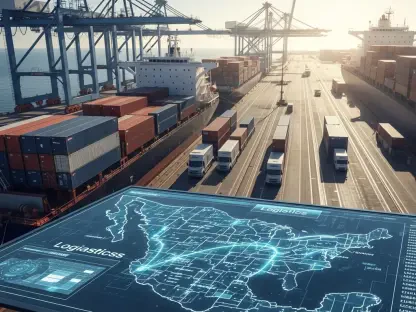
The sheer scale of a 600-acre site requires a surgical approach to layout to ensure that no second is wasted when moving goods. By positioning the hub adjacent to Junction 15 of the M1, we create a seamless bridge between the national motorway network and five million square feet of logistics accommodation. The design philosophy centers on “embedded connectivity,” where the rail terminal isn’t just an add-on but the heart of the site, allowing containers to transition from tracks to warehouse floors with minimal handling. This integration is what makes it possible to reach 90% of the UK population in about four hours, as the flow of heavy goods is optimized to avoid the bottlenecks typically found in less integrated industrial parks.
A 17-acre interchange handling 16 daily services for the heaviest freight trains requires massive container storage. What are the logistical steps for managing a 2,500 TEU capacity, and how do you ensure that these high-volume operations remain reliable for “can’t fail” supply chains?
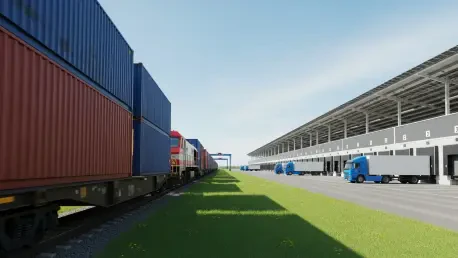
Managing a storage capacity exceeding 2,500 TEU requires a highly disciplined digital and physical choreography to ensure that “can’t fail” supply chains actually deliver on that promise. With 16 services running daily, the 17-acre terminal must operate with high-velocity throughput, where every container’s position is mapped for immediate retrieval. We rely on a combination of heavy-duty reach stackers and specialized rail-mounted infrastructure to service the UK’s longest and heaviest trains without delay. Reliability is further bolstered by an £80 million investment in the rail infrastructure itself, ensuring the tracks and signaling can handle the relentless pressure of a 24/7 intermodal operation.
Moving a quarter of all multimodal cargo by rail involves integrating electric heavy goods vehicles for the final miles of delivery. How does onsite charging infrastructure support a fleet of over 50 zero-emission vehicles, and what metrics are used to track carbon reduction across these combined operations?
The transition to a zero-emission fleet is supported by the eFREIGHT 2030 project, which has seen us develop one of the UK’s largest privately operated high-powered charging networks. For a fleet of over 50 eHGVs, we have installed high-output charging stations right at the Northampton gateway to ensure vehicles can “top up” while loading or unloading, maintaining maximum uptime. We track our progress by measuring the carbon displacement of shifting long-distance hauls from road to rail, combined with the tailpipe emission savings from our eHGVs. This holistic approach allows us to provide customers with a transparent view of how their specific supply chain contributes to the goal of the “cleanest, most sustainable freight operation.”
Reinstating regional rail sections, such as the Oxford–Bletchley corridor, connects inland hubs to major deep-sea ports. What are the primary operational benefits of having both northbound and southbound connections to a main line, and how will phased expansions further increase national freight capacity?
The primary benefit of having both northbound and southbound connections to the West Coast Main Line is the elimination of “dead mileage” and the ability to service multiple regions simultaneously without complex shunting. By utilizing the newly reinstated Oxford–Bletchley section of East West Rail, we’ve opened a vital corridor that links Northampton directly to DP World’s Southampton Port, significantly shortening the transit time for maritime cargo. This isn’t a static project; our phased expansion program is designed to steadily increase national capacity by adding more daily services as demand grows. This strategic growth ensures that the UK’s inland markets remain tightly coupled with major deep-sea ports, making the entire national economy more resilient.
Balancing road and rail freight often requires addressing cost disparities such as port admission fees. What specific strategies can logistics partners use to ensure fair competition, and how do government-backed demonstrator programs help prove the commercial viability of zero-emission heavy goods vehicles?
To ensure fair competition, we actively advocate for a level playing field, particularly regarding port admission costs which can sometimes unfairly penalize rail operators. Logistics partners must collaborate with central government and bodies like the Rail Freight Group to ensure that the environmental benefits of rail are reflected in its commercial structure. Programs like the Zero Emission HGV and Infrastructure Demonstrator (ZEHID) are crucial because they provide the “proof of concept” that skeptical shippers need to see before switching. By deploying these 50 eHGVs in a real-world, high-pressure environment, we are demonstrating that zero-emission road movements are not just a future dream but a commercially viable reality today.
What is your forecast for the future of strategic rail freight interchanges and their role in decarbonizing the global supply chain?
I believe we are entering an era where the Strategic Rail Freight Interchange will become the indispensable “spine” of the global supply chain. My forecast is that over the next decade, we will see a massive acceleration in the integration of rail and electric road transport, with rail handling the 300-plus mile hauls and eHGVs dominating the first and final miles. As we invest more than £100 million into our network, we are seeing a shift where carbon reduction is no longer a secondary goal but a primary driver of investment decisions. Ultimately, these hubs will evolve into fully integrated, low-carbon ecosystems that provide the only viable path for the logistics industry to meet its stringent net-zero obligations while supporting national economic growth.