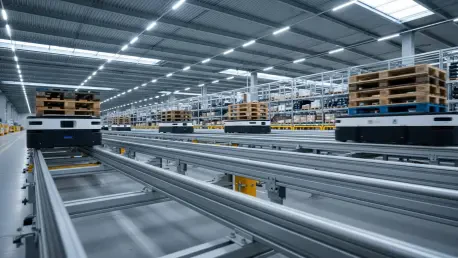

Modern warehouse operators are increasingly finding that traditional conveyor systems struggle to keep pace with the hyper-accelerated demands of global commerce and the ever-shrinking delivery windows expected by consumers. As supply chains move toward total automation, the need for a solution that combines the reliability of fixed infrastructure with the flexibility of mobile robotics has never been more pressing. Swisslog has responded to this industry-wide challenge by unveiling FastMove, a next-generation rail-guided vehicle system specifically designed for high-speed pallet transport. This technology represents a significant leap forward from standard automated guided vehicles, offering a robust alternative for facilities that require rapid, high-volume throughput across expansive distances. By focusing on a modular rail design, the system allows for intricate routing that maximizes existing floor space while maintaining a level of precision that manual forklift operations simply cannot replicate in a modern environment.
Engineering Precision: Speed and Payload Capacity
The mechanical architecture of FastMove enables it to reach travel speeds of up to four meters per second, which is a substantial improvement over conventional pallet transport methods currently utilized in many distribution centers. High acceleration rates ensure that the time spent in transit is minimized, allowing for a higher number of cycles per hour even in complex warehouse layouts. Beyond speed, the system is engineered to handle substantial payloads, with a standard capacity reaching up to 1,500 kilograms per vehicle. This makes it suitable for a wide range of industries, from heavy manufacturing to food and beverage production where pallet weights can vary significantly. The rail-guided nature of the vehicle provides a level of stability and predictability that is often lacking in free-roaming autonomous mobile robots. This stability is particularly crucial when transporting tall or unstable loads that require smooth movement and precise stopping at designated workstations. The refined control algorithms ensure that even at peak velocity, the transitions between straightaways and curves are managed with fluid motion.
Building on its physical capabilities, the system utilizes a versatile rail infrastructure that can be customized to suit the specific architectural constraints of a facility. Unlike traditional conveyors that often act as permanent barriers to floor traffic, the slender rail profiles used by FastMove can be integrated into the floor or elevated to create multi-level transport networks. This flexibility allows businesses to optimize their internal logistics without undergoing massive structural renovations. Furthermore, the inclusion of advanced sensor technology ensures that each vehicle maintains a safe distance from others on the same track, effectively eliminating the risk of collisions. This safety-first approach is complemented by the system’s ability to perform bidirectional travel and execute sharp turns, which reduces the overall footprint of the transport loop. Consequently, operators can achieve higher storage density by reclaiming space that would otherwise be dedicated to wide forklift aisles or bulky conveyor belts, directly improving the bottom line. This space-saving attribute is highly valued in urban distribution centers where land costs are at a premium.
Strategic Implementation: Software Control and Optimization
A critical component of this technological advancement is the seamless integration with the SynQ warehouse management software, which acts as the intelligent brain directing all pallet movements. This software provides real-time visibility into the status and location of every vehicle, allowing for dynamic task allocation based on current demand patterns and priority orders. By utilizing sophisticated algorithms, the control system can identify the most efficient routes, avoiding bottlenecks and ensuring that pallets reach their destinations with minimal delay. This level of synchronization is essential for operations that rely on just-in-sequence or just-in-time logistics strategies. Moreover, the digital twin capability within the software allows managers to simulate different operational scenarios before implementation, reducing the risk of downtime during the initial setup phase. This data-driven approach transforms pallet transport from a simple utility into a strategic asset that provides actionable insights for continuous process improvement. By leveraging this connectivity, facilities can maintain a high degree of responsiveness to volatile shifts in inventory.
Implementing this high-speed transport solution required a shift in how facility managers approached internal logistics and long-term infrastructure planning. Organizations that prioritized the integration of these rail-guided systems successfully reduced their reliance on manual labor while significantly increasing their daily throughput capacity. The most effective strategies involved a phased rollout, starting with high-traffic corridors before expanding the rail network to cover the entire facility. Technical teams conducted thorough audits of existing workflows to ensure that the SynQ software was perfectly calibrated to handle specific inventory fluctuations. It was observed that the modular nature of the hardware allowed for rapid scaling as business demands grew, providing a level of agility that was previously unattainable. Ultimately, the adoption of this technology served as a catalyst for broader digital transformation efforts across the entire global supply chain network, enabling more resilient and cost-effective logistics models for the future.