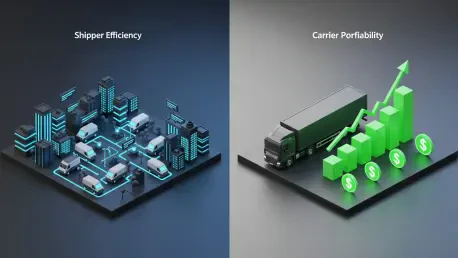

A profound shift is currently reshaping global logistics, with supply chain executives signaling that the industry has reached a crucial turning point where artificial intelligence is no longer a futuristic concept but a present-day competitive necessity. The insights gathered from over 230 industry leaders confirm that while the race to adopt AI is accelerating rapidly, most organizations are just leaving the starting blocks. This creates a brief but vital window for forward-thinking companies to establish a significant advantage by operationalizing AI, transforming it from a pilot project into a core driver of efficiency and resilience.
The Dawn of a New Competitive Edge
The central question emerging from this industry-wide sentiment is what will ultimately separate the leaders from the laggards in the coming years. As AI moves from the periphery to the center of strategic planning, the answer lies less in whether a company adopts the technology and more in how deeply it is integrated into its operational DNA. The inflection point represents the moment where early adopters begin to pull away, leveraging AI to build more predictive, agile, and cost-effective supply chains.
This competitive divergence is fueled by the current state of implementation. While awareness of AI’s potential is nearly universal, its practical application remains in its infancy for a majority of businesses. This gap between ambition and execution presents a finite opportunity. Companies that can quickly move beyond experimentation to deploy AI at scale are positioned to capture market share, while those that delay risk being outmaneuvered by more technologically adept rivals.
The Data Dilemma Hindering an AI Revolution
The push toward AI is not driven by technological novelty but by the urgent need for greater efficiency and resilience in the face of persistent global disruptions. Modern supply chains demand a level of predictive insight and operational agility that traditional systems can no longer provide, making AI an essential tool for navigating complexity and mitigating risk.
However, a formidable roadblock is preventing the full-scale AI revolution from arriving. A significant consensus among both shippers and carriers points to a single, pervasive issue: poor data quality. Inaccurate, incomplete, or siloed data undermines the very foundation upon which effective AI models are built, rendering even the most sophisticated algorithms ineffective. This data dilemma has tangible consequences, trapping many organizations in a perpetual cycle of pilot projects that fail to deliver a measurable return on investment.
A Tale of Two Priorities for Shippers and Carriers
An analysis of the current AI landscape reveals a distinct divergence in priorities based on an organization’s role within the supply chain. For shippers, the primary focus is on achieving operational optimization. Currently, 44% are using AI to refine transportation planning and perfect route efficiency. Looking forward, their conviction in this area deepens, with an overwhelming 86% believing that planning and optimization hold the greatest potential for AI-driven impact.
In contrast, carriers are leveraging AI with a sharp focus on profitability and asset utilization. Their most common application, reported by 42%, is in refining pricing strategies and optimizing lane selection to maximize revenue. This priority is projected to continue, as 59% of carriers identify smarter pricing as the technology’s most significant value driver for their business.
The Rise of Agents to Augment Human Expertise
A key trend gaining momentum is the deployment of “Agentic AI,” which involves autonomous software agents capable of monitoring complex data streams, executing predefined tasks, and proactively alerting human operators to critical events. This technology acts as a digital assistant, handling routine analytical work to free up logistics professionals for more strategic decision-making.
When it comes to deploying these AI agents, shippers and carriers again show different priorities. Shippers see the top opportunities in real-time ETA monitoring (52%) and automated carrier selection. Carriers, on the other hand, are focused on using agents for proactive ETA calculation and alerting (59%) and dynamic route optimization to respond to changing conditions on the ground. Despite the advanced capabilities of these agents, the prevailing vision is one of collaboration, not replacement. A clear majority—two-thirds of shippers and over half of carriers—view AI’s primary role as a “human-in-the-loop” tool that augments human expertise.
Unlocking Value Through a Connected Ecosystem
The ultimate strategic framework for success with AI in transportation extends beyond the capabilities of any single organization. The technology’s full potential is not realized within isolated company silos but is instead unlocked within connected, collaborative transportation networks where data and insights can be shared securely.
This ecosystem approach delivers practical, compounding benefits. For shippers, leveraging network-based systems provides access to a wider pool of data, leading to superior predictive capabilities for ETAs and disruption alerts. For carriers, tapping into the network facilitates smarter load matching, reduces empty miles, and optimizes overall asset utilization across multiple partners. Therefore, the most effective strategy positions AI not as a standalone tool but as the connective tissue of a smarter logistics network. Its true value emerges from its seamless integration across disparate systems, diverse partners, and skilled personnel to create a synergistic, intelligent operation.
The journey toward AI integration revealed a landscape defined by both immense opportunity and significant hurdles, primarily rooted in data quality. It highlighted a clear divergence in how shippers and carriers approached the technology, with one group seeking optimization and the other pursuing profitability. Ultimately, the most successful path forward was not one of automation alone but of human-AI collaboration within a connected ecosystem. Realizing the full promise of this inflection point will depend on building intelligent networks that integrate systems, partners, and people into a cohesive, data-driven whole.