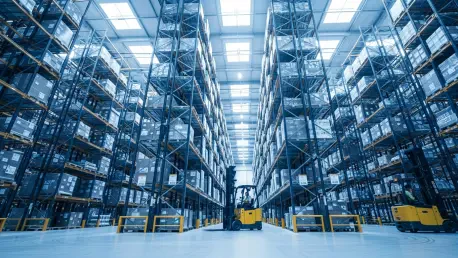

The relentless surge in industrial real estate costs has fundamentally transformed the warehouse from a mere storage box into a high-stakes arena for engineering efficiency. As land prices climb and urban expansion consumes available lots, logistics leaders are realizing that building outward is no longer a viable strategy for sustainable growth. Consequently, the focus has shifted toward high-density configurations and specialized machinery that squeeze every cubic inch of value from existing structures. This shift is not merely about cost-cutting; it represents a critical driver of operational agility in a market where space is the ultimate premium. This analysis explores how specialized material handling technology, data-driven density improvements, and the transition toward dual-use facilities are redefining the modern industrial footprint.
The Shift Toward High-Density Storage Solutions
Metrics of Growth in Narrow Aisle Technology
The adoption of Very Narrow Aisle (VNA) configurations has accelerated as firms prioritize pallet position density over traditional wide-aisle access. Current industry data suggests a global movement toward verticality, with lifting heights reaching new peaks to utilize previously ignored overhead space. By shrinking aisle widths, facilities can significantly increase their storage capacity without moving a single exterior wall. Moreover, recent statistics indicate that the return on investment for upgrading material handling fleets to accommodate these tighter spaces far outweighs the massive capital expenditure required for physical facility expansion.
Practical Implementation: The ITW and Combilift Integration
A clear example of this trend is seen in ITW Barcelona, a precision automotive component manufacturer that successfully navigated severe space constraints. By transitioning from standard 3.5-meter aisles to 2.3-meter widths using Aisle Master articulated forklifts, the facility underwent a radical transformation. This adjustment alone enabled a 34% increase in storage capacity, proving that intelligent equipment selection can solve structural limitations. Furthermore, this transition allowed the site to evolve into a dual-use facility, seamlessly housing both production lines and comprehensive warehousing under one roof to support regional growth.
Expert Perspectives on Operational Excellence and Safety
Utilizing specialized equipment requires a delicate balance between high-density storage and operator visibility. Modern articulated units allow for fluid movement in cramped quarters, yet the human element remains a primary concern for operational excellence. Advanced safety features have become a non-negotiable standard in these high-traffic environments. Innovations such as mast-mounted cameras provide operators with a clear view at maximum extension, while red halo lights and blue pedestrian spots create a visual perimeter that prevents collisions in the narrow corridors.
Beyond immediate safety, the ergonomic design of modern pallet-handling systems plays a vital role in workforce retention. As the labor market tightens, providing a work environment that reduces physical strain and enhances comfort is essential for long-term stability. Integrating specialized machinery with redesigned, ergonomic pallet-wrapping processes ensures that the workforce remains productive and healthy. This holistic approach to safety and ergonomics demonstrates that high-density storage does not have to come at the expense of employee well-being or operational security.
The Future of Scalable Resource Management
The evolution of electric-powered fleets is currently setting the standard for indoor emissions reduction and noise control. As environmental regulations become more stringent, the shift toward sustainable, battery-operated machinery helps companies meet green targets while maintaining peak performance. Additionally, there is a growing potential for increased automation within narrow aisle environments, which promises to enhance picking speed and accuracy. While retrofitting older facilities presents unique engineering challenges, the benefits of a lean logistics strategy often justify the initial complexity of the transition.
Global standardization is emerging as a preferred strategy for multinational corporations like the ITW group. By adopting optimized material handling solutions across various regions, including the United States and Australia, organizations can ensure consistent efficiency and safety protocols worldwide. This universal approach to resource management simplifies training and maintenance while maximizing the utility of every square foot of industrial real estate.
The integration of specialized material handling and safety technology offered a definitive path forward for organizations struggling with the space squeeze. Industry leaders recognized that layout assessment and equipment modernization were not one-time events but ongoing operational necessities. This shift facilitated a new standard of efficiency where verticality and density replaced physical expansion. Moving forward, companies began prioritizing modularity in their shelving and fleet selections to remain adaptable. The era of the static warehouse ended, replaced by dynamic, high-density environments that protected both the bottom line and the workforce.