
With decades of experience in management consulting and a deep focus on strategic operations, Marco Gaietti has mastered the complex choreography of corporate transitions. He has witnessed firsthand how economic shifts and the rise of remote work have transformed the commercial real estate landscape, turning office relocations into high-stakes logistical puzzles. In an industry where 63% of budgets are currently increasing to meet these demands, Marco provides the strategic vision necessary to ensure that a company’s physical infrastructure keeps pace with its organizational goals.
The following discussion explores the evolving financial drivers behind corporate moves, the specialized engineering of modern moving fleets, and the meticulous planning required to move thousands of employees without a single hour of lost productivity.
Economic conditions currently drive half of all corporate relocations while over sixty percent of relocation budgets are increasing. How do you navigate these shifting financial priorities for clients, and what specific logistics challenges arise when a company decides to move rather than remain in their current space?
Navigating these financial priorities requires a deep understanding of why 50% of companies are moving due to economic pressures. When a client sees their budget increase, we focus on maximizing the return on that investment by streamlining the transition from a legacy office to a more efficient modern footprint. The logistics challenges are immense because a move isn’t just about hauling boxes; it involves managing the “chaotic leasing activity” that has defined the post-pandemic era. We must account for every asset, from lateral filing systems to the last fake plant, ensuring that the decision to relocate results in a leaner, more productive environment rather than a disorganized drain on resources.
Modern moving fleets utilize twenty-two-foot trucks with five-person crew seating modeled after fire engines. Why is this specific configuration essential for maximizing operational efficiency, and how does the specialized air ride suspension protect sensitive IT racks and server cabinets during a complex transition?
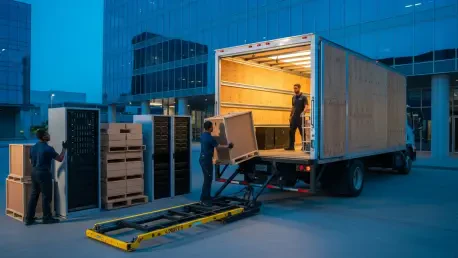
The fire-engine-style seating is a game-changer because it allows a full five-person crew to travel together in a single cab, ensuring that the entire team arrives at the site simultaneously and ready to work. This eliminates the staggered starts that happen when crews travel in separate vehicles, which is vital for maintaining a tight schedule. When we load high-value assets like IT racks and server cabinets, the air ride suspension becomes the most critical feature of the truck. It dampens the vibrations and shocks of the road, providing a smooth journey that prevents delicate internal components from shifting or breaking during transit.
These commercial box trucks are rated for 17,000-pound payloads and feature double e-track cargo systems. What are the step-by-step safety protocols for securing ten pallets of heavy office furnishings, and how does the 4,000-pound rail lift system accelerate the speed of a high-volume workstation decommissioning?
Securing ten pallets starts with utilizing the double e-track system, which allows us to strap heavy items at multiple heights against the 3/8” plywood-lined interior walls for absolute stability. Each pallet, often loaded with heavy executive desks or filing systems, is strategically positioned to balance the 16.5-ton gross vehicle weight. The 4,000-pound rail lift system is the “workhorse” of the decommissioning process, allowing us to move entire workstation clusters from the loading dock to the truck bed in seconds without manual lifting. This mechanical advantage significantly reduces crew fatigue and slashes the time required to clear out massive floor plans, keeping the project on its strict overnight timeline.
Corporate moves often occur during off-peak hours to minimize disruption for thousands of employees who remain unaware of the process. How do you manage the transition to ensure a seamless morning-after return to business, and what metrics do you use to track the success of these stealthy relocations?
The goal is to effectively “take a company out of business” at night and “put them back in business” before the first cup of coffee is poured the next morning. We manage this by operating in a “stealth mode” during off-peak hours, coordinating a fleet of 22-foot trucks and specialized vans to move assets while the workforce sleeps. Success is measured by the “zero-disruption” metric—if an employee sits down at their new desk and finds their IT equipment fully functional and their task seating perfectly placed, we have succeeded. We track the completion of every line item, from server cabinet connectivity to the placement of coat racks, to ensure the transition is invisible to the end user.
Large fleets often include a mix of passenger vans, cube vans, and max-length tractor trailers to handle varied cargo. How do you determine the ideal vehicle mix for a Fortune 500 headquarters move, and what role does the engine’s horsepower and torque play when hauling 16.5 tons?
For a massive move, like those we’ve handled for Toyota USA or Wells Fargo, we deploy a tailored fleet that might include 14-person passenger vans for labor transport and a 53-foot tractor-trailer for the largest bulk assets. The 22-foot commercial box trucks serve as the versatile middle ground, relying on 350hp and 373 lb.-ft of torque to move 17,000-pound payloads through city traffic. That torque is essential for maintaining momentum when the truck is fully loaded to its 16.5-ton limit, ensuring we stay on schedule regardless of the terrain. Even with this robust power, we prioritize modern engines with exhaust regeneration systems to remain certified as clean idle vehicles, meeting the sustainability standards many Fortune 500 firms demand.
What is your forecast for corporate relocations?
I expect the corporate relocation sector to remain extremely active as the nearly one-third of companies currently contemplating a move begin to execute their plans. We will see a continued shift toward “flight-to-quality,” where businesses use their increased budgets to move into smaller, higher-tech spaces that better accommodate a hybrid workforce. Logistics providers will need to invest even more heavily in specialized equipment and “stealth” operational capabilities to handle this wave of migration. Ultimately, the moving truck will remain the unsung hero of the American economy, quietly facilitating the massive geographical shifts of our most prominent corporations.