
With decades of experience in management consulting and a deep understanding of strategic operations, Marco Gaietti offers a unique perspective on the critical safety components powering the industrial vehicle industry. Today, he delves into the intricate world of braking systems for electric forklifts, exploring the fail-safe principles that secure vehicles on steep ramps, the engineering behind compact yet powerful designs, and the energy-saving innovations that enhance overall efficiency. We’ll also touch on how a vertically integrated approach to manufacturing leads to more reliable and tailored braking solutions for the most demanding applications.
The fail-safe principle is critical for holding brakes on ramps. Can you explain how this spring-operated, electrically released system works in a real-world fault scenario, and what design elements ensure its reliability after a high number of load changes?
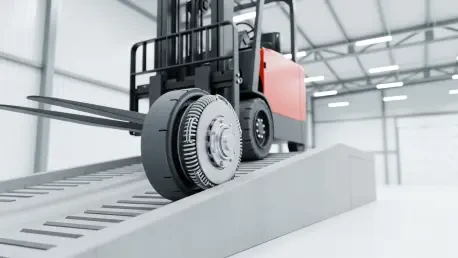
Absolutely, the fail-safe principle is the bedrock of safety for these vehicles. Imagine a forklift stopping on an incline. The system is designed to be closed, or engaged, in its natural, de-energized state. This is achieved by powerful springs that mechanically apply the braking force. To move the forklift, we apply an electric current to release the brake. In a fault scenario—like a power cut or a cable failure—that electric current disappears, and the springs instantly and automatically re-engage the brake, securely holding the vehicle. It’s this default-to-safe state that is so crucial. Our designs are mechanically hardened to withstand a very high number of these on-off cycles, ensuring that this life-saving function remains reliable throughout the entire service life of the forklift.
The BFK552-12 brake combines a flat 43.7 mm profile with 60 Nm of torque. How does this compact design aid back-to-back drive arrangements, and what practical impact does its IP66 protection have on a forklift’s operational life in demanding climates?
The BFK552-12 is a perfect example of packing high performance into a small package. That incredibly flat profile, just 43.7 mm, is a huge advantage for engineers designing compact drivetrains. It allows them to place two drive units “back-to-back” in very tight spaces, which is a common and efficient layout. This space-saving design doesn’t compromise on power, delivering a solid 60 Nm of torque. The IP66 protection is equally important for longevity. Think of a forklift operating in a dusty warehouse, a humid port, or a cold storage facility where condensation is common. The IP66 rating ensures the brake is completely sealed against dust and powerful water jets, preventing internal corrosion and contamination. This robust protection directly translates to fewer failures and a longer, more dependable operational life for the entire vehicle.
Your designs use overexcitation and holding current reduction to optimize energy. Could you walk us through how these features reduce power loss and heat, and then explain the resulting benefits for a forklift’s overall efficiency and component longevity?
Energy optimization is key, especially in an electrified world. Releasing a spring-applied brake requires a strong initial force, but keeping it open requires much less. So, we use a technique called overexcitation, which applies a short, powerful pulse of electricity to quickly and cleanly disengage the brake. Immediately after, the system drops to a much lower “holding current,” which is just enough to keep it released. This process dramatically reduces overall power consumption compared to applying full power continuously. The primary benefit is a significant reduction in heat generation. Less heat means less energy is wasted, which improves the forklift’s battery life and overall efficiency. It also prevents the brake and nearby motor components from degrading over time, leading to a much longer and more reliable service life.
For higher performance needs, the BFK457-14 platform offers over 90 Nm of braking torque. Could you share an example of how this brake handles high emergency stopping energies at speed and describe the process for adapting its design for a dense drive compartment?
The BFK457-14 is our solution for the most demanding applications, where both high speed and heavy loads are the norm. With over 90 Nm of braking torque, it’s designed to handle the immense energy of an emergency stop when a forklift is moving at high travel speeds. Its robust construction ensures it can absorb that energy repeatedly without a drop in performance. Because this brake is a design-in platform, we can tailor it for specific needs. For instance, when a customer needs to fit it into a very dense drive compartment, we can engineer a more compact version. Our process involves working closely with their design team to create application-specific adaptations, ensuring a perfect fit without sacrificing the power and reliability the platform is known for.
You combine application experience with vertical integration, including in-house rotor production. How does this approach specifically improve the design and reliability of your brakes compared to sourcing components externally?
This combination is our greatest strength. Having decades of application experience means we deeply understand the real-world stresses these brakes face. We’re not just designing in a lab; we’re solving problems we’ve seen in the field. Coupling this with vertical integration, especially our in-house rotor production, gives us total control over quality and innovation. For a recent project, our application team identified a need for improved thermal dissipation in a high-cycle environment. Instead of searching for an external supplier, our development site in Germany worked directly with our rotor production team. We were able to rapidly prototype and test new rotor materials and designs, achieving a solution that was perfectly coordinated and optimized for the brake’s performance, a level of synergy that’s nearly impossible when sourcing externally.
What is your forecast for the evolution of electric forklift braking systems over the next five to ten years?
I believe we’ll see a major push towards smarter, more integrated braking systems. The focus will continue to be on increasing power density—getting more braking torque from even smaller and more energy-efficient packages. However, the next frontier is integrating sensor technology and predictive maintenance capabilities directly into the brake itself. This will allow the system to monitor its own wear and performance in real-time, alerting operators to potential issues before a failure occurs. This shift from purely mechanical safety components to intelligent, self-monitoring systems will be crucial for enhancing the safety, efficiency, and uptime of the next generation of industrial trucks.