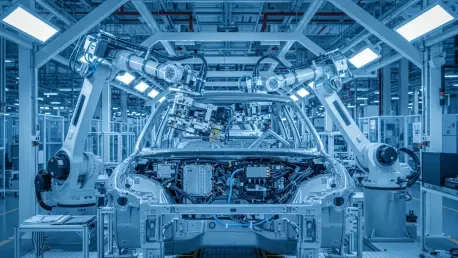

The global automotive industry is currently navigating a period of unprecedented transformation as vehicles evolve into mobile data centers, creating a multitrillion-dollar ecosystem that underpins much of the modern international economy. By the conclusion of the previous fiscal cycle, the sector achieved a significant milestone with approximately 90 million vehicles sold worldwide, a figure that underscores a resilient and growing demand for both personal and commercial mobility despite fluctuating economic conditions. This massive industry now accounts for nearly 1% of total global GDP and contributes roughly 6% of the gross value added by the manufacturing sector, making it a critical barometer for global financial health. However, this immense scale brings with it an intricate web of dependencies that are increasingly difficult to manage as cars shift from being purely mechanical machines to sophisticated technological hubs. The integration of advanced safety protocols, high-definition entertainment systems, and autonomous driving features has necessitated a supply chain that is arguably the most complex in human history, involving thousands of sub-tier suppliers scattered across every continent.
Within this sprawling logistical network, the sheer number of components required for a single vehicle means that even a minor disruption in a remote corner of the world can trigger a massive cascading crisis. Modern vehicles are no longer simple assemblies of steel and glass; they are integrated platforms of sensors, processors, and specialized materials that require precise coordination across borders. This complexity has made transparency a significant challenge for original equipment manufacturers, who often struggle to see beyond their immediate tier-one suppliers. As a result, the threat of production delays and sourcing bottlenecks has become a persistent shadow over the industry, putting billions of dollars in projected revenue at risk. If manufacturers cannot develop more robust methods for navigating these logistical hurdles, the financial stability of the entire sector could be compromised by the very innovations that were intended to drive it forward. The current landscape demands a shift in strategy, moving away from traditional cost-cutting measures toward a more holistic view of supply chain integrity and long-term resilience.
Financial Powerhouses and Material Vulnerabilities
Market Leaders: The Geography of Revenue
A highly concentrated group of dominant automotive manufacturers currently commands the vast majority of the global market, with production activities centered primarily in the United States, Europe, and East Asia. These specific regions are responsible for approximately 80% of the total revenue generated by the industry, creating a landscape where the financial health of a few key nations dictates the pace of global automotive development. For instance, Volkswagen remains a titan in the field, reporting annual revenues that exceed $380 billion thanks to its extensive portfolio that ranges from budget-friendly passenger cars to high-capacity commercial vehicles. Similarly, Toyota has maintained its position as a global leader by focusing on high-volume sales and a reputation for extreme reliability, generating roughly $330 billion in annual earnings. These organizations have built their empires on the back of globalized trade, but their reliance on specific geographical hubs makes them particularly sensitive to regional economic shifts and political instability that can disrupt the flow of finished goods and essential components.
Beyond these top-tier giants, other major contributors like Ford, Stellantis, and Mercedes-Benz continue to hold significant market shares by catering to diverse consumer segments across the globe. Ford has successfully leveraged its dominance in the American truck market, particularly with the F-150 series, to report revenues near $187 billion, while Stellantis has utilized its post-merger scale to manage a wide array of brands like Jeep and Alfa Romeo, totaling $178 billion in revenue. In the luxury segment, Mercedes-Benz demonstrates the high-margin potential of premium vehicles, reporting $153 billion in earnings. Despite these impressive financial figures, these companies are facing a systemic erosion of their profit margins due to rising operational costs and the increasing difficulty of securing stable supply lines. The concentration of revenue among these few players means that any disruption to their operations has a magnified effect on the global economy, as their purchasing power and production schedules influence thousands of smaller businesses within the broader automotive ecosystem.
Critical Dependencies: The Aluminum Bottleneck
One of the most immediate and tangible threats to automotive revenue streams involves the precarious procurement of essential raw materials, with aluminum currently acting as a primary focal point for industry concern. As vehicles become more advanced, the demand for lightweight materials to offset the weight of heavy battery packs and electronic systems has surged, making aluminum more critical than ever before. The Middle East has emerged as a vital hub for the production of this metal, with Bahrain and the United Arab Emirates accounting for nearly 10% of the world’s total output. This geographical concentration creates a significant vulnerability for manufacturers in the West, particularly those based in the United States, who import more than 80% of their aluminum requirements. Given that approximately one-fifth of these imports originate specifically from the Gulf region, any regional instability has the potential to halt assembly lines thousands of miles away, leading to massive financial losses and unmet consumer demand.
The geopolitical climate in the Middle East, characterized by ongoing tensions and the potential for trade blockades in critical maritime passages like the Strait of Hormuz, represents a dangerous bottleneck for the global supply chain. If these essential export routes were to be compromised, automakers would be forced into a difficult and costly dilemmthey would either have to source materials from much more expensive alternative providers or face the reality of significantly reduced production targets for the 2026 and 2027 fiscal years. This dependency highlights a recurring vulnerability within the industry where critical resources are tied to regions prone to rapid political shifts. The financial impact of such a disruption would not be limited to the cost of the raw material itself; it would encompass the overhead of idling factories, the loss of market share to more prepared competitors, and the logistical nightmare of rerouting global shipping lanes. Consequently, securing these material pipelines has become a top priority for executive boards seeking to protect their bottom-line revenue from external shocks.
Technological Hurdles and Semiconductor Shifts
Digital Infrastructure: The Memory Chip Supercycle
The technological sophistication of modern automobiles has effectively transformed them into high-performance computers on wheels, making the industry more dependent on the semiconductor market than at any other point in its history. A typical new vehicle rolling off the assembly line today contains anywhere from 1,000 to 3,000 individual chips, managing everything from engine timing to cabin climate. The industry is currently grappling with the “Memory Chip Supercycle,” a phenomenon where the demand for specialized memory products like RAM and NAND is growing at an exponential rate. This surge is primarily fueled by the integration of advanced driver-assistance systems and high-definition infotainment platforms that require massive data processing capabilities. For context, while a standard vehicle in recent years required about 90GB of combined memory, the requirements for models entering production in 2026 have tripled to approximately 270GB, creating an immense strain on global manufacturing capacity that was already struggling to keep pace with consumer electronics.
This rapid increase in demand has led to a period of extreme market volatility known within the industry as “RAMageddon,” a crisis defined by skyrocketing prices and severe shortages of critical digital components. The irony facing automotive manufacturers is that as their vehicles become more advanced and data-hungry, the global supply of these semiconductor commodities is becoming increasingly restricted due to manufacturing limitations and high demand from the artificial intelligence and cloud computing sectors. This mismatch between automotive needs and semiconductor availability is not a temporary glitch but a structural challenge that threatens the very core of modern vehicle production. Without these chips, the sophisticated safety features and autonomous capabilities that serve as primary selling points for new cars cannot function, effectively rendering the physical hardware of the vehicle incomplete. As a result, the ability to secure long-term contracts with chip manufacturers has become a competitive necessity, with revenue growth now directly tied to a company’s success in navigating the complex and often predatory semiconductor market.
Economic Consequences: Margins and Production Volume
The ongoing semiconductor mismatch presents a dual threat to the financial stability of global automakers, manifesting as both severe margin compression and forced restrictions on total production volume. As the cost of memory chips and other essential electronic components continues to climb, manufacturers are finding themselves in a difficult position where they must decide how to handle these rising overheads. One option is to absorb the additional costs internally, which directly erodes profit margins and reduces the capital available for future research and development. Alternatively, companies can choose to pass these costs on to the consumer by raising vehicle prices, but this strategy risks dampening demand in an already competitive market where buyers are sensitive to price increases. This economic balancing act is further complicated by the fact that electronic components now represent a much larger percentage of a vehicle’s total bill of materials than they did just five years ago, leaving less room for error in financial planning.
In addition to the financial strain on individual vehicle sales, the limited availability of components from major suppliers like Samsung, Micron, and SK Hynix is forcing many companies to intentionally slow down their assembly lines. Throughout 2026 and heading into 2027, several leading automakers are expected to report lower-than-anticipated production volumes because they simply cannot source enough digital parts to finish their vehicles. These production restrictions have a cumulative effect on revenue, as fixed costs for factory operations and labor remain high even when output is diminished. Furthermore, the inability to meet consumer demand allows competitors who may have secured better supply lines to gain market share, leading to long-term shifts in the automotive landscape. This environment has made it clear that manufacturing prowess is no longer enough to ensure success; the true winners in the current era will be the organizations that can best manage the financial and logistical risks associated with the high-tech components that define the modern driving experience.
Geopolitical Friction and Trade Barriers
Strategic Entanglement: The Complexity of Chinese Reliance
Despite concerted efforts by Western governments and corporations to diversify their supply networks, the global automotive industry remains deeply and perhaps inextricably linked to Chinese manufacturing. China has successfully positioned itself as the dominant force in the production of lithium-ion batteries and the refining of rare earth elements, both of which are foundational to the ongoing transition toward electric vehicles. This strategic dominance creates a significant revenue risk for American and European manufacturers, as any escalation in geopolitical tension could lead to “throttled” exports or even total cutoffs of these essential materials. Because the process of building alternative processing facilities and securing new mining rights is an incredibly slow and capital-intensive endeavor, the automotive sector remains highly vulnerable to the trade policies and political whims of the Chinese government. This reliance is not limited to batteries; it extends to a wide array of discrete semiconductors and passive electronic components that are integrated into nearly every system of a modern car.
The difficulty of decoupling from Chinese suppliers is further exacerbated by the sheer scale and efficiency of the existing infrastructure in the region, which often makes alternative sourcing look prohibitively expensive or logistically impossible in the short term. Automakers find themselves in a precarious position where they must plan for future growth while knowing that a significant portion of their supply chain is subject to external political control. The potential for the Chinese government to use its control over critical minerals as a geopolitical lever is a constant concern for industry analysts, who warn that a sudden shift in trade relations could halt the production of both electric and high-tech internal combustion vehicles almost overnight. This strategic entanglement means that revenue stability is now tied to international diplomacy as much as it is to engineering or marketing. To mitigate this, companies are forced to invest heavily in diversifying their portfolios, though these efforts often take years to bear fruit, leaving them exposed to immediate risks in the current trade environment.
Fiscal Pressure: The Burden of Volatile Tariffs
The era of unrestricted, low-cost global sourcing has been replaced by an increasingly volatile and complex tariff environment that serves as a persistent drag on automotive revenue stability. In 2026, industry surveys indicated that nearly one-third of automotive executives view fluctuating trade duties as one of their most significant manufacturing challenges, as these costs directly impact the bottom line without adding any value to the final product. Punitive tariffs imposed on components imported from specific regions, particularly China and Vietnam, have fundamentally changed the mathematics of vehicle production, forcing many companies to reconsider their long-standing sourcing philosophies. These “punitive cost penalties” can add thousands of dollars to the production cost of a single vehicle, making it difficult for manufacturers to maintain competitive pricing while still achieving the profit targets required by their investors. This shift has led to a broader reconfiguration of the global supply chain as companies seek ways to avoid these financial burdens.
In response to this rising fiscal pressure, many organizations are exploring strategies such as “onshoring” production back to their home countries or “nearshoring” it to neighboring regions, such as U.S. companies moving operations to Mexico. While these moves are designed to improve resilience and reduce the impact of international trade disputes, they often come with their own set of financial challenges, including significantly higher labor costs and the need for massive investments in new infrastructure. The transition from a low-cost, globalized model to a more localized and resilient one is a long and expensive process that can take years to stabilize. During this transition, automakers must navigate a landscape of shifting regulations and trade agreements that can change with little warning, creating a state of perpetual uncertainty. This systemic reconfiguration of the supply chain acts as a constant weight on the industry’s financial performance, as the pursuit of resilience often comes at the direct expense of the cost-efficiency that previously drove record profits.
Navigating Chaos with Data-Driven Solutions
Risk Management: Implementing SCRM Platforms
To effectively combat the multifaceted threats currently facing the sector, the automotive industry is increasingly turning toward advanced Supply Chain Risk Management software, such as the Z2 platform. These sophisticated digital tools allow manufacturers to transition from a reactive posture, where they scramble to fix problems after they occur, to a proactive, data-driven strategy that identifies vulnerabilities long before they manifest as production stoppages. By mapping the global supply chain down to the sub-tier levels, these platforms provide companies with a level of visibility that was previously impossible, allowing them to see exactly where their raw materials and components are being sourced. This granular data is essential for identifying specific geographical risks, such as whether a critical component is being manufactured in a region prone to natural disasters or political conflict. Having this information in real-time enables procurement teams to develop contingency plans and secure alternative sources before a crisis hits.
The implementation of these risk management tools has become a necessity in an environment where a single missing part can halt a multibillion-dollar production line. These platforms utilize massive databases and artificial intelligence to monitor global events and assess their potential impact on specific supply lines, providing manufacturers with early warning signs of impending trouble. For example, if a major port in the Middle East is threatened by a blockade, a company using advanced risk management software can immediately quantify how much of its aluminum supply is at risk and begin rerouting shipments or engaging with backup suppliers. This level of agility is a key differentiator in the current market, as the ability to maintain production continuity while competitors are stalled provides a massive competitive advantage. By investing in these digital solutions, automakers are essentially buying insurance against the unpredictability of the global market, ensuring that they have the information needed to protect their revenue and maintain the flow of goods to their customers.
Strategic Resilience: Sourcing and Tariff Analysis
Beyond the immediate identification of geographical risks, advanced supply chain platforms provide critical financial intelligence that allows companies to optimize their sourcing strategies and minimize the impact of volatile trade duties. These tools enable engineers and procurement specialists to access vast databases of electronic components, allowing them to find “cross-references” or alternative parts when their primary supply of memory chips or sensors is constrained. This flexibility is vital in the current “RAMageddon” era, as it allows production to continue even when specific components are unavailable. Furthermore, by analyzing the Country of Origin for every single part in a vehicle’s bill of materials, these platforms can provide a highly accurate assessment of a company’s total tariff exposure. This financial clarity allows original equipment manufacturers to make informed decisions about when to move production or switch suppliers to avoid the prohibitive costs associated with trade wars and punitive duties.
The shift from a “just-in-time” manufacturing model to one focused on “just-in-case” resilience represents a fundamental change in how the automotive industry operates. In this new paradigm, the ability to act on trusted, real-time insights is the only way to safeguard revenue and ensure long-term continuity in an increasingly unpredictable global market. By utilizing Harmonized Tariff Schedule codes and comprehensive material tracking, companies can strategically diversify their supplier base, reducing their reliance on any single nation or region. This approach does more than just mitigate risk; it allows companies to build a more agile and responsive supply chain that can adapt to changing economic and political conditions. Ultimately, the successful integration of these data-driven solutions will define the next era of automotive manufacturing, as the companies that can best navigate the complexities of global logistics will be the ones that thrive in the face of ongoing technological and geopolitical challenges.
The automotive industry has reached a pivotal juncture where the pursuit of technological innovation must be matched by an equal commitment to supply chain resilience. Throughout the current production cycles, it was observed that the most successful manufacturers were those that prioritized transparency and data-driven decision-making to navigate the complexities of global trade and resource scarcity. These organizations moved beyond traditional cost-reduction models and instead invested heavily in diversifying their supplier bases and implementing advanced risk-monitoring platforms. The shift toward “just-in-case” manufacturing proved to be a critical safeguard, allowing companies to maintain production volumes even as geopolitical tensions and semiconductor shortages threatened the broader market. As the sector moves forward, the integration of these resilient strategies will likely become the standard for any organization wishing to maintain its market position and protect its revenue from systemic shocks. The lessons learned during this period of high volatility emphasized that financial success is now inextricably linked to the ability to foresee and mitigate logistical vulnerabilities before they impact the bottom line.