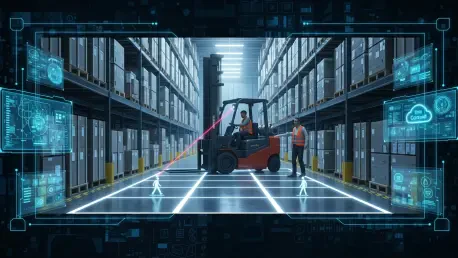

The volatile intersection of heavy machinery and human labor in high-throughput distribution centers demands a level of precision that traditional safety measures can no longer provide on their own. Yale Lift Truck Technologies addressed this challenge by launching a sophisticated pedestrian detection dashboard that integrates with existing telemetry and camera systems to create a unified safety ecosystem. This advancement marks a departure from reactive protocols, focusing instead on high-precision data to manage facility risks more effectively.
Bridging the Gap Between Material Handling and Intelligent Safety Systems
Modern warehouse safety relies on the synergy between lift truck hardware and advanced vision technology. By moving away from simple thermal sensing toward AI-driven feature recognition, the system identifies human figures up to five meters away. This capability ensures that managers receive accurate information about pedestrian proximity even in congested or dimly lit industrial environments where legacy sensors often fail.
Integrating telemetry with vision systems allows for a move beyond basic detection. The significance of high-precision data in high-throughput environments cannot be overstated, as it provides the foundation for data-driven facility management. Key market players are increasingly shifting toward these integrated solutions to maintain a competitive edge while ensuring worker protection.
Driving the Future of Intralogistics Through Real-Time Monitoring
The transition from reactive safety to proactive behavioral coaching represents a significant shift in fleet management. High-resolution photographic data provides specific context for every alert, allowing supervisors to see if an operator was in motion during an encounter. Audible cues and real-time visual signals shape operator habits instantly, reinforcing safer driving patterns through immediate feedback.
Market Projections and the Economic Impact of Automated Safety
From 2026 to 2028, the demand for integrated telemetry is expected to grow as thin-margin industries seek to minimize the massive costs associated with workplace accidents. Analyzing the return on investment for these systems reveals that reducing just a few incidents can offset the hardware expenditure. Performance indicators provided by the dashboard enable fleet optimization that balances speed with worker protection.
Navigating the Technical and Operational Obstacles of Modern Warehousing
Implementing these systems involves overcoming environmental hurdles such as high-congestion zones and sensor interference. Integrating hardware sensors with centralized cloud dashboards requires robust data architecture to avoid overwhelming facility managers with noise. Effective strategies must also address alarm fatigue, ensuring that operators remain attentive to legitimate threats without being desensitized by non-critical notifications.
Compliance and Standards in the Age of Automated Industrial Equipment
This technology aligns with international standards for workplace hazard regulations by maintaining detailed audit trails through telemetric data. Security protocols protect sensitive photographic information, ensuring that facility safety measures also respect operational privacy. Standardized safety protocols are becoming essential for global labor practices, providing a consistent framework for multi-site industrial operations.
The Horizon of Smart Material Handling and Predictive Safety
The next phase of material handling will likely involve autonomous intervention, where vehicles automatically decelerate based on pedestrian proximity alerts. Integration with 5G and the broader IoT landscape will facilitate seamless communication between multiple vehicles. Predictive safety models will use historical event mapping to anticipate potential accidents before they occur, optimizing spatial layouts to prevent human-machine conflict.
Synthesizing Data-Driven Insights for a Safer Industrial Workforce
The implementation of integrated safety ecosystems established a new benchmark for protecting the industrial workforce through continuous monitoring and targeted feedback. Management teams successfully leveraged granular data to transform behavioral safety culture across high-traffic zones. Future operations prioritized these predictive models to achieve a state of permanent accident prevention through spatial optimization.