
The global landscape of warehousing is undergoing a profound transformation, driven by the need for smarter, faster, and more reliable distribution networks. As the LogiMAT exhibition in Germany approaches, ZS Robotics, a prominent specialist in smart intralogistics, is preparing to showcase its latest breakthroughs in 4-way shuttle technology. This presentation aims to address the final complexities of automated deployment by focusing on the intersection of hardware innovation and software intelligence. The goal is to demonstrate how modern warehouses can achieve unprecedented levels of safety and operational fluidity while navigating the demands of a high-throughput economy.
Beyond mere technical displays, the upcoming showcase highlights a strategic vision for the European and North American markets. By examining the synergy between high-capacity machinery and intuitive control systems, the company provides a blueprint for overcoming common hurdles in warehouse automation. This evolution is particularly relevant as industries grapple with rising land costs and the urgent need to optimize existing footprints. Readers will gain insights into the specific technologies being debuted and the strategic frameworks that allow for seamless integration into diverse industrial environments.
The Evolution of Automated Storage and Retrieval Systems
To appreciate the significance of this upcoming debut, one must look at the historical progression of warehouse automation. For decades, traditional pallet handling relied heavily on manual forklifts and static racking, which often led to inefficiencies and safety risks. The shift toward Automated Storage and Retrieval Systems (AS/RS) marked a turning point, yet early iterations were frequently plagued by high installation costs and rigid configurations that limited adaptability. Understanding this background is essential, as it highlights why the focus on refined, adaptable 4-way shuttles represents the next logical step in solving spatial and labor constraints.
Industry shifts over the last few years have moved away from these monolithic structures toward modular, flexible shuttle systems. This transition reflects a broader market trend where scalability is prioritized over permanent, static infrastructure. By moving toward a decentralized model of automation, companies can now increment their capacity based on real-time demand rather than committing to massive upfront capital expenditures. This historical context sets the stage for a new generation of hardware that is designed to be as agile as the supply chains it supports.
A New Benchmark in Hardware Excellence
Engineering the #25: The World’s First 20-Wheeled Shuttle
The centerpiece of the current portfolio is the #25 shuttle, a machine designed to push the boundaries of mechanical stability. As the world’s first 20-wheeled 4-way pallet shuttle, it offers a substantial 1,500 kg load capacity while maintaining a surprisingly compact frame. The increased wheel count is not merely a design quirk; it distributes weight more effectively across the racking, which reduces structural wear and significantly enhances battery longevity. While high-capacity shuttles often face challenges regarding energy consumption, the #25 addresses these through precision engineering that ensures stability does not come at the cost of speed.
Space Optimization: The Single-Position Lift and #50 Model
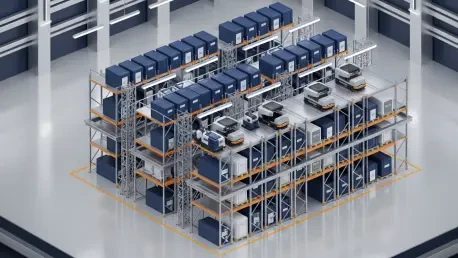
Building upon the heavy-duty capabilities of the #25, the company also introduces the #50—a “workhorse” model designed for high-frequency reliability in demanding environments. However, hardware is only effective if it maximizes the available footprint. To address this, the exhibit features a Single-Position Lift, a space-saving mechanism that occupies only one rack position. This innovation allows facilities to increase storage density significantly compared to traditional lift systems that require expansive corridors. By integrating these various components, businesses can navigate the trade-offs between storage volume and throughput, selecting a configuration that fits their specific environmental constraints.
The ZSmart Intelligent Platform: Bridging Hardware and Software
The complexity of managing a fleet of independent shuttles necessitates a sophisticated digital brain. The ZSmart Intelligent Platform serves as this central nervous system, utilizing advanced algorithms for warehouse control and cluster scheduling. One common misconception in intralogistics is that hardware alone determines efficiency; in reality, the software’s ability to prevent bottlenecks and optimize travel paths is what defines a successful deployment. ZS Robotics addresses this by offering a unified software suite that simplifies maintenance and installation, ensuring that the technology remains accessible to internal operators.
Global Shifts Toward Sustainable and Safe Automation
As the industry looks forward, the intralogistics sector is being shaped by the dual pressure of a chronic shortage of skilled labor and a global mandate for greener industrial practices. Current trends indicate a decisive move toward low-energy consumption systems that prioritize worker safety without sacrificing output. By securing international safety certifications, such as the EU CE mark, the company positions itself at the forefront of this shift. This focus on compliance and energy efficiency is no longer an optional feature but a core requirement for companies operating in highly regulated markets like Europe and North America.
Furthermore, the expansion into the Netherlands and the United States suggests a future where localized support and rapid deployment become the standard for global tech providers. This regional presence allows for more resilient and responsive supply chains in the face of economic volatility. As the demand for 4-way shuttle technology grows from 2026 to 2030, the ability to provide on-site technical expertise and spare parts will be the primary differentiator between experimental technology and a mature, enterprise-grade solution.
Strategic Frameworks for Implementing Smart Warehousing
For businesses looking to modernize, the transition to 4-way shuttle technology requires a holistic strategy. The major takeaway from over 200 successful projects is that automation is most effective when it is treated as an ecosystem rather than a series of isolated tools. Best practices suggest that companies should prioritize modularity, allowing them to scale their shuttle fleets as demand grows. Additionally, professionals are encouraged to look for user-centric systems where software interfaces are intuitive enough for internal staff to master, reducing long-term dependency on external vendors.
Applying these insights involves conducting a thorough audit of current pain points—such as vertical space wastage or high error rates—and mapping them to specific hardware capabilities. For instance, cold chain and pharmaceutical sectors benefit specifically from the high-density storage and low-temperature resilience of these automated systems. By aligning technological capabilities with sector-specific challenges, organizations can ensure a higher return on investment and a more sustainable operational model that stands up to the rigors of modern commerce.
Advancing the Maturity of Global Intralogistics
The debut at LogiMAT represented a significant milestone in the maturation of 4-way shuttle technology as a mainstream solution for diverse industries. From retail and 3PL to specialized sectors like pharmaceuticals, the ability to synthesize robust hardware with intelligent scheduling became the new benchmark for operational excellence. As the market moved toward a more automated and safety-conscious framework, the integration of hardware and software remained the most critical factor for success. Organizations that embraced these advanced systems effectively positioned themselves to handle the increasing complexities of a demanding global market. Strategies shifted toward localized support and modular scalability, ensuring that technology served as a flexible asset rather than a rigid constraint. Professionals recognized that the path to resilience lay in adopting user-centric platforms that empowered internal teams to maintain high throughput with minimal intervention.