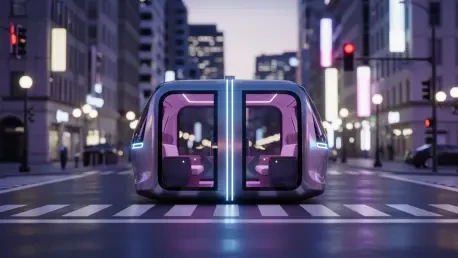

The traditional experience of grasping a steering wheel and scanning side mirrors is rapidly becoming a relic of the past as autonomous technology moves into its most ambitious phase. While many competitors are busy trying to teach standard internal combustion SUVs how to drive themselves, Amazon’s Zoox is taking a fundamentally different path by removing the driver’s seat entirely. The company has officially deployed a fleet of 100 purpose-built, bidirectional vehicles across the bustling streets of San Francisco and Las Vegas. This “toaster-shaped” design represents a radical departure from the retrofitted cars of the previous decade, signaling a shift toward a future where transportation is a service rather than a personal possession.
This transition is not merely about novelty; it is about the logistical evolution of urban mobility. By developing a vehicle that can drive in either direction without needing to U-turn, Zoox is optimizing the way passengers move through dense city centers. This Nut Graph moment highlights the company’s transition from a secretive Amazon subsidiary into a visible contender for the crown of the ride-hailing market. As testing expands into new territories like Austin and Miami, the stakes have never been higher for the tech giant’s massive capital investment.
Beyond the Retrofit: The Arrival of a Steering-Wheel-Free Future
The autonomous vehicle industry has long been defined by a “retrofit” mentality, where existing cars are burdened with bulky lidar rigs and computer stacks. Zoox, however, has discarded this baggage by creating a symmetrical vehicle designed specifically for passengers. Inside, riders find face-to-face carriage seating, which fosters a social environment that a traditional car cabin simply cannot provide. This layout maximizes interior volume while maintaining a compact footprint, making it ideal for navigating tight metropolitan corners where standard vehicles struggle.
Moreover, the bidirectional nature of the hardware eliminates the inefficiency of complex maneuvers in heavy traffic. Because the vehicle does not have a front or a back in the traditional sense, it can pull out of a driveway or a parking spot with equal ease in either direction. This design choice is not just a gimmick; it is a calculated move to reduce the physical stress on the vehicle’s components and simplify the artificial intelligence required to navigate urban grids. By focusing on the passenger experience from the first sketch, Zoox has bypassed the limitations that still haunt its more conventional rivals.
Why the Purpose-Built Approach Defines the Next Era of Mobility
Efficiency is the primary metric by which the success of autonomous fleets will be measured. Retaining a steering wheel and pedals in a robotaxi represents wasted space and unnecessary weight, both of which drag down the performance of an electric drivetrain. Zoox’s ground-up approach allows for a heavy-duty battery placement and a low center of gravity, ensuring a smooth ride that mirrors the quality of a luxury lounge. This architectural freedom enables the company to integrate sensors directly into the bodywork, protecting them from the elements and reducing the drag that typically plagues sensor-heavy retrofits.
As the company pushes into markets like Austin and Miami, it is testing the scalability of this specialized hardware in varied climates and road conditions. The industry is closely monitoring whether this high-cost, high-reward strategy will pay off compared to the software-first approach of other tech firms. If Zoox can prove that a purpose-built vehicle lasts longer and costs less to maintain over hundreds of thousands of miles, it will set a new gold standard for the entire mobility-as-a-service sector.
Strategic Scaling and the Integration with Global Ride-Hailing Networks
Building a world-class autonomous vehicle is only half the battle; the other half is ensuring there are passengers ready to pay for the service. To solve the problem of user acquisition, Zoox has entered a landmark partnership with Uber. Starting this summer in Las Vegas, riders will be able to summon a steering-wheel-free Zoox vehicle directly through the Uber app. This collaboration provides an immediate bridge to millions of active commuters, bypassing the need for Zoox to build a standalone consumer brand from scratch while they are still in the scaling phase.
This move creates a significant competitive hurdle for other players like Waymo and Tesla. While Waymo has an established lead in commercial operations using retrofitted minivans, Zoox’s integration into the Uber ecosystem gives it a massive distribution advantage. Furthermore, this strategy distances Zoox from Tesla’s Cybercab ambitions, as Amazon’s subsidiary already possesses a mature manufacturing infrastructure and a fleet currently navigating real-world traffic. By leaning on Uber’s existing network, Zoox can focus on operational uptime rather than marketing.
Navigating the Regulatory Part 555 Barrier to Commercialization
The most formidable roadblock standing in the way of widespread adoption is the “Part 555” exemption from the National Highway Traffic Safety Administration. Because the Zoox vehicle lacks traditional manual controls like mirrors and pedals, it does not meet standard Federal Motor Vehicle Safety Standards designed for human drivers. CTO Jesse Levinson has indicated that federal approval for a fully commercial service is nearing, which would allow the company to transition from its current employee shuttle program to a revenue-generating public utility.
Securing this regulatory green light is the final key to unlocking the Hayward, California factory’s full production capacity. Until this exemption is fully realized, the fleet remains in a high-tech limbo, operating for free or within limited testing parameters. A successful “Part 555” certification would not only be a win for Amazon but would also establish the legal precedent for all future unconventional vehicle designs in the United States. This regulatory milestone will determine how quickly these toaster-shaped pods become a common sight on American boulevards.
Framework for Achieving Long-Term Operational Efficiency in Autonomy
Zoox’s long-term viability hinges on a meticulous framework designed to offset the steep costs of proprietary engineering. By focusing on vehicle longevity, the company aims to run its machines 24/7, spreading the initial manufacturing cost over millions of miles of service. Unlike consumer electric vehicles that sit idle most of the day, these robotaxis are built for high-utilization cycles, featuring easy-to-clean interiors and modular components that can be swapped out quickly during maintenance windows at Amazon-managed logistics hubs.
- Maximize Vehicle Longevity: Engineering a chassis intended for continuous operation to lower the per-mile cost.
- Eliminate Human-Centric Design Waste: Removing pedals and columns to increase interior volume and simplify the electric drivetrain.
- Localized Market Saturation: Focusing on high-density cities to prove the revenue model before expanding to suburban areas.
- Hybrid Fleet Management: Using Amazon’s logistical expertise to handle charging and maintenance at scale.
The path forward for autonomous transit shifted toward a more integrated, service-oriented model. Stakeholders recognized that the success of these fleets depended on a combination of federal cooperation and localized infrastructure support. Cities began evaluating how dedicated pick-up zones and smart-grid charging stations could accommodate a surge in driverless traffic. Ultimately, the focus moved beyond the technology itself toward the creation of a seamless urban fabric where specialized hardware and digital networks functioned as one.