
Amid the escalating rhetoric of a new technological cold war, the bipartisan consensus in Washington to curtail the sale of advanced semiconductors to China is widely viewed as a prudent measure to safeguard national security. This prevailing logic dictates that providing a strategic rival with the building blocks of artificial intelligence is akin to handing them the keys to future global dominance. However, an alternative and perhaps more nuanced perspective challenges this entire framework, suggesting that what appears to be a threat could, in fact, be one of the most powerful instruments for maintaining peace. This counter-argument posits that deep, complex economic interdependence, particularly in critical sectors like high-performance computing, does not create a vulnerability but rather a powerful deterrent to military conflict. By weaving American and Chinese economies together through the indispensable threads of technology, the cost of war becomes prohibitively expensive for both nations, transforming commercial relationships into a bulwark against aggression. The ongoing debate over Nvidia’s sales to China, therefore, may be missing the larger strategic picture: that free and open trade in even the most sensitive technologies could be the key to a more stable global order.
The Interdependence Doctrine
Taiwan’s Silicon Shield as a Blueprint
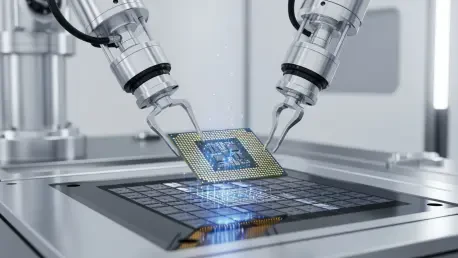
The most potent real-world example of this principle is Taiwan’s “silicon shield,” a concept that redefines national defense in the 21st century. The security of the island is often framed in terms of military alliances and defense capabilities, yet its most formidable protection may lie within the cleanrooms of Taiwan Semiconductor Manufacturing Company (TSMC). As the world’s most advanced chip manufacturer, TSMC is the linchpin of the global economy, producing the vast majority of cutting-edge processors that power everything from smartphones and data centers to advanced weaponry. The argument is that China is deterred from a full-scale invasion not solely by the threat of military reprisal, but by the certainty of catastrophic economic self-destruction. Even a minor disruption to TSMC’s intricate and irreplaceable operations would trigger a global economic depression, crippling supply chains and halting production across nearly every industry worldwide. This economic fallout would devastate China’s own export-driven economy, making the cost of military action unimaginably high. This “shield” demonstrates how strategic economic indispensability can function as a more credible deterrent than a fleet of battleships, creating a powerful incentive for all parties to maintain the status quo.
Critiquing the Consensus on Restriction
This logic directly challenges the prevailing American policy consensus, which views Nvidia’s chip sales to China through a narrow lens of technological containment. From both sides of the political aisle, policymakers argue that restricting access to high-end AI chips is essential to slow China’s military modernization and technological advancement. However, this perspective fails to appreciate the stabilizing power of mutual dependence. By framing the issue as a zero-sum game, restrictionist policies overlook the fact that severing these economic ties actively dismantles a key deterrent to conflict. When China’s burgeoning AI industry becomes deeply integrated with and reliant upon American technology from companies like Nvidia, the incentive to disrupt the global order that enables this progress is significantly diminished. The real national security threat, therefore, may not be the sale of these chips, but the continuation of policies designed to block them. Such restrictions not only represent a missed commercial opportunity for a leading American innovator but, more critically, they erode the very economic interconnectedness that makes the cost of war astronomical for all involved. In this light, the push to decouple is not a strategy for security but a pathway to a more dangerous and unstable world.
Economic Principles and National Security
Historical Arguments for Open Commerce
The case for using trade as a tool for peace is not a new or radical idea but is deeply rooted in centuries of economic and political thought. From a left-leaning perspective, it echoes the classical liberal ideal that commerce is a civilizing force that peacefully connects the world, replacing the zero-sum logic of military conquest with the positive-sum game of mutual exchange. When nations trade, they build relationships, foster understanding, and create shared interests that transcend national borders, making conflict less likely. From a right-wing, pro-growth viewpoint, the argument aligns perfectly with Adam Smith’s foundational principle of the division of labor. Smith argued that specialization and collaboration lead to far greater innovation and wealth creation than isolationist efforts. Applying this to the modern AI race, collaboration between the world’s leading American and Chinese experts, facilitated by the trade of essential hardware like Nvidia’s GPUs, promises technological leaps and economic benefits that neither nation could achieve alone. Current U.S. policies designed to restrict this collaboration are, in essence, a rejection of these time-tested principles, opting for a strategy of technological containment that risks stifling innovation and, ironically, increasing geopolitical friction by removing the peaceful outlet of commercial partnership.
Forging an American Shield
The analysis ultimately extended the “silicon shield” theory beyond Taiwan, applying its powerful logic directly to the United States itself. It was argued that by enabling a pivotal American company like California-based Nvidia to become an indispensable supplier to the entire world, including strategic rivals like China, the U.S. had fundamentally bolstered its own global importance and long-term security. The core principle remained the same: just as the global economy could not withstand the loss of Taiwan’s chip production, a world deeply enmeshed with and reliant upon America’s singular technological ecosystem made the United States itself more immune from direct attack. This strategic entanglement turned American innovation into a cornerstone of global stability. The immense wealth and technological advancement generated through the U.S.-China commercial relationship had elevated the potential cost of direct confrontation to an untenable level for both sides, creating a powerful, built-in incentive for the peaceful resolution of disputes. The national policy debate, therefore, should have decisively shifted from a narrow focus on containment to a more sophisticated strategy of deep, intentional economic integration, where American technological leadership was leveraged not as a wall, but as a bridge to a more secure and interconnected world order.