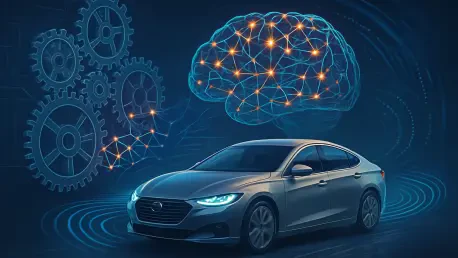

The shift from mechanical engineering to neural-network-driven intelligence has redefined the automotive industry, turning vehicles into mobile supercomputers that learn from their surroundings in real time. This transition marks the end of an era where hardware dictated a car’s capabilities, ushering in a period where software determines safety, efficiency, and the overall passenger experience. Modern autonomous software acts as a sophisticated cognitive layer, processing vast streams of data to make split-second decisions that were once the exclusive domain of human intuition.
The Evolution of Software-Defined Mobility
The industry has undergone a radical transformation, moving away from “AV 1.0” systems that relied on rigid, rule-based programming and highly localized maps. These early iterations were often fragile, struggling to adapt when faced with scenarios that fell outside their pre-defined parameters. In contrast, the current “AV 2.0” paradigm utilizes end-to-end machine learning, allowing the software to generalize its driving logic across diverse environments without needing a manual script for every possible obstacle.
This evolution facilitates the rise of hardware-agnostic solutions, which decouple the “brain” of the vehicle from the physical chassis. By separating software intelligence from manufacturing, developers can create systems that are compatible with various vehicle platforms. This modularity is essential for the broader integration of autonomous technology into smart cities, where vehicles must communicate with infrastructure and participate in a seamless, data-driven sharing economy.
Core Technical Innovations in Autonomous Software
Hardware-Agnostic: The Plug-and-Play Architecture
One of the most significant breakthroughs in the current landscape is the development of software models designed to function across heterogeneous sensor suites. Unlike proprietary systems that are hard-coded for specific camera placements or lidar specifications, these flexible architectures interpret data through a generalized abstraction layer. This adaptability allows a single software stack to power a wide range of transport options, from compact urban delivery pods to heavy-duty commercial trucks.
This shift supports a high-margin licensing model, which is proving far more scalable than the asset-heavy approach of managing a proprietary fleet. For automakers, this means they can integrate world-class autonomy into their existing lineups without the massive overhead of developing a full-stack AI from scratch. This strategy bridges the gap between luxury consumer vehicles and mass-market transit, ensuring that advanced safety features are not limited to premium segments.
Advanced Sensor Fusion and AI Integration
Modern autonomous software achieves environmental awareness through the simultaneous processing of inputs from cameras, radar, and lidar. This sensor fusion creates a redundant and highly accurate representation of the world, ensuring that the system remains functional even if one sensor is obscured by heavy rain or intense glare. The integration of machine learning allows the vehicle to predict the behavior of other road users, navigating complex urban intersections with a level of fluidity that mirrors human driving.
A critical performance characteristic of this new generation of software is its ability to operate without geofencing. By moving away from a total reliance on high-definition pre-mapping, these systems can explore new territories and handle unexpected road changes dynamically. This technical independence is the key to global scalability, as it allows vehicles to function in areas where detailed digital maps do not yet exist.
Market Dynamics: The Surge in Strategic Investment
The financial landscape of the autonomous sector has seen a massive influx of capital, driven by the realization that software will be the primary value-driver in future transportation. Recent funding rounds, including a landmark $1.5 billion investment led by a consortium of Microsoft, Nvidia, and SoftBank, signal a shift in market confidence. This capital injection is not merely about survival; it is about establishing a dominant position in an industry that is rapidly consolidating around the most effective AI models.
Furthermore, a collaborative spirit is replacing the isolated research silos of the past. Legacy automakers like Mercedes-Benz and Stellantis are increasingly partnering with software startups to accelerate their time-to-market. This cooperative investment strategy allows startups to challenge established giants like Tesla and Waymo by leveraging the manufacturing scale of traditional car brands while maintaining the agility of a tech company.
Real-World Applications and Deployment Strategies
Deployment strategies are evolving toward large-scale partnerships, such as the high-profile collaboration between Wayve and Uber. By integrating autonomous software into existing ride-sharing platforms, developers can gather massive amounts of real-world driving data while providing immediate value to consumers. These robotaxi pilots are currently expanding in major hubs like London and Silicon Valley, serving as the ultimate proving ground for software reliability in dense, unpredictable traffic.
Beyond ride-sharing, the integration of these systems into personal consumer vehicles is expected to accelerate from 2026 to 2030. Manufacturers are planning to offer autonomous features as over-the-air updates, allowing cars to become more capable over time. Additionally, the logistics sector is adopting this technology for last-mile delivery services, where autonomous pods can operate around the clock to optimize supply chain efficiency and reduce urban congestion.
Technical Obstacles and Market Challenges
Despite the rapid progress, achieving Level 4 and Level 5 autonomy remains a significant technical hurdle, particularly in extreme weather conditions like heavy snow or dense fog. These “edge cases” represent the final frontier for software developers, requiring even more robust neural networks to ensure total safety. Reliability is not just a technical requirement; it is a prerequisite for overcoming public skepticism and securing the trust of regulators who demand rigorous proof of safety.
The regulatory landscape remains fragmented, with different countries adopting varying standards for autonomous testing and liability. These inconsistencies can slow down global adoption, as software must be fine-tuned to comply with local traffic laws and cultural driving norms. Moreover, the high initial cost of sensor hardware and the R&D required for AI training continue to be market obstacles that must be addressed through economies of scale.
The Long-Term Outlook for Global Autonomous Systems
The transition from the current development phase to large-scale commercialization will likely be defined by breakthroughs in generative AI. By using synthetic data to train software in virtual environments, developers can simulate millions of dangerous scenarios without any real-world risk, significantly accelerating the safety-validation process. This will eventually lead to a more unified global transport network where interoperable software allows different vehicle brands to communicate and coordinate.
As these systems become more widespread, the impact on urban planning will be profound. Reduced traffic congestion and a decrease in the need for downtown parking lots will allow cities to reclaim space for green areas and pedestrian infrastructure. The long-term goal is a transport ecosystem that is not only autonomous but also fundamentally safer and more sustainable than the human-driven models of the past century.
Summary of the Technological Landscape
The shift toward flexible, software-centric models provided a clear roadmap for the future of the autonomous vehicle industry. It became evident that the ability to decouple intelligence from hardware allowed for faster innovation and broader market reach. This review found that the “AV 2.0” approach, characterized by end-to-end learning and hardware-agnostic design, was better suited for the complexities of global scaling than its predecessors.
The state of autonomous software reached a point where mass-market integration seemed not only possible but inevitable. Stakeholders began focusing on creating standardized frameworks to ensure safety across different platforms. This technological maturity suggested that the focus would now move toward optimizing the user experience and refining the commercial models that will support a fully autonomous society.