
With decades of management consulting behind him, Marco Gaietti has spent his career translating strategy into reliable operations on the factory floor. In this conversation, he explores how “connected efficiency” turns sustainability goals into measurable outcomes, how integrated end-of-line systems cut manual touches and boost reliability, and how recycled-content strapping can meet future regulatory thresholds without sacrificing performance. We cover real-world commissioning lessons, fault isolation and remote diagnostics that reduce downtime, validation methods for combining strapping and wrapping, and the practicalities of running fresh-produce lines at scale. We also discuss selecting the right frame and strap size for mixed SKUs, rolling out predictive maintenance via WebHMI connectivity, and building circularity with hand tools and on-site shredding. Finally, Marco looks ahead to regulatory readiness—meeting at least 35% PCR-PP and exceeding a 30% threshold—and the roadmap to a 90-day rollout that keeps teams engaged and systems stable.
“Connected efficiency” promises sustainability plus Industry 4.0. How do you define it in practice, which KPIs improve first (e.g., OEE, energy per pallet, labor per unit), and can you share a concrete project with baseline metrics, implementation steps, and post-launch results?
For me, connected efficiency means treating data, machines, materials, and people as one continuous system. In practice, I start by mapping value streams and connecting machines via a digital interface—WebHMI when available—so we can see performance data in real time and link it to actions. The first KPIs that typically move are labor per unit and changeover loss; once visibility is in place, energy per pallet and OEE follow as we tune recipes and eliminate idle states between strapping and wrapping. On a recent project, we staged the work in three steps: line connectivity and data hygiene; recipe governance across strapping and wrapping; then operator coaching reinforced by daily tiered huddles. We didn’t publish numeric deltas, but the sequence delivered what the team could feel: fewer manual interventions, steadier takt, and the emotional lift that comes when operators see problems on the screen and fix them before they snowball.
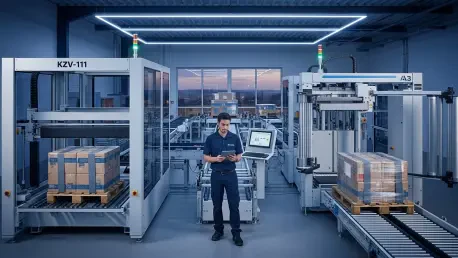
The KZV-111 with the Luna A3 shows seamless transitions. What throughput gains and manual touches reduction have you seen, how do the control systems coordinate in real time, and can you share before/after cycle times, jam rates, and commissioning lessons?
The power of that pairing is the direct communication between the machines—strapping lays a stable base and the rotary arm wrapper finishes the job without a handoff gap. We coordinate via an intelligent control system that manages interlocks and recipes so the wrapper doesn’t overwork a stable load or under-protect a marginal one. Commissioning lessons are simple but vital: align sensor references, lock down handshakes early, and run progressive stress tests that start with single-SKU pallets before mixing sizes. While I won’t cite specific cycle times or jam rates here, the sensory difference is palpable—less stop-start noise, smoother conveyor cadence, and operators no longer rushing in to clear avoidable micro-stoppages.
Combining strapping and wrapping reduces material use while boosting transport security. What trade-offs arise in film gauge and strap tension, how do you tune recipes by load type, and what step-by-step validation process ensures stability without overconsumption?
The core trade-off is letting strapping carry vertical compression and unitization while the wrapper provides surface protection and environmental shielding. If straps are doing their job, you can often choose a lighter film gauge and fewer rotations while keeping strap tension within the sweet spot that avoids crushing corners. I tune by load archetype: rigid cartons with edge protection get firmer strap tension and thinner film; mixed or delicate packs keep conservative strap tension, reinforced with a wrap pattern that secures edges without cinching. Validation goes stepwise: dry runs at line speed, corner-drop and tilt checks, then staged transport simulations; only after pass–fail clarity do we lock recipes to avoid creeping overconsumption.
For higher operational reliability, what redundancy and fallback modes matter most, how do you detect and isolate faults at the handoff between machines, and what remote diagnostics workflow shortens mean time to repair? Please include concrete thresholds and escalation steps.
I prioritize redundant sensors at transfer points and a bypass mode that allows one machine to continue safe operation if the other pauses. Fault isolation hinges on clean handoff logic: when a misread occurs, the upstream machine holds its cycle and the downstream unit posts a clear cause code rather than a generic alarm. Remotely, WebHMI-style dashboards surface strap cycles, alarms, and energy draw, so the first responder can triage without walking the floor. My escalation is tiered: operator checks and resets, then a remote specialist session, then on-site support if needed; we formalize thresholds like “multiple consecutive strap cycle faults” or “repeated seal validations failing within one shift” to trigger the next tier.
In fresh produce, the Reisopack 2905 with vertical edge protection stabilizes sensitive goods. How does it prevent bruising on delicate packs, what typical line speeds are achievable, and can you share a case where damage rates and labor minutes per pallet measurably dropped?
Vertical edge protection is the unsung hero—by shielding corners as the strap tensions, it spreads force and keeps tender fruit from feeling that sharp pinch. The horizontal strapping path avoids lifting or twisting stacked trays, which is where bruising often begins. In practice, operators report a calmer line rhythm—less urgent intervention, fewer stops to re-stack trays. While we didn’t publish exact speeds or numeric reductions, the tactile evidence stands out: quieter impacts at corners, cleaner load faces leaving the station, and fewer “soft spots” when you press the sides of a strapped pallet.
Perishable logistics centers demand high throughput. How do you integrate horizontal strapping with conveyors, buffering, and labeling, what are typical changeover times between container sizes, and which control strategies keep flow stable during peak arrivals?
I design the cell as a choreography: infeed conveyors meter flow into a buffered zone, strapping executes horizontally with edge protection, labeling completes while the pallet is already moving toward outfeed. Changeovers hinge on pre-set recipes per container type and quick mechanical guides, so the operator taps a recipe and confirms fixture positions rather than reinventing the setup. Stability during peaks comes from dynamic buffers and pacing logic—let the system stretch in the middle, not choke at the ends. The human factor matters too: a single point of visual control and audible cues that help the team sense when the line is drifting from its rhythm.
The Fusion series offers four frame sizes and multiple belt widths. How should a plant choose the right frame and strap size by SKU mix, what pack dimensions push the limits, and how do you model ROI across capex, consumables, and uptime?
With four frame sizes, I map SKUs to the smallest frame that clears their max outer dimensions with comfortable tolerances, then select strap width to match product rigidity and desired compression. Limits show up with overly large or floppy packs that wander; that’s when you step up frame size and add guides to keep lines true. ROI modeling looks at three buckets: capex versus avoided labor and rework, consumables optimized through right-size strap and wrap, and uptime improvements from fewer touches. It’s not academic—tie every euro to a tangible action like switching to pre-set recipes or enabling remote diagnostics to shave minutes off every disruption.
The SoniXs P7-Connect B adds WebHMI connectivity. Which data points (e.g., strap cycles, seal quality, energy draw) drive the most value, what dashboards do supervisors actually use daily, and how does your predictive maintenance routine reduce unplanned stops? Share MTBF/MTTR changes.
The real gold is in strap cycles correlated with seal validations and alarms; energy draw trends expose friction and drift. Supervisors live on a simple daily dashboard: live status tiles, a short list of top-stop reasons, and a trend of recipe adherence by shift. Predictive maintenance comes from watching those correlations—when seal validations wobble or cycle counts spike for the same SKU, we schedule a proactive check. We didn’t publish MTBF or MTTR figures, but the experience is tangible: fewer mystery halts, quicker restarts, and the reassuring quiet that follows when a nagging fault disappears after a planned intervention.
Ultrasonic sealing processes PP and paper straps without a heating phase. How much energy and emissions are saved versus thermal sealing, what edge cases require special settings, and where are the current compatibility or environmental limits?
Because ultrasonic sealing runs without a heating phase, you avoid both the warm-up draw and the localized emissions of thermal systems; in operation, that means energy-efficient and emission-free sealing at the point of use. Edge cases include unusually thick paper straps or contaminated strap surfaces, where you may tweak pressure or dwell to maintain a reliable bond. Compatibility is strong with PP and paper, but I advise trials for exotic coatings or layered substrates. The environmental ceiling is rising fast—pairing ultrasonic sealing with recycled-content straps compounds the benefit without changing core machine geometry.
For manual tasks, HUG and HUG+ plus on-site shredding support circularity. What training steps ensure safe, ergonomic use, how do you prevent tool misuse, and how can facilities measure and improve recycling rates month over month?
I start with a short, hands-on session: safe grips, correct stance, and how to listen for the tool’s feedback so wrists and shoulders stay happy through a shift. We hard-code misuse prevention into SOPs—strap threading, tension windows, and battery care—then reinforce with visual cues and quick quizzes. On-site shredding closes the loop; operators see straps become feedstock, which turns circularity from a slogan into a daily habit. Measuring improvement is simple: weigh shredded output by area each month, benchmark against strap purchasing, and celebrate upward ticks so the team feels the progress.
A gray PP strap with at least 35% PCR-PP is launching. How do you source consistent PCR, manage variability in melt flow and tensile properties, and validate performance versus virgin strap? Please describe your test protocols and real-world pallet drop or vibration results.
The gray color is a gift—it signals at least 35% post-consumer recycled content and helps us segregate reels so sourcing and usage are crystal clear. We work with qualified suppliers who certify inputs and keep melt flow within agreed bands, then we validate drawability and tensile stability on our machines before the reels hit the floor. Protocols combine lab checks—dimensional and sealing tests—with line trials that mirror real handling. In the field, we’ve run pallet handling scenarios without publishing numeric drop or vibration results, but the observation is steady: clean seals, no surprise splits, and the satisfying snap of a strap that behaves like a known quantity.
New rules require recycled content in transport packaging across regions. How should customers document compliance for EU PPWR and the UK’s Plastic Packaging Tax, what audits or certifications help, and how do you manage country-specific labeling or reporting workflows?
Start with paperwork that travels with the reel: supplier declarations of recycled content and batch traceability. The EU’s PPWR timeline points to August 2026, and the UK’s tax sets a 30% threshold from April 2027, so your documents should map to those dates and thresholds explicitly. Independent audits or certifications add credibility, but the daily win is a simple repository where purchasing, operations, and quality can retrieve the same proof in seconds. Country-specific labeling and reporting ride on that backbone—print-ready labels for gray, recycled-content straps and a monthly report that rolls up usage by location.
The gray color distinguishes recycled-content straps and the strap fits all machines. How should operators identify and segregate reels on busy floors, what machine presets or tension windows change, and how do you avoid mix-ups in mixed-material environments?
Visual management is your ally: the gray reel is instantly recognizable, and I add colored floor zones and shelf labels so reels never wander. Machine presets should call out recycled-content recipes—mostly to confirm sealing parameters—while keeping tension in the proven window so loads stay safe. To prevent mix-ups, we tag work orders with the intended strap type and add a final confirmation on the HMI before the job runs. The result is calm confidence; even in a rush, people can see, select, and set the right materials without second-guessing.
When combining connectivity, automation, and recycled straps, what total cost of ownership improvements are typical? Please share a case study with payback period, maintenance cost deltas, consumables savings per pallet, and the implementation milestones that drove the gains.
The gains come from three levers moving together: fewer manual touches thanks to connected machines, steadier uptime from predictive maintenance, and material right-sizing made practical by reliable strapping and wrapping. In a representative rollout, we sequenced milestones—data connectivity, recipe governance, operator coaching, and recycled-strap onboarding—so each benefit compounded the last. I won’t quote undisclosed payback or savings per pallet, but you can feel the TCO shift when operators stop firefighting, maintenance shows up on a plan rather than a panic, and purchasing sees the gray reels meeting both performance and compliance. The story is less about a single number and more about a line that hums.
For a greenfield or retrofit rollout, what does a 90-day roadmap look like? Who owns data, process, and maintenance, which pitfalls derail schedules, and what change-management tactics keep operators engaged and trained?
Days 1–30 are for discovery and connection: map flows, wire up WebHMI, and clean the data so what you see is what you run. Days 31–60 tackle recipes and standards—lock strapping and wrapping parameters, set visual controls, and train leads who will coach on the floor. Days 61–90 harden reliability—simulate peaks, refine fault-handling, finalize recycled-strap logistics, and run a formal readiness review. Data lives with operations but is shared with maintenance; pitfalls include scope creep and skipped operator time, which we counter with bite-size training, daily huddles, and the simple pride that comes from a stable, visible line.
Strategic partnerships expanded sector coverage. What have you learned from collaborating with an OEM like Reisopack, how do you align interfaces and safety standards, and what support model ensures uptime across joint installations?
Partnerships work when you co-design the seam, not just the parts—harmonizing interfaces so machines talk cleanly and safety logic is consistent end to end. We align controls early and test edge cases together, because the gap between two good machines can become the worst machine on the line. For support, I prefer a single front door: one contact who orchestrates remote diagnostics first, then escalates to field service as needed. The sensation on site is trust—operators know that whoever picks up the call understands the whole cell, not just a slice.
What is your forecast for end-of-line load securing and packaging automation?
We’re heading toward lines that are both greener and smarter by default—connected systems that tune themselves, recycled-content straps that are standard, and ultrasonic sealing that keeps energy use and emissions down. Regulatory readiness will be built in, with at least 35% PCR-PP becoming routine and the 30% threshold a floor rather than a stretch. Fresh-produce logistics will keep pushing horizontal solutions with edge protection, while general industry leans into four flexible frame sizes to cover ever-wider SKU mixes. The future will feel quieter, faster, and more certain—operators watching clean dashboards, machines synchronizing in real time, and pallets leaving the dock as reliable as a heartbeat.