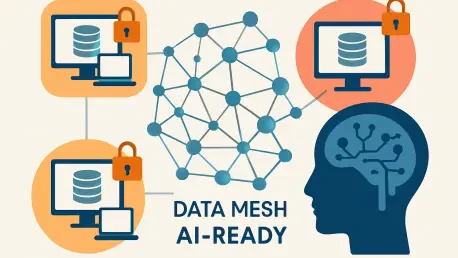

High-performance artificial intelligence models are only as effective as the underlying data streams that feed them, making the shift from monolithic storage to agile data products a non-negotiable step for modern enterprises. As organizations transition away from experimental pilots toward full-scale deployment, the fragility of traditional data pipelines becomes a significant hurdle. Efficiency in this landscape requires more than just better hardware; it demands a fundamental restructuring of how information is curated, owned, and distributed across the corporate ecosystem. This article examines the intersection of data mesh architecture and domain ownership, providing a roadmap for turning chaotic data lakes into refined, AI-ready assets.
The objective is to address the most pressing questions regarding decentralized data management and its impact on machine learning readiness. By exploring the mechanisms of federated governance and the practicalities of treating data as a product, the content provides a clear understanding of how to dismantle organizational bottlenecks. Readers can expect to learn about the shift in responsibility from central IT to business units and how this transition supports both innovation and regulatory compliance.
Key Questions: Charting the Path to Data Maturity
Why Are Traditional Centralized Data Architectures Struggling to Support Modern AI Initiatives?
For decades, the standard approach to data management involved funneling information from every corner of the company into a single, massive warehouse or data lake. This centralization was intended to create a single source of truth, yet it frequently resulted in the creation of a massive bottleneck. As the volume and variety of information grew, the central data team became overwhelmed, unable to keep pace with the specific needs of various business units. This friction is particularly visible now that AI requires high-quality, high-velocity data to remain relevant and accurate.
Modern AI initiatives demand a level of agility that centralized teams simply cannot provide. When a marketing team needs a specific set of customer behaviors to train a predictive model, they often wait weeks or even months for the central IT department to process the request. Recent industry observations suggest that over half of large organizations still find their data environments insufficient for AI requirements. The architecture that was designed to provide control has instead provided stagnation, making it nearly impossible to iterate on machine learning models at the speed the market requires.
How Does the Concept of Data Domain Ownership Transform Data Management into a Strategic Advantage?
Moving toward a model of domain ownership means that the people who closest to the data are the ones responsible for its quality and accessibility. In this framework, a department like finance or sales no longer just generates data for someone else to clean; they own the lifecycle of that information. This shift ensures that those with the most context are the ones making decisions about how the data should be structured and governed. It removes the “lost in translation” effect that occurs when a central team tries to interpret data they did not create.
This transformation turns data from a dormant byproduct of business operations into a strategic asset. When domain experts are empowered to manage their own information, they can produce data products that are tailored for specific use cases, such as real-time sentiment analysis or supply chain optimization. By distributing the workload across the entire enterprise, the organization gains the ability to scale its AI efforts horizontally. This distributed responsibility fosters a culture of accountability, where data quality is viewed as a prerequisite for business success rather than a chore for the IT department.
What Role Does the Data Mesh Architecture Play in Balancing Decentralization With Corporate Standards?
The primary concern with decentralization is the potential for chaos, where every department uses different formats and definitions, leading to a fragmented ecosystem. Data mesh architecture addresses this by introducing the concept of federated governance. While individual domains own their data, they must adhere to a set of global standards that ensure interoperability. This is achieved through a self-service data platform that provides the necessary tools and templates for teams to build data products that remain compatible with the rest of the enterprise.
A successful data mesh functions much like a well-regulated marketplace. Each stall, or domain, offers its unique products, but they all use the same currency and follow the same safety regulations. The central platform acts as the infrastructure, providing the “paved path” for security, discovery, and access control. This balance allows for local autonomy without sacrificing the ability to join data from disparate sources. Consequently, data scientists can pull reliable information from multiple domains to train complex models without having to manually clean every new set of records they encounter.
In What Ways Does Data Mesh Assist Organizations in Navigating Complex Regulatory Frameworks?
As global regulations regarding artificial intelligence and data privacy become more stringent, the need for transparent and auditable data practices has never been higher. Frameworks like the EU AI Act require organizations to demonstrate data provenance and quality, particularly for high-risk systems. A data mesh naturally supports these requirements by embedding governance into the data product itself. Because every asset has a clear owner and a defined set of attributes, providing evidence of compliance becomes a streamlined process rather than a forensic nightmare.
The federated model allows for the automation of policy enforcement through code. Instead of relying on manual checks that are prone to human error, the data platform can automatically apply security protocols and privacy masks as data is produced. This capability ensures that documentation and monitoring are continuous rather than periodic. By shifting governance to the point of origin, organizations can satisfy the demands of regulators while maintaining the speed necessary for innovation. This structural alignment makes compliance a byproduct of the operational flow rather than a separate, costly hurdle.
What Are the Practical Steps for Implementing a Data Mesh and Domain Ownership Model Successfully?
The transition to a decentralized model should never be an overnight overhaul; instead, it requires a staged approach that demonstrates value early on. A common strategy involves the “show, shift, and scale” methodology. During the initial phase, a pilot project is launched within a single domain to solve a specific business problem, such as improving trial diversity in life sciences or optimizing inventory in retail. This pilot serves as a proof of value, operating in a sandbox environment where new processes can be tested without disrupting the entire organization.
Once the pilot proves successful, the focus moves toward shifting the organizational culture and infrastructure. This involves defining new roles, such as data product owners, and training staff on how to use the self-service platform. The final stage is scaling these practices across all business units, which requires significant change management and executive support. Success in this journey is measured not by the amount of data moved, but by the reduction in time-to-market for new AI applications and the increased trust users have in the information available to them.
Summary: Recap
The move from centralized data management to a decentralized data mesh represents a shift in both technology and mindset. By establishing data domain ownership, companies ensure that those with the most context are responsible for the quality and delivery of information. This model reduces the bottlenecks that have traditionally plagued AI initiatives, allowing for faster iteration and more reliable results. Federated governance acts as the glue, maintaining enterprise-wide standards and ensuring that local autonomy does not lead to global fragmentation.
Furthermore, the data mesh provides a robust foundation for meeting the evolving demands of global AI regulations. The ability to treat data as a product with built-in transparency and provenance simplifies the compliance process and builds trust with stakeholders. Implementing this change through a phased approach—starting with targeted pilots and expanding through a self-service platform—enables organizations to modernize their data architecture without causing operational paralysis. Ultimately, the goal is to create an environment where data is a fluid, accessible, and high-quality fuel for the next generation of intelligence.
Conclusion: Final Thoughts
The decision to adopt a data mesh and embrace domain ownership was a pivotal moment for enterprises looking to survive the transition into an AI-saturated market. Organizations that recognized the limitations of their centralized legacy systems were able to pivot toward a more resilient and scalable structure. This shift required more than just technical adjustments; it necessitated a complete cultural realignment where data quality became everyone’s business. By distributing the responsibility for data assets, these companies effectively removed the single points of failure that previously slowed their growth.
Moving forward, the focus should shift toward the continuous refinement of the self-service ecosystem. As AI models become more sophisticated, the metadata and contracts associated with data products will need to evolve to support even more complex interactions. Leaders must remain vigilant in fostering collaboration between domains to prevent the emergence of new, localized silos. The journey toward being AI-ready is an ongoing process of adaptation, where the architecture must be as dynamic as the technology it supports. Investing in these foundational changes now ensures that the organization remains agile enough to leverage whatever breakthroughs the next wave of innovation brings.