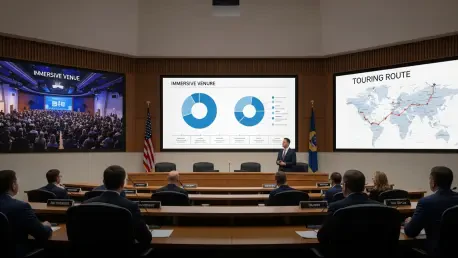

A venue that was widely dismissed as a billion‑dollar misfire ended up vaulting to the top of global gross rankings, and that reversal forced a hard question that shaped this analysis: if a single, format-defining build can seize demand so quickly, how durable are monopoly claims about live entertainment’s gatekeepers. The Las Vegas Sphere transformed from a pandemic-delayed overrun to a destination draw, unsettling the view that scale and ticketing control alone dictate outcomes.
This analysis evaluates whether the Sphere’s ascent meaningfully weakens the thesis that Live Nation holds entrenched power. It frames the issue through market signals, capital risk, innovation velocity, and regulatory posture, then projects how immersive venues, residencies, and content flywheels could reorder competition. The goal is to help operators, artists, investors, and policymakers recalibrate strategy amid a market that punishes complacency and rewards distinctive experiences.
Market Context and Purpose
The core dispute is not whether concentration exists, but whether it fixes market structure. Live Nation’s blended model—promotion, venues, and ticketing—invited scrutiny for years, culminating in intensified antitrust action two years ago. Yet volatility has remained the norm: the company endured a severe pandemic drawdown, then posted outsized recovery, a pattern inconsistent with static dominance.
The Sphere complicated the picture. Built under heavy skepticism, it carried the hallmarks of a doomed capex cycle: late delivery, rising costs, and a fragile tourism backdrop. Investor sentiment mirrored those fears, with the stock tied to the project languishing near $26 before climbing to roughly $129 within a year as attendance, programming, and sponsorship traction surprised to the upside. Such price discovery suggested that new formats can reprice the entire category.
Industry Backdrop and Reset
Live entertainment has long swung with consumer confidence, artist routing, and technology. The merger that placed promotion and ticketing under one corporate roof standardized parts of the value chain, but it did not erase cyclicality. Streaming expanded fan bases while compressing margins for generic touring, pushing producers to deliver higher-intensity shows to justify price.
The pandemic reset the ledger. Capacity restrictions crushed revenue, then pent-up demand turned into a touring boom. That whiplash, coupled with dynamic pricing and premium tiers, showed how quickly buyer behavior could move. In this environment, the Sphere’s thesis—immersion over throughput—emerged as a credible alternative to multipurpose arenas.
Performance Signals and Competitive Dynamics
The Sphere’s about-face from likely flop to category leader undercut claims of entrenchment. Attendance surged, residencies anchored programming, and media coverage amplified destination appeal. The market’s response was clear: consumers prioritized experience novelty over legacy routing power. If incumbency alone controlled demand, this outcome would have been unlikely.
Live Nation’s own path echoed that volatility. A dramatic contraction followed by record activity signaled that perceived power can swing with macro shocks, artist supply, and consumer sentiment. Importantly, the Sphere’s success did not rely on controlling ticketing rails; it relied on product differentiation—LED architecture, spatial audio, cinematic assets—and residency economics that stabilized utilization and marketing.
Monetization Flywheels and Substitution Effects
What looked like a venue became a content platform. Residency shows generated reusable visual assets, cross-sold hospitality, and attracted sponsors seeking spectacle-level reach. As content libraries grew, so did optionality: filmed experiences, limited theatrical windows, and branded integrations extended revenue per show beyond seats.
This created substitution pressure. When destination residencies capture headlines and deliver blockbuster average revenue per attendee, some artists and consumers reweight away from sprawling tours. That shift does not eliminate promoters’ leverage, but it blunts legacy advantages built on routing density and network access.
Capital Risk and Barriers That Cut Both Ways
High capex is a double-edged sword. If creative misses or tourism slows, returns compress fast; if programming resonates, the moat widens through artist preference, earned media, and distinctive IP. Traditional arenas defend with diversified calendars, yet the Sphere’s format reset changed the basis of competition from capacity maximization to immersion leadership.
Entry remains hard but not impossible. Financing partnerships with technology vendors, revenue-sharing with artists, and co-produced content reduce upfront risk. Modular immersive theaters and retrofits in major hubs further expand contestability, drawing studios, streamers, and gaming firms into live events via hybrid offerings.
Regulatory Framing and Market Measurement
Antitrust cases often hinge on static market definitions. However, the Sphere’s rise illustrated that market boundaries—concerts versus cinematic experiences—are porous. Once consumers treat immersive residencies as substitutes for tour stops, legacy share metrics lose predictive power. In practice, demand flowed toward the best experience, not the deepest distribution pipeline.
A dynamic assessment would emphasize speed of entry, innovation cycles, and consumer switching. Conduct that forecloses new formats warrants scrutiny, but scale alone becomes a weak proxy for harm when distinctive venues can emerge and win despite incumbent reach. The lesson was straightforward: the target kept moving.
Outlook and Scenarios
The base case pointed toward more Sphere-like builds in global tourism nodes, plus smaller, modular spaces in regional markets. Competitive advantage would lean on creative IP, residency deals that balance risk and upside, and rapid content refresh powered by real-time rendering, AI-driven visuals, and sensor-rich interactivity.
In a bullish scenario, tentpole residencies and media rights created durable libraries, sponsorship deepened, and venues exported content to cinemas and streaming, extending ROI. In a bearish case, capex piled up as novelty faded, tourism softened, or rivals copied core features quickly, compressing margins and bargaining power.
Strategic Implications
Operators gained by differentiating the product, not just the lineup: invest in immersion, flexible staging, and content that can be re-monetized across channels. Artists benefited from mixing broad exposure with high-impact residencies, securing upside in filmed assets and premium tiers tailored to venue canvases. Investors sized for volatility, underwriting capex with visible content pipelines and diversified revenue beyond tickets.
For policymakers, the most effective path focused on conduct that blocks innovation—exclusionary contracting, retaliatory practices—rather than penalizing scale per se. Market health was better gauged by entry speed, switching behavior, and format substitution than by static shares.
Conclusion
The data and behavior patterns indicated that live entertainment competition was more fluid than monopoly narratives suggested, and the Sphere’s surge served as a vivid demonstration. Distinctive formats redirected demand, challenged distribution moats, and forced incumbents to adapt. Strategy that prioritized immersion, content flywheels, and flexible deal structures proved more resilient than scale alone, while policy that targeted anti-innovative conduct offered the clearest path to preserving dynamism.