
As the Operations Manager at AKON Curtains Limited, Scott Fullerton stands at the intersection of logistical efficiency and industrial sustainability. With the cold chain sector contributing a massive £14 billion in gross value added to the economy, the pressure to maintain profitability in the face of skyrocketing utility costs has never been higher. Fullerton’s expertise lies in identifying the “invisible” energy leaks that plague high-traffic distribution centers, offering a perspective that moves beyond traditional refrigeration plant maintenance to focus on the physics of air movement and the strategic use of flexible zone separation.
With energy costs for cold storage facilities jumping by nearly 50% in a single year, how has the role of energy shifted from a standard overhead to a core competitive variable for logistics operators?
The reality on the ground is that energy is no longer a background cost that can be ignored; it has become a defining factor in whether a facility remains profitable or falls behind. In 2023 alone, the industry saw cold-chain energy costs surge by 46%, forcing operators to look past their refrigeration plants and evaluate every aspect of their thermal envelope. When you are operating in a sector that adds £14 billion in value to the economy, these sharp increases represent a massive drain on resources that could otherwise be used for expansion. We are seeing a shift where logistics managers must treat every BTU of escaped cold air as a direct loss to their bottom line. It’s no longer just about keeping food frozen; it’s about the surgical management of temperature zones to ensure that expensive refrigerated air isn’t simply being pumped out into ambient spaces.
Many operators focus on upgrading their refrigeration hardware, yet you’ve noted that air movement is often a much larger source of energy loss. Could you elaborate on why infiltration is such a silent killer for warehouse efficiency?
While insulation and plant efficiency are important, they often pale in comparison to the sheer volume of energy lost through open doorways and constant traffic. According to data from the ASHRAE Handbook of Refrigeration, heat gain from infiltration air can actually account for more than 50% of the total refrigeration load in a high-throughput distribution warehouse. Think about a modern fulfillment center where doors are opening and closing hundreds of times a day to move goods between a chilled pick face at 8°C and a frozen zone at -18°C. Every time that seal is broken, you have an uncontrolled exchange of air where the cold air literally spills out and the warmer air rushes in to take its place. This creates a massive rebound effect where the refrigeration system has to work overtime just to stabilize the environment, leading to a cycle of over-cooling that is incredibly expensive.
When implementing physical zone separation like PVC curtains or insulated walls, what kind of measurable performance improvements can a facility manager expect to see?
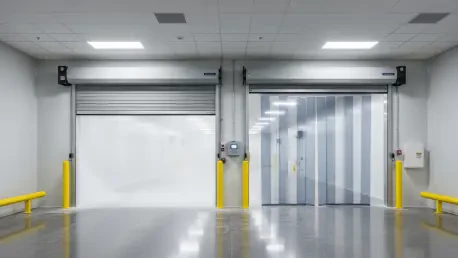
The impact of high-quality zone separation is immediate and can be quite dramatic if the materials are maintained correctly. Peer-reviewed research indicates that strip curtains in good condition can reduce doorway air infiltration by as much as 90%, which directly slashes the workload on the refrigeration units. However, this isn’t a “set it and forget it” solution; the effectiveness drops off significantly if the curtains are gapped, damaged, or poorly overlapped. You can physically feel the difference at the threshold—rather than a chaotic bleed of cold air into warmer neighboring zones, the air stays partitioned, allowing each area to be held exactly where it needs to be. This precision prevents the common problem of “over-cooling” where an operator tries to compensate for leaks by dropping the thermostat even lower than necessary.
Third-party logistics (3PL) providers often deal with fluctuating inventory and changing client needs. How does the flexibility of curtain systems compare to traditional permanent construction in these environments?
Flexibility is perhaps the greatest operational advantage of using curtain systems over fixed, permanent walls. In a 3PL environment, space requirements are never static; a zone might need to expand or contract based on a new contract, a seasonal surge, or a change in the product mix. Warehouse curtain dividers allow an operator to reconfigure their chilled zones without the need for a massive, disruptive construction project that would halt operations. You can essentially move a wall or create a new temperature-controlled cell over a weekend, protecting both your capital and your continuity of operation. This adaptability is crucial because it allows the facility to evolve alongside the business, rather than being stuck with a rigid layout that becomes inefficient as soon as the inventory profile changes.
As the industry faces the UK’s legally binding 2050 Net Zero targets, how do these types of thermal interventions fit into a broader corporate sustainability strategy?
The path to Net Zero is often portrayed as requiring massive capital investments in new technology, but zone separation is one of the most straightforward and effective interventions available today. The Cold Chain Federation’s ongoing work emphasizes measurable energy reductions, and reducing the refrigeration load at the source is the most logical first step. By installing better separation systems, an operator can achieve meaningful carbon footprint reductions without having to replace their entire plant or shut down for weeks. It aligns perfectly with the 2050 goals because it addresses waste directly; there is no greener energy than the energy you simply don’t have to use in the first place. This makes it a rare “quick win” in the logistics world—a way to hit environmental targets while simultaneously improving the financial health of the facility.
Beyond thermal efficiency, what are the critical safety and regulatory standards that must be met when partitioning a large-scale distribution center?
Safety can never be sacrificed for the sake of energy savings, and any internal partitioning must be integrated into the building’s overall fire strategy. It is vital that curtains do not obstruct escape routes, interfere with fire detection systems, or impede sprinkler coverage as outlined in BS EN 12845. We always advise operators to ensure their fabrics are certified to BS 5867 Part 2 Type B and possess the appropriate BS EN 13501-1 Euroclass rating for the specific environment. Managers should never just take a salesperson’s word for it; they need to check the manufacturer’s actual test certificates to ensure compliance with the Regulatory Reform (Fire Safety) Order 2005. When handled with this level of technical rigor, zone separation becomes a powerful tool that enhances the facility’s performance without introducing new risks to the workforce.
Do you have any advice for our readers?
My best advice is to stop viewing energy loss as an unavoidable cost of doing business and start looking at your doorways as the primary source of your savings. Many operators are surprised to find that simply maintaining their existing strip curtains or upgrading to a more robust insulated partition can yield a better return on investment than almost any other facility upgrade. Take a walk through your warehouse and pay attention to where you feel a draft; if you can feel the temperature change before you even reach a zone, you are essentially watching money evaporate into the air. By tightening these zones and treating air movement as a manageable variable, you can protect your margins even as energy prices remain volatile and the pressure to reach Net Zero continues to mount.