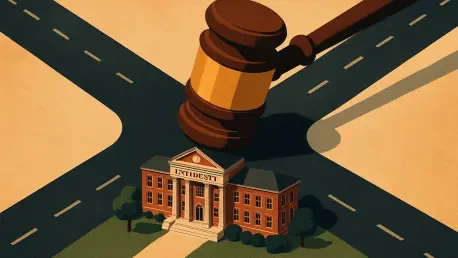

The landscape of American higher education is currently navigating a precarious intersection where legal caution often overrides the fundamental mission of intellectual inquiry and open debate. This phenomenon, increasingly recognized as suppressive compliance, involves university administrations preemptively adopting the most restrictive possible interpretations of state legislation to avoid potential political conflict or litigation. Instead of merely adhering to the letter of the law, many institutions are now effectively self-censoring their curricula and support services long before a judge or regulator even reviews their programs. This proactive retreat creates a moving target for compliance, where policies change not because the law has evolved, but because the political temperature has shifted. Consequently, the mere threat of a lawsuit or a budget cut has become a powerful tool for restructuring public universities, turning academic centers into risk-averse corporate entities.
The Administrative Shift Toward Risk Mitigation
As this trend intensifies, the locus of institutional power has noticeably migrated away from faculty senates and academic deans toward university general counsel and risk management departments. These legal teams are primarily tasked with the total elimination of liability, which often leads to the prohibition of activities that remain technically legal under existing statutes. When a university frames its survival solely through the lens of legal safety, the educational mission of the institution is frequently relegated to a secondary priority. This shift is particularly evident in the way schools handle new anti-DEI legislation, where administrators may dismantle programs that were specifically carved out as exceptions in the bill text. By prioritizing the avoidance of any possible controversy, legal departments effectively rewrite institutional policy to be more conservative than the law requires, thereby narrowing the scope of permissible speech and activity on campus without a direct legislative mandate.
Furthermore, this reliance on legal interpretations as the primary driver of policy creates an environment of perpetual uncertainty for both students and staff. Administrators often find themselves in a reactive cycle, constantly adjusting internal guidelines to anticipate the next wave of political scrutiny or external audits. This approach leads to an invisible expansion of the law, where the boundaries of what is allowed are determined by the most cautious voices in the room rather than by academic or ethical standards. The result is a culture of administrative retrenchment that discourages innovation and risk-taking in teaching or research. When the goal is to become as inconspicuous as possible to avoid political fallout, the university loses its ability to serve as a laboratory for new ideas. This strategic silence does not just protect the institution from lawsuits; it simultaneously hollows out the intellectual vibrancy that justifies its existence in the first place, leaving a shell of an institution focused on compliance.
Institutional Audits and Programmatic Erasure
The physical and organizational manifestation of suppressive compliance often begins with exhaustive internal audits that scrutinize everything from departmental names to student organization websites. At several large public institutions like the University of Texas at Austin, this process has resulted in the reorganization or permanent closure of programs specifically designed to support first-generation and underserved student populations. These initiatives are often dismantled not because they violate a specific statute, but because their names—containing words like equity or inclusion—are seen as lightning rods for political criticism. Even in cases where the underlying services could be legally maintained under a different administrative umbrella, many universities choose the path of total dissolution to demonstrate absolute compliance. This trend reveals a fundamental shift in how institutional leaders perceive their obligations, prioritizing the satisfaction of external political actors over the needs of the student body they are pledged to serve.
This atmosphere of administrative caution is further exacerbated by the rise of external monitoring from political activists and media outlets who specialize in identifying perceived ideological bias. These actors utilize public records requests, social media stings, and public hearings to exert constant pressure on university leadership, creating a sense of perpetual surveillance. In response, many institutions have established rapid-response committees that often bypass traditional faculty governance to make immediate changes to programs that attract negative attention. This dynamic has led to multiple waves of closures, where programs initially deemed safe by university lawyers are later reclassified as prohibited once the political pressure reaches a certain threshold. Such instability has led to sudden staff layoffs and the abrupt termination of essential student resources, leaving many individuals without the support structures they relied on for academic success. This cycle of reactive decision-making ensures that the university remains in a state of defensive flux.
The Erosion of Scholarship and Student Inclusion
Beyond the administrative changes, the impact of suppressive compliance reaches deep into the classroom, fostering a significant chilling effect on faculty scholarship and instruction. Many professors have begun to self-censor their teaching materials and research agendas, fearing that discussing sensitive topics like systemic inequality or historical injustices could make them a target for political retribution or professional discipline. This pervasive fear discourages early-career scholars from pursuing certain fields of inquiry, effectively stunting the growth of knowledge in areas deemed controversial by the current political climate. When academic departments are pressured to align their curricula with the political preferences of state officials, the fundamental principle of academic freedom is compromised. The long-term consequence of this environment is a reduction in the diversity of perspectives available to students, as the curriculum becomes sanitized to avoid any potential conflict with the prevailing administrative directives.
Moreover, the widespread withdrawal of identity-based support services has created a paradox where the concept of neutrality is used as a justification for exclusion. By framing the removal of these resources as a move toward a more egalitarian campus, universities effectively push existing social inequities further out of sight rather than addressing them. Staff members who previously served as mentors or advocates for minoritized students are often instructed to step back from these roles to avoid the appearance of providing what critics term preferential treatment. This strategy ignores the documented reality that different student populations face distinct barriers to success and that targeted support is often necessary to achieve a truly level playing field. By prioritizing the appearance of political neutrality over the actual outcomes of their students, institutions are failing to fulfill their role as engines of social mobility. This focus on cosmetic compliance ultimately treats the symptoms of political pressure rather than the fundamental needs of the campus.
Reclaiming the Mission of Higher Education
Historical evidence suggests that attempting to appease political critics by preemptively cutting programs is a fundamentally flawed and self-defeating strategy for any major educational institution. When university leadership concedes to outside pressure by dismantling departments or disciplining individuals, it rarely satisfies the critics; instead, it often signals a lack of institutional resolve. These concessions frequently invite more aggressive demands for intervention, as external actors perceive that the administration is susceptible to pressure and lacks a clear commitment to its own academic values. Recent high-profile cases at major research universities have demonstrated that every retreat by the administration only emboldens those seeking to further restrict academic inquiry. Rather than resolving the conflict, the strategy of suppressive compliance tends to escalate it, creating a cycle where the university is forced to make increasingly damaging compromises to maintain its funding or its political standing. This erosion of autonomy eventually leaves the institution vulnerable.
To protect the future of independent inquiry, institutional leaders moved from a purely defensive posture toward a more proactive defense of core academic values and institutional autonomy. Strategic responses included direct legal challenges to overbroad legislation and the formation of collective advocacy groups among university boards to counter political overreach. By standing their ground and clearly articulating the educational necessity of their programs, university presidents demonstrated that academic freedom was not a luxury to be traded for political peace. They sought to re-establish the boundary between legitimate oversight and ideological interference, ensuring that campuses remained spaces for rigorous scholarship and open debate. Effective leadership required a commitment to transparency and a refusal to implement restrictive policies that went beyond the strict requirements of the law. These actions preserved the integrity of the educational experience and reaffirmed the university as a vital space for the free exchange of ideas.