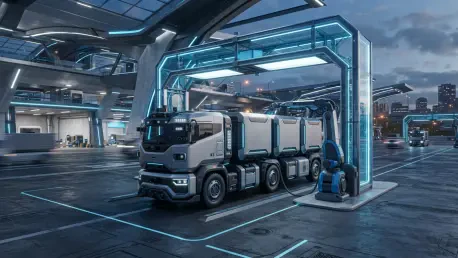

The startup expects to launch its purpose-built autonomous electric trucks commercially in the third quarter of 2027 following extensive validation and regulatory approvals. This ambitious timeline follows a significant financial milestone for the company, which recently secured $51 million in a Series A funding round led by Obvious Ventures. With participation from existing backers like Eclipse and Energy Impact Partners, the California-based firm has successfully amassed $75 million in total capital since its inception less than a year ago. Led by Eyal Cohen, a seasoned professional with a background at Apple, Uber, and Waabi, Humble Robotics has assembled an elite team of engineers from prestigious organizations including Tesla, Waymo, and Cruise. This influx of capital and talent marks a pivotal moment for the enterprise as it seeks to redefine the heavy-duty logistics sector by moving away from the conventional approach of modifying existing diesel-powered semi-trucks with third-party software kits.
Redefining the Architecture of Class 8 Vehicles
Humble Robotics differentiates itself by eschewing the common industry practice of retrofitting legacy truck chassis with autonomous sensors and computers. Instead, the company focuses on creating the “Humble Hauler,” a fully autonomous, electric Class 8 vehicle designed from the ground up to support high-level automation. By developing a purpose-built modular hardware platform, the engineering team ensures that every sensor, cooling system, and electrical component is optimized for the specific demands of self-driving operations. This holistic design philosophy eliminates the hardware bottlenecks often encountered when trying to force sophisticated AI software to communicate with mechanical systems that were never intended for electronic control. The integration of a vision-first artificial intelligence system allows these vehicles to process high-resolution visual data in real-time, providing the perception capabilities required for maneuvering through the tight confines of busy industrial sites.
The choice to build a native electric platform provides significant advantages beyond simple emission reductions, as it allows for superior control over the vehicle’s torque and braking systems. Traditional internal combustion engines often suffer from mechanical complexity that can hinder the precise movements required for automated docking and terminal navigation. Humble’s unified technology approach merges the powertrain and the autonomous stack into a single, cohesive unit, reducing the total number of moving parts and lowering the long-term maintenance burden for fleet operators. By focusing on industrial environments like loading docks, ports, and rail terminals, the company addresses specific operational challenges that highway-only autonomous systems typically cannot handle. This technical foundation allows for a more reliable and cost-effective solution for short-distance movements, providing a level of efficiency that legacy frameworks have failed to achieve.
Modernizing the Regional Freight Network
While the public conversation surrounding autonomous trucking frequently highlights transcontinental long-haul routes, Humble Robotics identifies a more pressing opportunity within regional networks. Approximately 87% of all U.S. truck tonnage moves across distances under 250 miles, forming the backbone of the domestic supply chain. These regional routes are often characterized by frequent stops, complex navigation through urban centers, and the need for precision at logistics hubs. By targeting these dock-to-dock movements, the startup aims to alleviate the severe labor shortages and operational bottlenecks that currently plague distribution centers and warehouses. The modular nature of their vehicle design allows for multiple configurations, ensuring that the trucks can be adapted for various types of cargo and specific regional infrastructure requirements. This strategy enables logistics providers to optimize their fleets for local demands, ultimately reducing the cost per mile.
Logistics operators and warehouse managers needed to begin prioritizing the installation of high-capacity charging infrastructure and digitized loading bays to accommodate the transition toward fully autonomous fleets. The emergence of unified autonomous systems demonstrated that simply replacing human drivers was insufficient; rather, the entire physical environment of the warehouse required a shift toward standardization and machine-readable markers. Companies that proactively updated their terminal operating systems to integrate with the data feeds from these electric Class 8 vehicles secured a competitive edge in throughput speed and safety metrics. Future investments focused heavily on modular maintenance facilities that could service both the high-voltage electrical components and the sensitive sensor arrays without the need for extensive downtime. As the industry moved toward these specialized, short-haul solutions, the emphasis shifted from sheer horsepower to integrated intelligence.