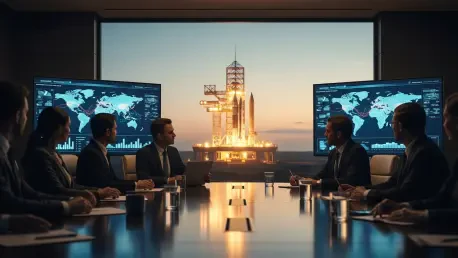

The aerospace industry currently stands at a historical crossroads where the boundary between a visionary founder’s persona and a multibillion-dollar enterprise’s stability has become dangerously thin. As SpaceX progresses through its initial public offering process in 2026, potential investors are forced to weigh the immense value of a singular leader against the mounting operational hazards his personal conduct creates. Elon Musk serves as both the Chief Executive Officer and the Chief Technology Officer, positioning himself as the indispensable architect of the company’s engineering triumphs, yet this centralization of power presents a unique vulnerability known as key person risk. Unlike traditional corporations that mitigate such exposure through comprehensive insurance or deep benches of executive talent, this entity lacks key person insurance, meaning any sudden absence of its leader would fundamentally destabilize management. The company’s trajectory is inextricably linked to one individual’s intellectual drive and public standing, turning a standard corporate hierarchy into a high-stakes bet on a single human life and interest span.
Operational Hurdles of Divided Executive Attention
The sheer breadth of current leadership roles across multiple high-stakes industries creates a persistent diversion of focus that could undermine long-term mission objectives. Beyond the demands of orbital launches and Starlink expansions, the executive must manage the complex requirements of Tesla, Neuralink, and The Boring Company, alongside an increasingly active involvement in national political spheres. This fragmented attention span is not merely a logistical annoyance but a documented risk factor that complicates high-level decision-making processes. As federal agencies account for nearly twenty percent of the company’s revenue in 2026, the need for a focused and present leader becomes paramount for maintaining the rigorous safety and schedule standards required by the government. The competition in the heavy-lift launch sector is intensifying, and any delay in strategic pivots caused by the CEO’s preoccupation with external ventures could result in a loss of market share to emerging private and international space agencies.
Furthermore, the close alignment with the current administration and specific advisory roles in Washington D.C. introduces a volatile geopolitical dimension to the business model. While these ties undoubtedly facilitate smoother procurement processes for domestic military contracts, they simultaneously create a perception of the company acting as a de facto arm of the United States defense apparatus. This branding as a nationalistic entity risks alienating international commercial clients and foreign governments who are increasingly wary of American influence over global communications and space infrastructure. Strategic partners in Europe and Asia may seek more neutral launch providers to avoid being caught in the crossfire of the founder’s personal political skirmishes. The challenge lies in balancing the benefits of deep federal integration with the necessity of appearing as an independent global commercial provider, a task made difficult by the highly publicized and often partisan nature of the founder’s recent political engagements.
Legal Consequences of External Social Entanglements
The unpredictability of external business interests has already demonstrated a direct and measurable impact on the company’s financial health and global operational capacity. A definitive example of this occurred during the recent Starlink asset seizure in Brazil, where a dispute involving a separate social media platform led to severe financial penalties for the aerospace firm. In that instance, the founder’s refusal to comply with local judicial orders regarding content moderation on X resulted in the freezing of Starlink’s accounts and the subsequent seizure of millions of dollars to cover unrelated fines. This event established a dangerous precedent where the space venture is held financially and legally accountable for the personal or ideological crusades of its majority owner in entirely different sectors. Investors must now account for a reality where their capital is exposed to the whims of foreign courts reacting to digital speech controversies that have nothing to do with satellite technology or rocket engineering.
Moreover, the disclosure documents highlight that the company may face legal or financial repercussions globally regardless of whether such actions are consistent with local or international law. This admission underscores a growing trend of “reputational contagion,” where the controversial actions of a leader on social media platforms trigger retaliatory regulations or boycotts against his physical infrastructure businesses. As the company seeks to expand its footprint in various sovereign territories, it faces a landscape where the founder’s brand is increasingly viewed as a liability by local regulators who prioritize stability over disruptive innovation. The blurring of lines between a private citizen’s right to expression and a corporation’s duty to its stakeholders has created a volatility that is difficult to quantify using traditional risk assessment models. This volatility forces a reconsiderations of how much control a single founder should retain when his public persona begins to eclipse the operational integrity of the organization.
Strategic Realignment for Future Organizational Stability
To safeguard the future of American space dominance and private orbital logistics, the organization must prioritize the institutionalization of its technical knowledge and management culture. Moving forward from 2026, the implementation of a more robust and independent board of directors could provide a necessary buffer between the founder’s external activities and the company’s core operations. Developing a transparent succession plan is no longer a bureaucratic formality but a vital requirement for maintaining the confidence of large-scale institutional investors and international partners. By empowering a secondary tier of leadership with the authority to manage day-to-day operations and government relations, the firm can ensure that technical milestones remain uncoupled from the founder’s personal public relations cycles. This shift toward a more traditional corporate structure does not necessitate the removal of visionary influence, but rather the protection of that influence from the fallout of external controversies.
The ultimate objective for the coming years should be to transition the company’s identity from a personality-driven venture to a reliable global utility provider. This involves establishing clear protocols for how the organization responds to geopolitical pressures and ensuring that Starlink’s infrastructure is legally and financially insulated from the founder’s other business interests. Strengthening relationships with a broader spectrum of international regulators through dedicated diplomatic and legal teams can mitigate the risk of sudden asset seizures or service bans. As the space economy matures, the most successful entities will be those that offer predictable and stable environments for global commerce. By addressing these disclosed risks with proactive structural reforms, the company was able to maintain its lead in the industry while proving that its groundbreaking technology can thrive independently of any single individual’s personal trajectory.