
The conversation surrounding sustainable industry often fixates on electric vehicles, yet a profound transformation is occurring beneath the surface of the energy sector. Marco Gaietti, a veteran of management consulting with a career dedicated to strategic operations and customer relations, brings a seasoned perspective to this shift. As the automotive market faces increasing volatility and shifting global competition, Gaietti’s insights into grid-scale infrastructure and energy storage offer a roadmap for companies navigating the complex transition from manufacturing products to powering entire economies.
The following discussion explores the strategic pivot toward energy storage, the technical hurdles of scaling solar and lithium production, and the long-term financial implications of an identity shift from a car manufacturer to a diversified utility and AI provider.
Battery revenue recently rose by 27% to nearly $13 billion while automotive sales dipped. How does this shift affect long-term capital allocation, and what operational changes are necessary to transition a company from a vehicle-first focus to an energy-storage priority?
When you see energy revenue hitting $12.8 billion while automotive revenue slides by 10% to $69.5 billion, the capital allocation strategy must pivot toward where the momentum lives. Operationally, this requires a massive redirection of supply chain resources; for instance, the company is already leveraging the battery cell production originally meant for EVs and funneling it into stationary storage. To make this transition stick, a firm must prioritize high-margin utility products over the volume-heavy consumer car market, which is currently “cracking” under global competition. We are seeing a shift in focus where the 80 gigawatt-hours of capacity currently split between Lathrop and Shanghai becomes the primary driver of the balance sheet. It’s an emotional shift for a brand built on the “cool factor” of cars to realize its most durable thesis is actually the “mine-and-burn” alternative of grid reliability.
Data centers and AI are significantly increasing electricity demand and pushing up residential utility costs. What specific role do utility-scale Megapacks play in stabilizing these grids, and what are the primary hurdles when deploying 70 gigawatt-hours of capacity across diverse geographic regions?
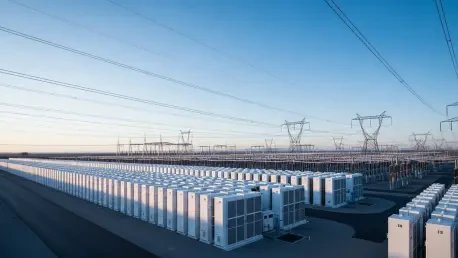
Megapacks act as the “shock absorbers” of the modern grid, absorbing excess energy from nuclear, gas, or solar sources and discharging it during those expensive demand peaks that drain consumer wallets. The goal of hitting 70 gigawatt-hours of total installed capacity by the end of this year is ambitious because it requires a multi-step deployment: first, securing permits which are often harder to get than the batteries themselves, followed by the logistical feat of shipping massive units to utility substations or even “behind the meter” locations like big-box stores. The primary hurdles are often local; you are not just building a product, you are integrating with legacy infrastructure that wasn’t designed for two-way power flow. Walking through a deployment site like the Victorian Big Battery in Australia, you can sense the immense scale—hundreds of white blocks standing in rows—which must be synchronized to react in milliseconds to grid frequency changes. This isn’t just hardware; it’s a sophisticated software play to manage “space-based aspirations” versus terrestrial reality.
Scaling solar production to 100 gigawatts annually involves a complex return to manufacturing at sites like the Buffalo facility. What technical milestones must be met to reach this volume, and how does building a domestic lithium refinery in Texas change the manufacturing timeline for these products?
Reaching that 100-gigawatt target is a mountainous climb, especially when you consider the Buffalo plant is currently only aiming for a 300-megawatt assembly capacity this year. To hit the larger milestone, the company has to master the entire supply chain, moving from a mere assembler to a raw material refiner. The new lithium refinery near Corpus Christi, Texas—the largest in America—is the “linchpin” that secures the manufacturing timeline by reducing dependence on volatile international logistics. I’ve heard anecdotes about the Buffalo facility being underutilized for years, so the technical milestone here isn’t just about speed; it’s about proving that domestic manufacturing can be profitable without the “rescue” narrative of the past. By refining lithium at home, the company can bypass some of the friction of global trade tensions and move toward those “greenfield” factories that experts believe will be built in 25-gigawatt stages over several years.
Energy storage capacity is projected to supply over 50 million homes soon, yet residential solar has historically struggled. How do newer battery technologies improve the value proposition for homeowners, and what are the requirements for integrating these systems into local utility substations?
The value proposition for homeowners has shifted from a “green hobby” to a necessity for grid independence, especially as utility prices spike. Newer technologies, like the LFP cells used in Megapacks and residential units, offer a more stable and longer-lasting cycle life, which makes the $50 billion to $100 billion valuation of the energy arm feel grounded in reality. To integrate these into local substations, the infrastructure requires significant “transmission grid” upgrades, including advanced inverters and smart-metering systems that allow a home to talk to the utility. It’s a sensory experience for the homeowner; there is a peace of mind that comes with seeing your Powerwall kick in during a storm, but behind the scenes, it requires a massive overhaul of how we think about “neighborhood” electricity. We are moving toward a world where every school, church, and home acts as a mini-power plant, which requires a level of local utility cooperation we haven’t seen in the past century.
While newer projects like the Cybercab and Semi face production headwinds, the energy arm is already booking record profits. How should a company manage the identity crisis between being an AI-robotics firm versus a grid-utility provider, and what are the financial risks of this pivot?
Managing this identity crisis is perhaps the greatest leadership challenge of our time, as the company tries to balance “Optimus cosplay” with the “un-sexy” business of selling grid-scale batteries. The financial risk lies in the trade-off: if you pour all your capital into unproven AI and robotaxis, you might starve the energy business which is actually booking the revenue Wall Street loves. Long-term, the trade-off is between the high-risk, high-reward “moonshot” of autonomous robots and the steady, high-margin growth of a utility provider. Investors like Ross Gerber are already pointing out that while the car business is fading, the energy unit is “expanding” and profitable. The danger is that the “billionaire oligarch” rhetoric might distract the engineering talent from the core EV and battery mission, leading to an “engineering exodus” just when the competition from Chinese rivals is most fierce.
What is your forecast for Tesla?
My forecast is that Tesla will undergo a “de-automobilization” of its brand identity over the next five years, where the energy sector eventually accounts for more than 30% of its total valuation. While the car business will likely remain the largest revenue contributor in the near term, the 17% projected growth in energy sales—driven by those 40GWh factories in Lathrop and Shanghai—will be the “buffer” that saves the company during automotive downturns. We will see the company move away from defining itself by “vehicle deliveries” and toward “gigawatt-hours deployed,” effectively becoming a global sustainable energy utility that just happens to sell cars. If they can successfully navigate the manufacturing hurdles in Buffalo and Texas, they won’t just be an EV company anymore; they will be the backbone of the decentralized American grid.