
The bustling, fog-laden streets of San Francisco have become the latest proving ground for the future of transportation, as Amazon’s autonomous vehicle subsidiary, Zoox, has officially begun offering public rides in its distinctive, purpose-built robotaxi. This expansion from a similar initial launch in Las Vegas represents a significant step forward for the company, which is now operating an “early rider initiative” to gather crucial data and refine its technology in one of the nation’s most complex urban environments. While the rides are currently free, this move signals a clear intent to challenge the established players in the self-driving arena and brings the long-promised vision of a driverless city one step closer to reality. The initiative not only tests the vehicle’s technical capabilities but also probes public acceptance and the intricate regulatory frameworks that will ultimately determine the success of commercial autonomous mobility.
A Glimpse into the Future of Urban Mobility
A Vehicle Unlike Any Other
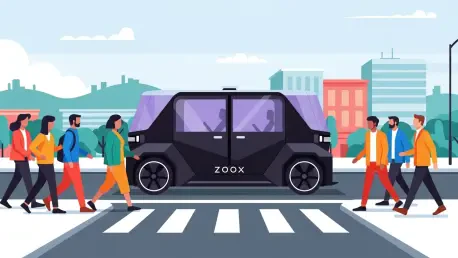
The Zoox vehicle is not merely a conventional car retrofitted with sensors; it is a ground-up reimagining of personal transport engineered exclusively for an autonomous world. Stepping inside, passengers will immediately notice the complete absence of traditional driver controls. There is no steering wheel, no pedals, and no mirrors, a design choice that maximizes interior space and fundamentally alters the rider’s experience. The vehicle is a symmetrical, bidirectional microvan capable of traveling with equal ease in either direction, eliminating the need for complex maneuvers like three-point turns on narrow city streets. Access is provided through wide, sliding doors reminiscent of a train, which are less likely to obstruct sidewalks or bicycle lanes. The interior features a “carriage” seating arrangement, with two benches facing each other, fostering a more social and spacious environment for up to four passengers. This deliberate departure from over a century of automotive design conventions underscores Zoox’s ambition to create a service that is not just autonomous but also optimized for the passenger from its very conception, aiming to provide a seamless and comfortable journey through the urban landscape.
The vehicle’s ability to navigate safely is underpinned by an exceptionally dense and diverse sensor array that provides a 360-degree, multi-layered perception of its surroundings. At the core of this system are eight laser lidars, which use light pulses to create a precise, three-dimensional map of the environment, detecting objects with centimeter-level accuracy. This is complemented by a network of 10 radar units, which excel at measuring the velocity of other vehicles and performing reliably in adverse weather conditions like rain or fog. A total of 18 digital cameras provide high-resolution visual data, enabling the AI to recognize and interpret complex road signs, traffic signals, and the nuanced behaviors of pedestrians and other drivers. Uniquely, the vehicle is also equipped with four thermal cameras, a feature that gives it a distinct advantage in low-light situations by allowing it to detect the heat signatures of people and animals, even in complete darkness or when obscured by foliage. This comprehensive fusion of sensor data creates a redundant and robust perception system designed to exceed the capabilities of a human driver.
Redefining the Ride-Hailing Experience
The launch in San Francisco marks a critical evolution in Zoox’s operational model, moving beyond the more constrained service offered in Las Vegas. While the Nevada deployment primarily operates between fixed pickup and drop-off points, such as hotels on the Strip, the San Francisco system introduces a far more dynamic “point-to-point” service. This allows users to summon a robotaxi in a manner that closely mirrors the convenience of established ride-hailing platforms. Riders can request a vehicle by simply dropping a pin on a map within the service area or by typing in a specific street address. This increased flexibility is a crucial step toward creating a commercially viable product that can genuinely compete with traditional ride-hailing and personal car ownership. Operating in the dense and unpredictable environment of San Francisco, with its steep hills, intricate intersections, and heavy pedestrian traffic, provides an invaluable real-world test for the system’s ability to handle complex, on-demand requests, pushing the boundaries of its routing and navigation algorithms. This sophisticated model is essential for demonstrating the technology’s readiness for widespread public adoption.
While the “early rider initiative” offers a tantalizing preview of a futuristic service at no cost to the passenger, its primary purpose is strategic data acquisition. Each trip taken in San Francisco provides Zoox with a wealth of information that is instrumental in refining every aspect of its operation. The data collected from the vehicle’s sensors helps engineers improve the AI’s driving behavior, its decision-making in edge cases, and its ability to predict the actions of other road users. Furthermore, feedback from the early riders offers direct insight into the passenger experience, from the ease of use of the summoning app to the comfort and sense of safety felt during the ride. This iterative process of testing, learning, and refining is a fundamental part of the autonomous vehicle development cycle. By operating in a controlled but public-facing manner, Zoox can methodically identify and address system weaknesses, harden its software against unexpected scenarios, and build a robust safety case before it seeks regulatory approval for a full-scale, paid commercial service, ensuring the final product is both reliable and user-friendly.
Navigating the Road to Commercialization
The Complex Web of Regulation
The path to deploying a commercial fleet of autonomous vehicles is paved with significant regulatory hurdles, primarily because existing U.S. auto safety rules were written with a human driver in mind. The Federal Motor Vehicle Safety Standards (FMVSS) mandate the presence of manual controls like steering wheels and pedals, components that are entirely absent from Zoox’s purpose-built vehicle. This fundamental conflict between legacy regulations and innovative design means companies like Zoox cannot simply manufacture and sell their vehicles as they would a conventional car. To operate on public roads legally, they must navigate a complex process of seeking exemptions from federal authorities. Currently, Zoox is conducting its free public rides in San Francisco under a research and development exemption granted by the National Highway Traffic Safety Administration (NHTSA). This permit allows the company to test its technology and gather data in a real-world setting but strictly prohibits charging a fare for the service. It is a critical but temporary phase that serves as a stepping stone toward the ultimate goal of full commercialization.
The transition from a free, data-gathering initiative to a revenue-generating public service hinges on securing a more substantial federal waiver known as a “Part 555 exemption.” This provision allows the NHTSA to grant a temporary exemption from certain FMVSS requirements for vehicles that incorporate new safety features or innovative designs. Obtaining this waiver is a rigorous process that requires the applicant to demonstrate that their vehicle provides an equivalent or greater level of safety than a conventionally compliant one. Zoox has formally petitioned the NHTSA for this exemption and anticipates receiving approval sometime next year. If granted, the waiver would permit the company to deploy a commercial fleet of up to 2,500 vehicles annually. This represents the most critical regulatory milestone for the company, as it would unlock the ability to launch a paid robotaxi service and begin scaling its operations. Successfully navigating this process will not only be a victory for Zoox but will also help establish a precedent for how the U.S. government regulates the next generation of fully autonomous vehicles.
The Competitive Landscape Heats Up
Zoox’s public launch in San Francisco has solidified its position as a primary challenger to Waymo, the Alphabet subsidiary that has long been considered the frontrunner in the autonomous driving space. With Waymo already operating paid services in cities like Phoenix and San Francisco, the robotaxi market is quickly evolving from a futuristic concept into a tangible business reality. This direct competition is part of a much broader, industry-wide race to develop and deploy self-driving technology at scale. Other major players are also making significant strides; Uber continues to invest heavily in its autonomous programs, chipmaker Mobileye is advancing its own turnkey self-driving systems, and traditional automakers like Volkswagen are partnering with tech firms to integrate autonomy into their future vehicle lineups. Each company is pursuing a slightly different strategy, from retrofitting existing vehicles to developing purpose-built platforms, but the common goal is to capture a share of the transformative and potentially lucrative market for autonomous mobility. This intense competition is accelerating the pace of innovation and placing increasing pressure on all contenders to demonstrate tangible progress.
The Road Ahead for Autonomous Transport
The methodical, regulation-focused approach taken by Zoox stood in contrast to the bold pronouncements from competitors like Tesla, whose CEO, Elon Musk, had also announced plans for a similar purpose-built vehicle. However, while Zoox had already navigated the initial steps of the federal waiver process, Tesla had not yet formally submitted a request for a similar exemption from the NHTSA. This highlighted a key divergence in strategy within the industry, with some companies prioritizing a structured engagement with regulators while others focused on rapid software development for existing vehicle platforms. The expansion of services from both Zoox and Waymo placed an increasing strain on federal and state regulatory bodies, which were tasked with adapting century-old safety standards to accommodate a new era of AI-driven transportation. The progress made in cities like San Francisco demonstrated that the technology had moved beyond the research phase and was ready for public interaction, creating an urgent need for clear, updated guidelines to ensure safety and foster continued innovation in the rapidly advancing field of autonomous mobility.