
With decades of experience in management consulting, Marco Gaietti is a seasoned expert in Business Management. His expertise spans a broad range of areas, including strategic management, operations, and customer relations, making him a critical voice in the conversation regarding the intersection of wearable technology and corporate security. In this discussion, we explore the rising threat of smart glasses in the enterprise, touching upon the challenges of “stealth” recording, compliance nightmares under GDPR and HIPAA, and the evolving technical countermeasures available to modern CIOs.
With shipments of smart glasses jumping over 200% recently and designs now mimicking traditional eyewear, how does this “stealth” factor change physical security? What specific challenges do these devices create for protecting boardrooms or R&D labs, and what step-by-step measures can security teams take to identify them?
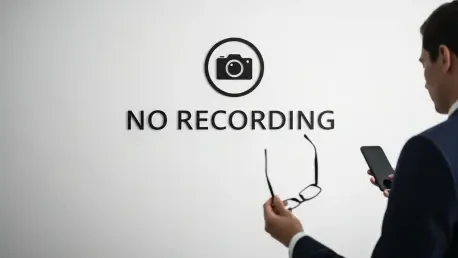
The shift from the “clunky” aesthetic of early Google Glass to the stylish Meta Ray-Bans represents a fundamental shift in the threat landscape. Because these devices are now nearly indistinguishable from regular glasses, they act as mobile sensors that can bypass traditional visual security checks. In an R&D lab or a boardroom, a wearer can ambiently capture high-definition video of prototypes or whiteboards without ever raising a hand. Security teams must first conduct a 30-day audit to see where these devices are already present and immediately designate “no-recording zones” for high-value spaces. We have to train personnel to look for the tiny LED indicators that signal recording, though we must also remain vigilant against “rooted” devices where these lights have been disabled.
Modern wearables often integrate AI that transmits data to third-party clouds for real-time analysis. What are the specific compliance risks regarding GDPR or HIPAA when these devices record ambiently? How should a CIO manage the trade-off between employee efficiency and the risk of unauthorized data collection?
The compliance risks are staggering because smart glasses lack data minimization; they capture everything in the field of vision, including bystanders’ faces and sensitive medical charts. If a healthcare worker wears these while looking at a patient’s history, that data could be transmitted to a third-party cloud, triggering immediate HIPAA or GDPR violations regarding cross-border data transfers. For a CIO, the trade-off must be managed through strict governance—if the glasses are used for a hands-free workflow, they must be locked down with enterprise-grade encryption and access controls. It’s not just about efficiency; it’s about protecting the company from the massive legal liabilities that come with “always-on” surveillance.
Researchers have already demonstrated how hacked glasses can link faces to home addresses or Social Security numbers instantly. How do you prepare for visitors using these tools for reconnaissance? What are the protocols for managing a suspected surreptitious recording incident in a high-stakes environment like a hospital or bank?
The I-XRAY proof-of-concept, which used facial recognition to pull Social Security numbers in real-time, shows that these aren’t just cameras—they are weapons for reconnaissance. To prepare, organizations in high-stakes environments like banks must implement visual consent protocols where visitors are required to declare wearable tech upon entry. If a surreptitious recording is suspected, the protocol should involve immediate isolation of the individual and a check of the device’s status, following pre-defined legal and HR guidelines. We must treat these incidents with the same gravity as a data breach, as the captured biometric data of employees and customers is a permanent, non-recoverable asset.
New mobile apps can now detect Bluetooth signatures from smart glasses within a 15-meter range. How effective are these technical countermeasures for enterprise-scale security? Beyond software, what physical cues or “no-recording zones” should be prioritized during a 90-day governance rollout to protect proprietary information?
Apps like Nearby Glasses, which scan for Bluetooth Low Energy advertising frames from brands like Meta or Snap, are a great start but difficult to scale across a 500-person office. Within a 90-day rollout, these tools are best deployed at “choke points” or entryways to sensitive areas rather than as a blanket solution. Beyond technical scans, we must prioritize physical governance: clear signage, updated employee handbooks, and “clean room” protocols for data centers. The goal is to move from reactive detection to a proactive culture where everyone understands that proprietary information cannot be viewed through a third-party lens.
Subcontractors sometimes review captured footage to improve AI models, occasionally seeing faces that were not properly blurred. How should vendor management policies change to address these third-party data risks? What metrics can a company use to audit the presence and impact of smart glasses among outside contractors?
The recent reports of subcontractors in Kenya seeing unblurred faces from smart glass footage highlight a massive hole in third-party risk management. Moving forward, vendor management policies must explicitly prohibit the use of unapproved recording wearables by contractors on-site and include “right to audit” clauses regarding how that data is stored. Companies should track metrics such as the number of wearable-related policy violations and the percentage of vendors who have signed off on smart-glass-specific data governance. If a vendor cannot guarantee that their AI training data is stripped of your company’s intellectual property, they simply shouldn’t be allowed on the premises.
What is your forecast for smart glasses in the enterprise?
I forecast that smart glasses will follow a “bifurcated” path: they will become indispensable tools for specialized remote assistance and hands-free logistics, but they will simultaneously be banned from most general office environments. Within the next few years, we will see the emergence of “Enterprise-Only” models that lack third-party cloud connections, designed specifically to satisfy the strict privacy requirements of regulated industries. However, until that hardware matures, the “cat-and-mouse” game between covert recording and detection technology will only intensify, forcing CIOs to treat every pair of glasses as a potential endpoint.